

Everyone selling AEO right now is only talking about the first step in the buying journey.
Show up in the answer. Be the first name that the chatbot returns when a buyer asks for recommendations in your category. The advice is solid, I gave a version of it myself a few weeks ago, when i spoke about how the decision is already made in rooms you cannot enter, much before anyone fills a lead form.
This week I will take you through what happens after you have entered the chatbot’s answer.
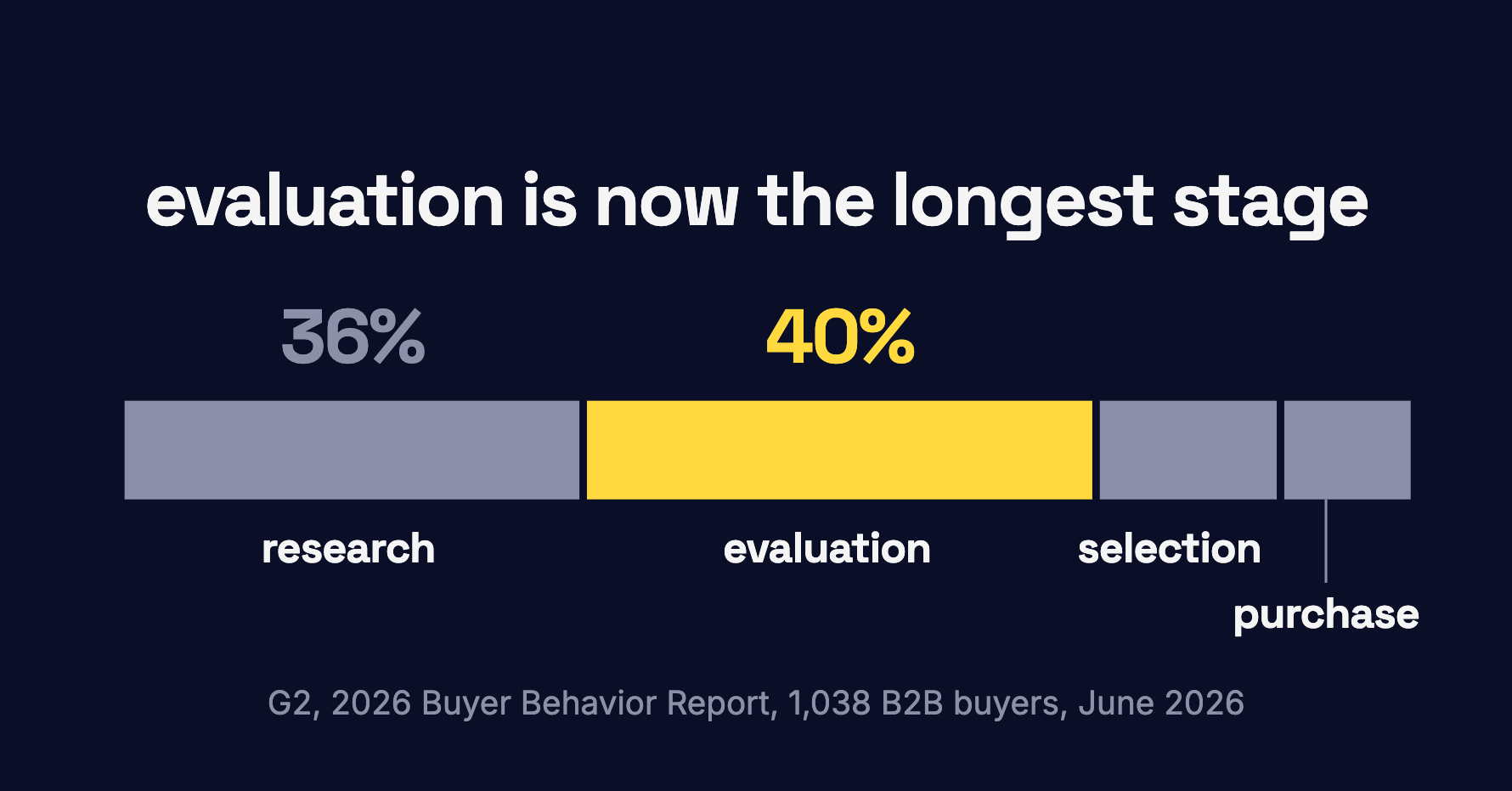
Because the research house that documented the shift in discovery process, went back to the field and found something the first one did not. Evaluation has overtaken research as the longest stage of the buying journey, at 40% against 36%. The bottleneck did not disappear when AI made discovery easy. It moved ahead to a place your content strategy could not reach.
The room you are not in
The shortlist of vendors is created exactly how everyone says it does. Someone asks a question to an AI chatbot, gets yours and 3 other names back, adds them to a document. Yayy! You have won. Aced your AEO strategy.
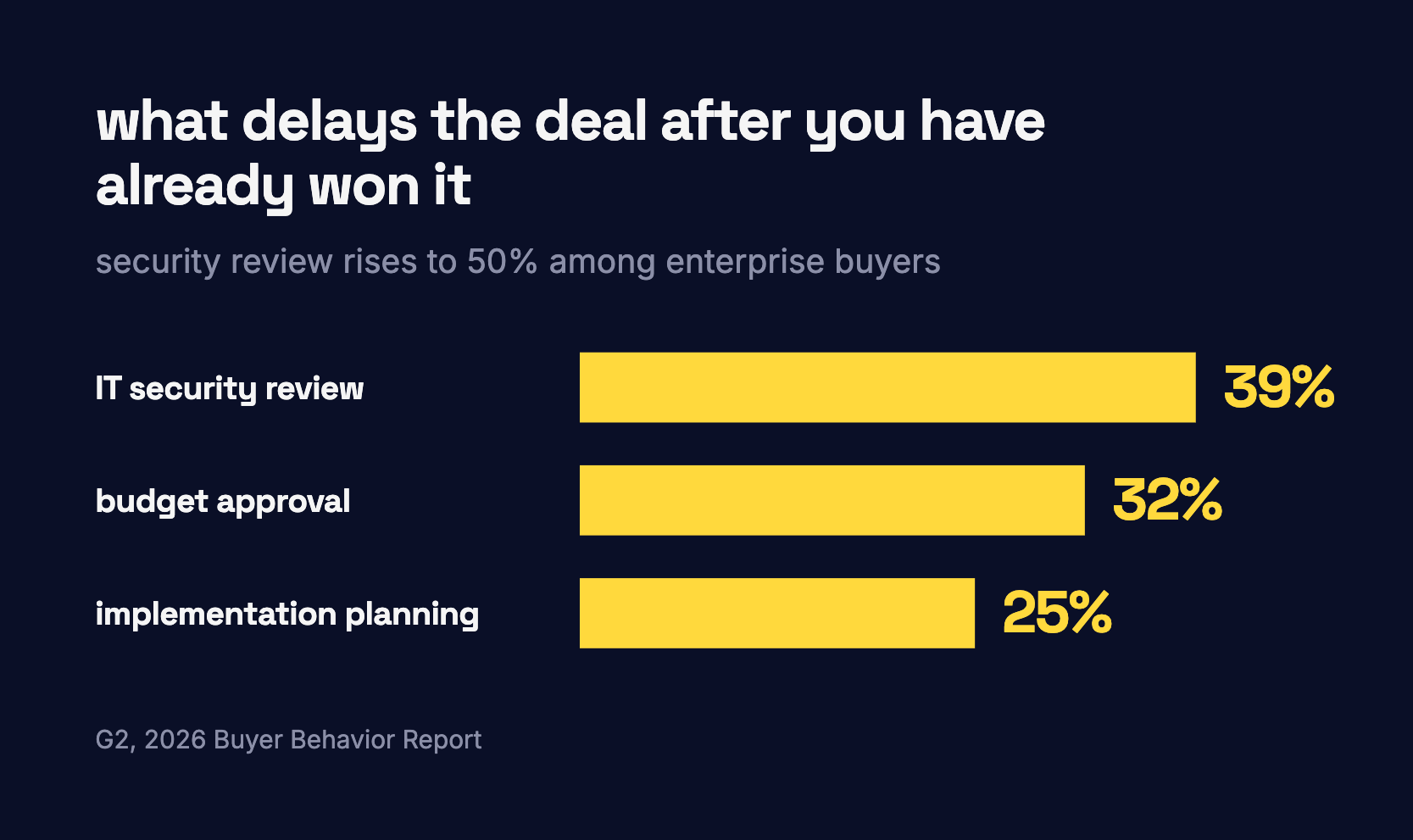
Then the document goes to security review. 39% of buyers name IT security review as the single biggest source of delay after a vendor is selected, and among enterprise buyers that rises to half. Budget approval follows at 32%, implementation planning at 25%.
None of those people saw the AI answer. None of them care that you were in it.
Your champion is now doing something no AEO playbook prepares them for. They are defending a choice, internally, to colleagues who were not there when it was made, using material you did not give them.
The two who kill your deal
The first is finance.
49% of buyers say their CFO vetoed an already-approved software purchase in the last 12 months. This means that the CFOs are now reversing purchases that the buying team thought was settled. Separately, and this is a different finding rather than the same one restated, finance involvement in software decisions rose from 31% to 46% in a single year.
Buyers who have been through a veto now expect positive ROI within 6 months at a rate of 3 in 4. They also push for contract terms under 12 months at more than double the rate of buyers who have not, 40% against 18%.
The second killer is newer and I think more interesting. Buyers citing internal resistance to AI adoption as a concern rose from 16% to 29%, which the study flags as its largest single-year shift.
Read that alongside the argument I made about the MQL and the picture is clear. The buying group did not just get bigger, it also grew a sceptic who does not want another AI tool in the stack. And their objection is not about your product. It is about your category.
Take these numbers with a grain of salt
I want to be straight about these studies.
Both of those buying studies are G2’s, and G2 is not a neutral party. It sells buyer-intent and visibility tooling, and it is itself a review site. So when the July study reports that review sites have edged ahead of AI chatbots as the top influence on shortlists, 38% against 37%, treat it accordingly. That it is a one-point gap between two different samples 3 months apart, published by a company that owns review sites. My reading is that the two channels are tied, not that one overtook the other.
More importantly, the CFO veto figure has no independent corroboration that I could find.
And that is what I want you to read between the lines. The pre-contact stage of B2B buying has many independent studies. The post-selection stage has essentially one. Nobody is measuring what happens between “you got shortlisted” and “you got the deal” which is precisely why the visibility market can keep selling you the first half of the problem without ever being asked about the second.
Two independent checks do hold. TrustRadius, surveying 1,862 buyers in January, found that 63% used AI in the purchase journey while 94% of those fact-check its answers, 72% always or very often, and 47% now trust online resources less than a year ago. Different company, different sample, same conclusion: being in the answer is necessary but it is nowhere near sufficient. And Forrester puts procurement professionals as decision-makers in 53% of buying cycles, engaging from the start, with more than 60% of buyers now running a trial before committing and 78% on purchases above $10 Mn.
TrustRadius is a review platform too. I am not pretending otherwise. Its relevance here is that it is a separate sample reaching the same inference, not that it does not have any skin in the game.
What the report says to do about it, and why I think it is wrong
G2’s own conclusion is that you should arm the buyer with proof and counters to its objections. It sounds obviously right, and it is also an argument for buying more of what G2 sells.
Here is my counter arguement. The rest of the evidence says vendor-supplied proof is exactly the thing that gets discounted now.
94% of AI-using buyers fact-check what they are told. 47% trust online resources less than they did a year ago. When buyers rank what actually influences them at the point of selection, demos, free trials, prior experience and peer reviews come out on top. Every one of those is something the buyer experiences or hears from someone who is not you.
So a beautifully built ROI deck, authored by the vendor, handed to a CFO who reversed a purchase last year, is the least persuasive object in the room.
The useful version of the advice is narrower and hits harder. Your champion does not need your proof. They need to either experience it or hear it from someone else who experienced it.
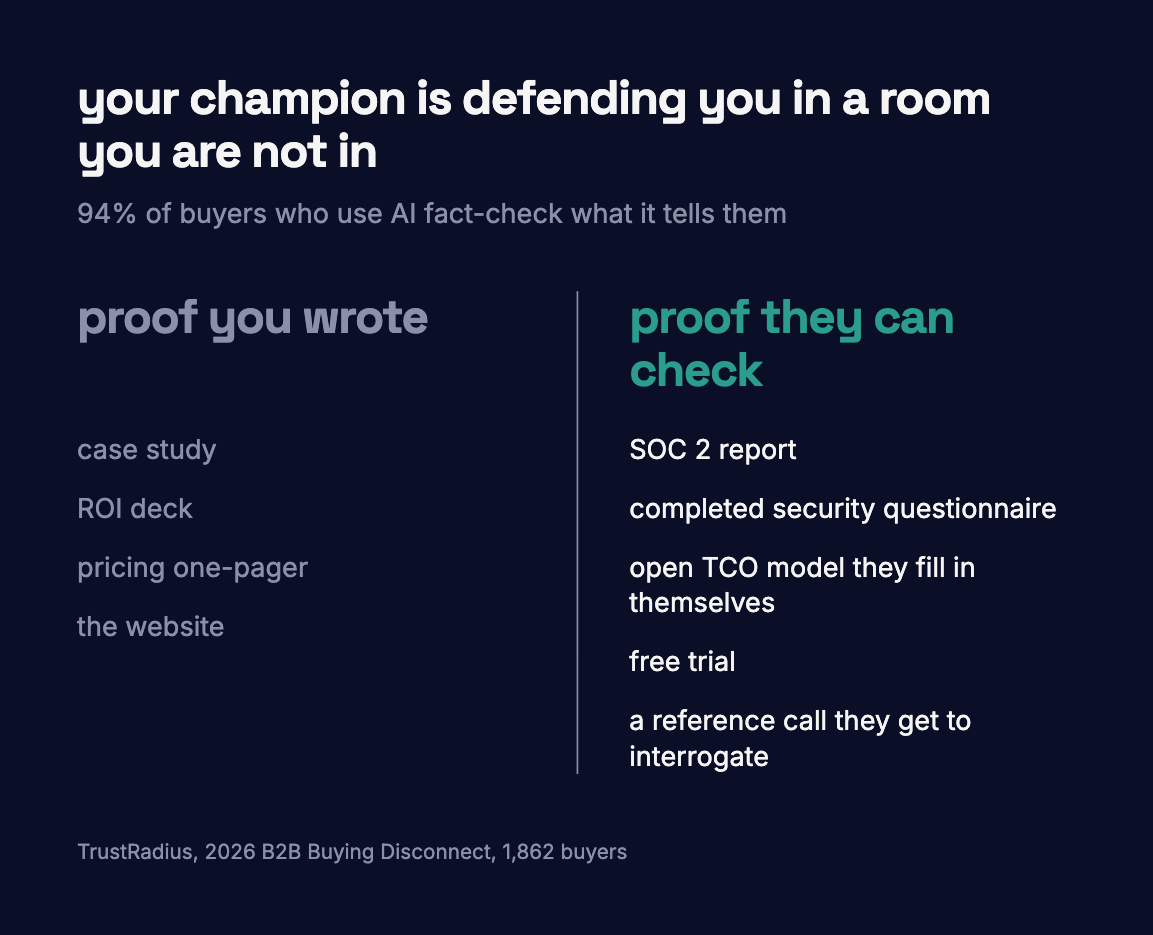
Documentation beats any argument. A SOC 2 report, a sub-processor list, a completed standard questionnaire, a penetration test summary. These work not because they are persuasive but because they are verifiable. Security review is the biggest post-selection delay in the data, and most vendors treat it as a sales-engineering task that begins after the demo. Put the pack somewhere your champion can forward without having to reach out to you first.
Give them the model, not the answer. Evaluating total cost of ownership is the joint-top task buyers now hand to AI agents. Your cost is getting modelled either way by an AI agent. An open model your champion fills in with their own numbers survives scrutiny.
Make the trial the proof. More than 60% of buyers now run a trial, rising to 78% above $10 Mn. A trial is the only evidence in this list the buyer generates themselves, which is exactly why it carries the weight a case study cannot.
Find them a peer. The single hardest objection to answer is the internal sceptic who does not want another AI tool. A twenty-minute call with someone who bought it last year and is a credible voice in the buyer’s industry can placate most of the sceptic’s doubts.
To be clear about what this is: the facts are from the research, the disagreement with the recommendation is mine.
There is a fifth thread in this data I am leaving alone. The same study shows real shifts in how software gets priced, and I have tackled this previously.
I know that I have added a lot your already endless to-do list. Let me unburden you a bit. If there is only one item that you can work on then make it the security pack. Because it unblocks the longest delay and the work is mostly assembling documents your company already has rather than creating something new.
The bit that should bother you
There is a scenario where you did everything right and still did not land the deal. You got into the AI answer. You made the shortlist. Your champion genuinely fought for you at the meeting. But then a security questionnaire got lost in someone’s queue for weeks and the finance head asked what the 6 month ROI looked like. And your champion was mute because you did not give them the answer. Unfortunately, this is the likely scenario.
The industry has spent the entire year focusing on and buying visibility and it does not look like they will stop anytime soon. Ironically, this is also the year visibility stopped being the constraint.
Being in the answer is great. it will get you considered but it won’t build your case for the decision makers.
The market is still selling the first whereas the deals are dying because of the second.
Next up: the 2026 benchmarks say your acquisition engine got more efficient while your customers left faster. Churn is a GTM problem, and you sold it.
Hey Meghna the real bottleneck you've brought up here is something most AEO advice completely ignores... getting into the answer is just the price of entry; the deal dies in the rooms you can't see. The security pack suggestion is the most actionable takeaway I've seen on this topic. It's not sexy, but it's the thing that actually unblocks the process because it's verifiable, not persuasive.
How do you structure that security pack so it's comprehensive enough for the skeptics but digestible enough that it can actually be forward without feeling like they're dumping a textbook on someone?