

There is a cafe in Paris where I worked most of my mornings in May, and it took me till my second outing to notice something strange about my coffee.
The same espresso had 3 different prices. One, if you drink it standing at the bar. Two, if you sit at a table indoors. And three, if you wanted it at the terrace with the view of everyone walking past. This was written on the board and no one found it odd. The cafe was not confused about what it sells. It sells coffee, but it sold the chair and the view separately and decided to charge for both.
This was the first thing that popped up in my head when I spent the day reading about people announcing that seat based pricing is dead.
All announcements were the same, AI has killed the seat. Everyone is charging for the outcome now. My guess is that a lot of this is coming from companies that edited their pricing page with the trendiest words.
So let me do the dirty work and look at what the loudest companies are actually charging.
What the numbers say
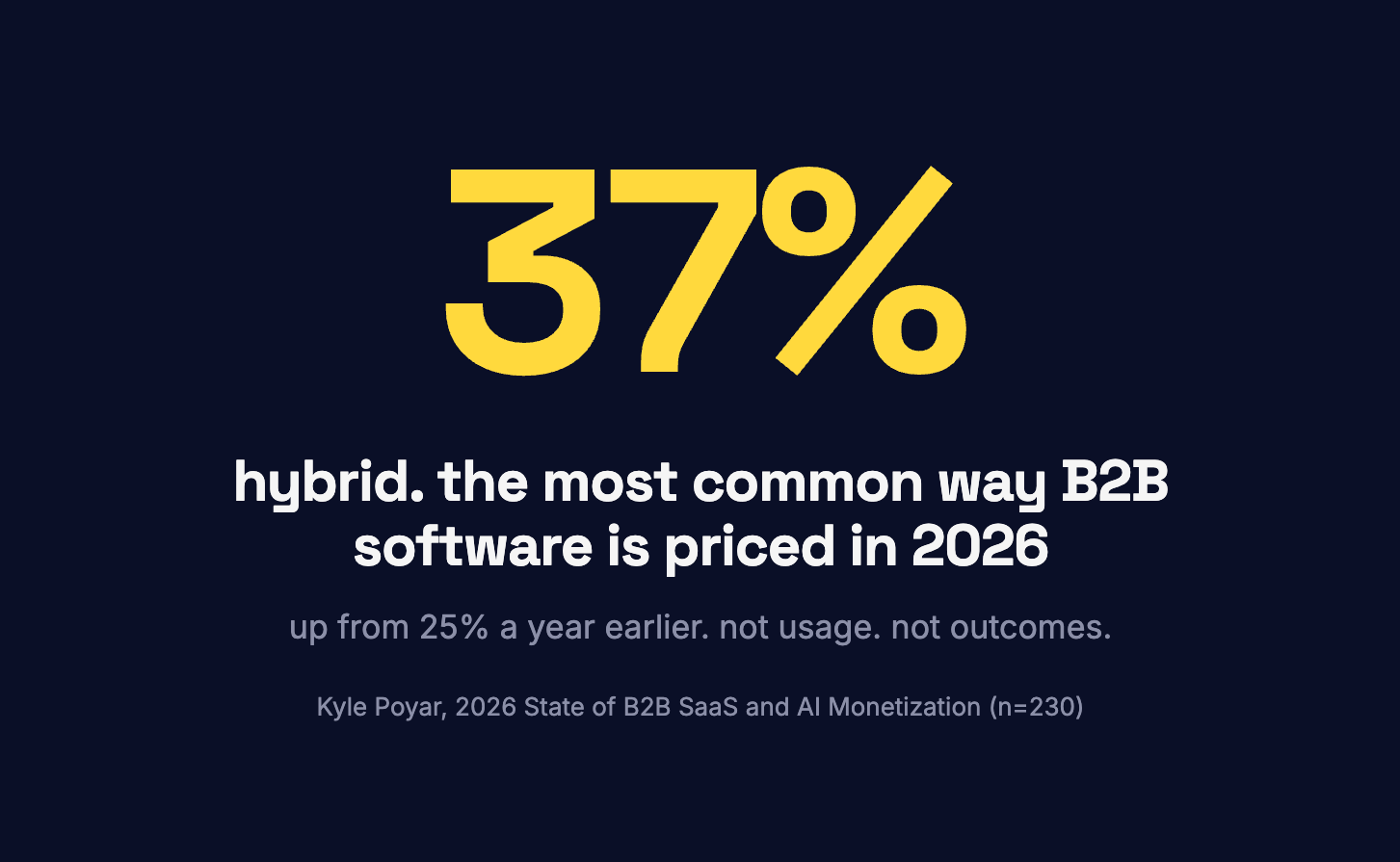
Kyle Poyar’s 2026 State of B2B Monetization report, which surveyed 230 software and AI companies across April and May, found that the most common pricing model in B2B right now is hybrid, at 37%, up from 25% a year earlier.
Read that word slowly. Hybrid.
Not usage. Not outcomes. Hybrid usually means a seat, and add-ons. This means that the per-seat model has survived. The fastest growing B2B pricing model is the one where you still charge for access and then charge for consumption on top of it. Which is significantly different from the headlines.
One product, 3 pricing models
Here is the part that made me write this article.
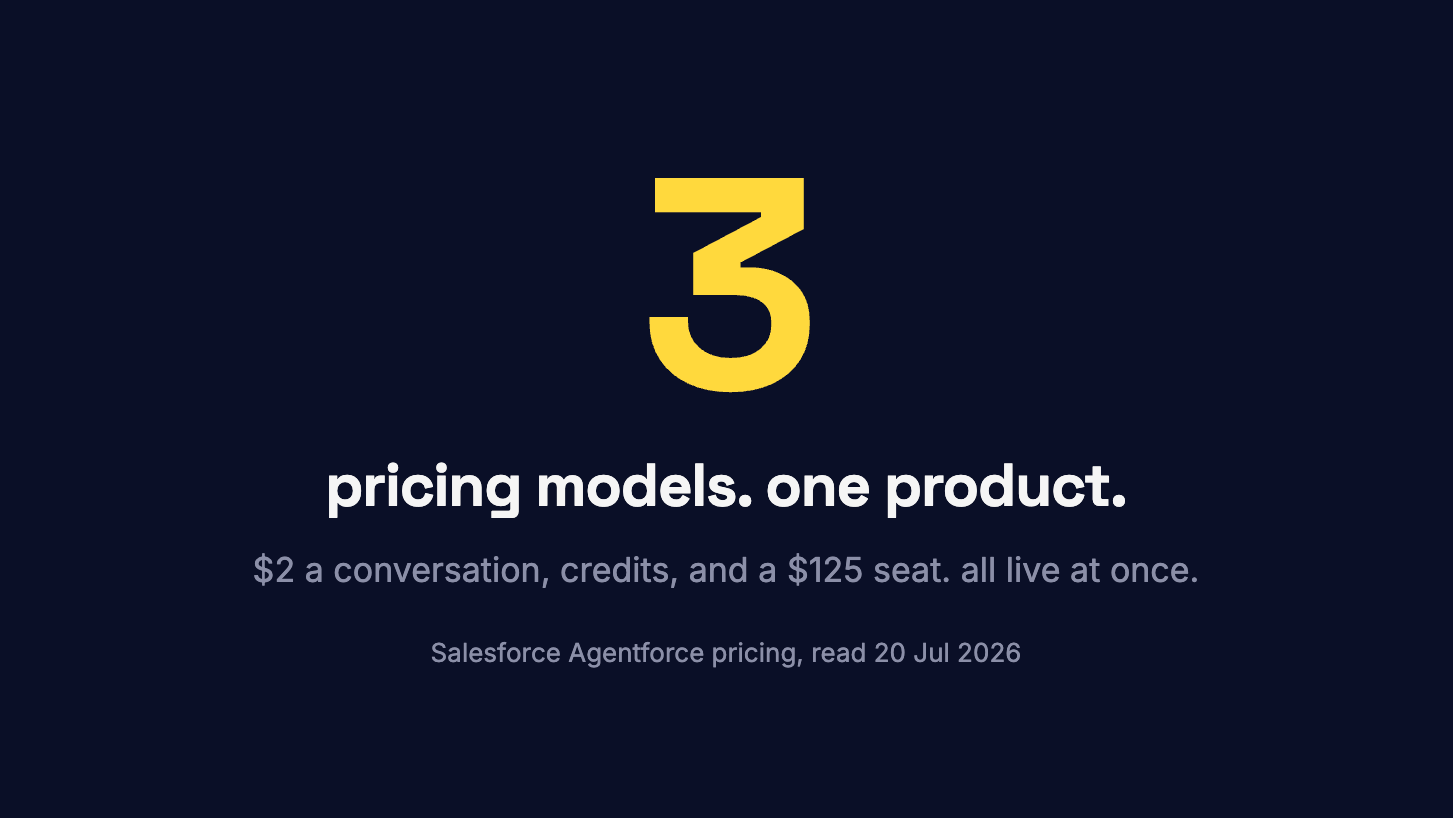
Salesforce sells Agentforce on three pricing models at the same time. There is $2 per conversation. There are Flex Credits, where a standard action costs 20 credits, roughly $0.10, bought in blocks of 100,000 for $500. And there is a per-user licence at $125 per user per month, sold as separate add-ons for Sales, for Service, and for Field Service. All of them for one product. Shipped across roughly eighteen months.
Those are the facts and they sit on Salesforce’s own pricing page. What follows in this article is my take on them, and I want to keep the two apart.
A company does not have 3 pricing models for one product because it has 3 mutually exclusive customer groups. It does this because it has not settled on what the unit of value is and running all 3 at once is cheaper than being wrong in the market. And that is a logical thing to do in a market that is so nascent. It is just hard to digest when this is done by the company that has been so outspoken about their adoption of the concept of “digital labour”. This phrase only holds meaning if the per-seat model is really going away and being replaced by pure outcome based pricing.
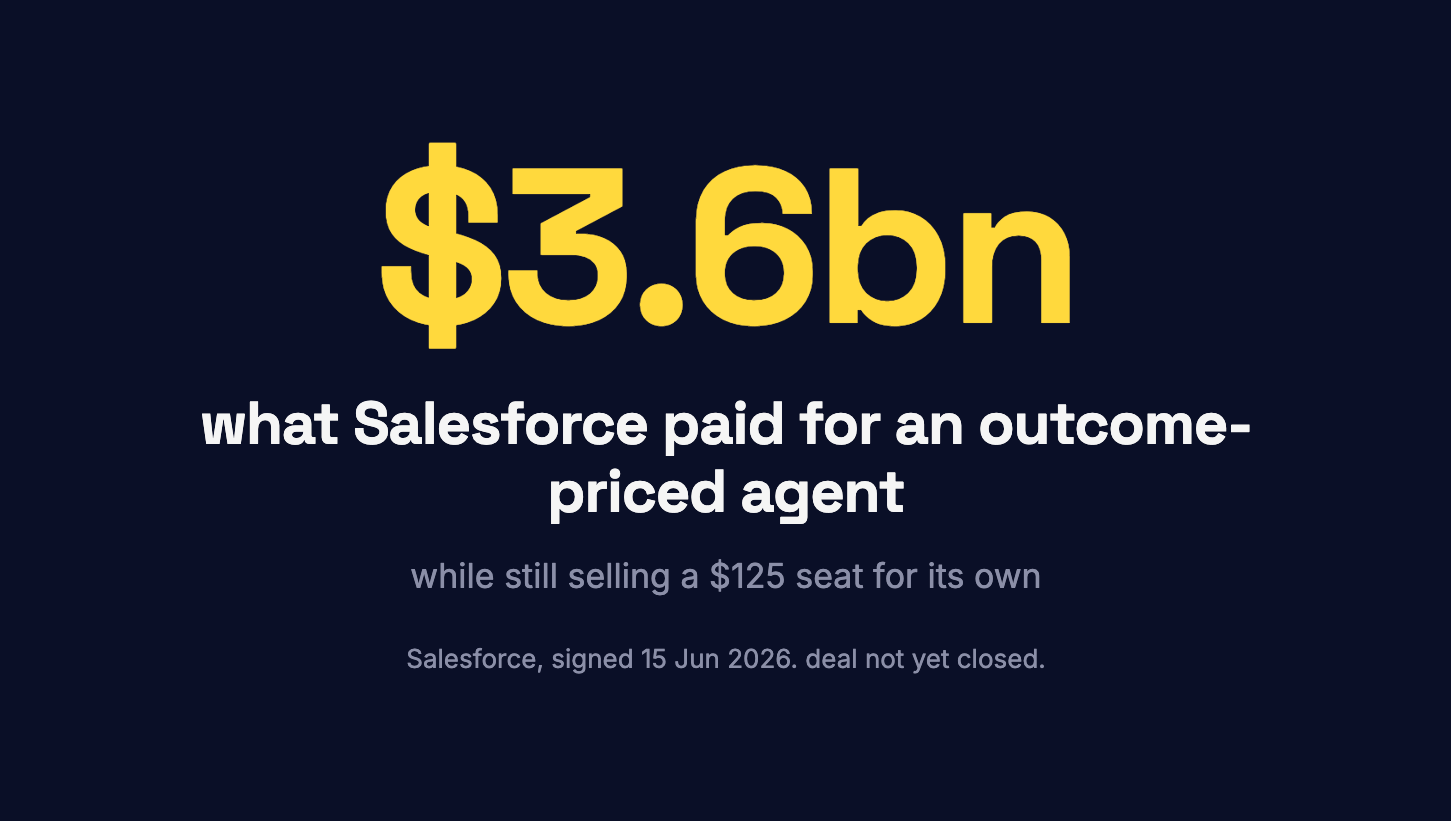
And then in June it went further. On 15 June, Salesforce signed a definitive agreement to acquire Fin, formerly Intercom, for about $3.6bn. Fin charges $0.99 every time its agent resolves a conversation. So the largest software company in the category spent $3.6bn on an outcome-priced agent while continuing to sell a $125 seat for its own. The deal is not closed yet, completion is expected in Salesforce’s next financial year, but this is a direction they are moving towards.
The counter-example
If per-seat pricing was genuinely on its way out, you would see the biggest AI product in enterprise software to be priced in a different way.
And that’s not the case. Microsoft 365 Copilot, at the enterprise tier, is $30 per user per month, on an annual commitment, sitting on top of a qualifying Microsoft 365 licence. Per user. Per month. The most widely deployed AI product in corporate software is sold per seat, and it is sold that way because seats are recognisable to a procurement team in a way that a credit balance is not.
What an actual revamp looks like
Two companies have done the thing everybody claims to have done.
Sierra gets paid only when its agent resolves the customer’s problem without human intervention. Not per conversation, not per user, but per resolution. Bret Taylor’s argument for it is that salespeople have always been paid on commission, so it is strange to treat software as the exception. Sierra reached $100M ARR in under two years, which is what takes this from being an interesting philosophy to a working business model.
Fin does the same at $0.99 per resolution, with a fifty-outcome monthly minimum and no volume discount. This model only works if the agent actually resolves things at a high enough rate to be worth someone’s budget. Salesforce markets Fin at around a 76% resolution rate, though different sources claim it to be much lower. This is another small example of the gap this whole piece is about - the number a company puts out and the number it actually delivers.
Notice what both of those companies gave up. If you charge per resolution, a quiet month for your product is a quiet month for your revenue. You have handed the customer a lever that used to be yours. Nobody does that as a marketing exercise. It costs too much when it goes wrong.
That is the difference between the two groups. One changed what it is willing to be measured on. The other changed a heading.
The test
If you want to know which side of the line you’re on, there is one question you need to ask.
Has the unit you charge for changed, or only its name?
If you renamed seats to workspaces, or licences to digital workers, and the invoice still goes up when the customer hires someone, you have not revamped anything. You have just redecorated. There is nothing wrong with that as long as you don’t tell yourself or publish it as a pricing model revamp.
If your revenue now moves when the product does its job well, independent of headcount, then you’ve rebuilt. And you will already know it, because the first quarter of it was probably horrible.
The bottom line
Earlier in the trip, in Geneva, I stood in front of a shop window of watches with no prices on any of them. Not one person buying these watches is calculating the cost per hour of accurate timekeeping. The unit is not the point here.
Most companies currently panicking about per-seat pricing do not have a usage problem. They have a value problem. If your customer cannot clearly say what they are paying you for, changing the unit will not solve that. You will just confuse them with a new metric, and you would have spent two quarters of IT time to do it.
The Paris café can charge three different prices for one espresso because everyone walking past understands precisely what the third one buys. Very few software companies can say the same thing about their own pricing page. That is the actual problem.
Next week
I’m looking at what happened to the go-to-market team itself. Headcount across GTM teams is down, output is up, and the seat being cut is the SDR. The story being sold is that AI simply does that job now. I don’t think that’s quite what happened, and the numbers underneath it are more interesting than the story on top.
Want it Monday morning? Subscribe. It’s free.