

I was in a quarterly review once where a marketing guy put up a slide with a big green number, MQLs are up 40% this quarter. There were a few nods around the table. Then someone from the sales team, who clearly wanted to do this all along, asked the most obvious follow up question - “How many of them led to closures?”. The room went silent because everyone knew what the answer was but didn’t want to say it out loud.
This meeting came back to me now because last week my feed was filled with articles declaring that the MQL is dead. But what struck me was that these confidently worded articles were written almost entirely by companies that were dying to sell you whatever they declared to be the replacement.
Here’s what I want to achieve with this article - tell you what really died, what didn’t, and if the suggested replacement is worth our time at all.
The number that buried the MQL
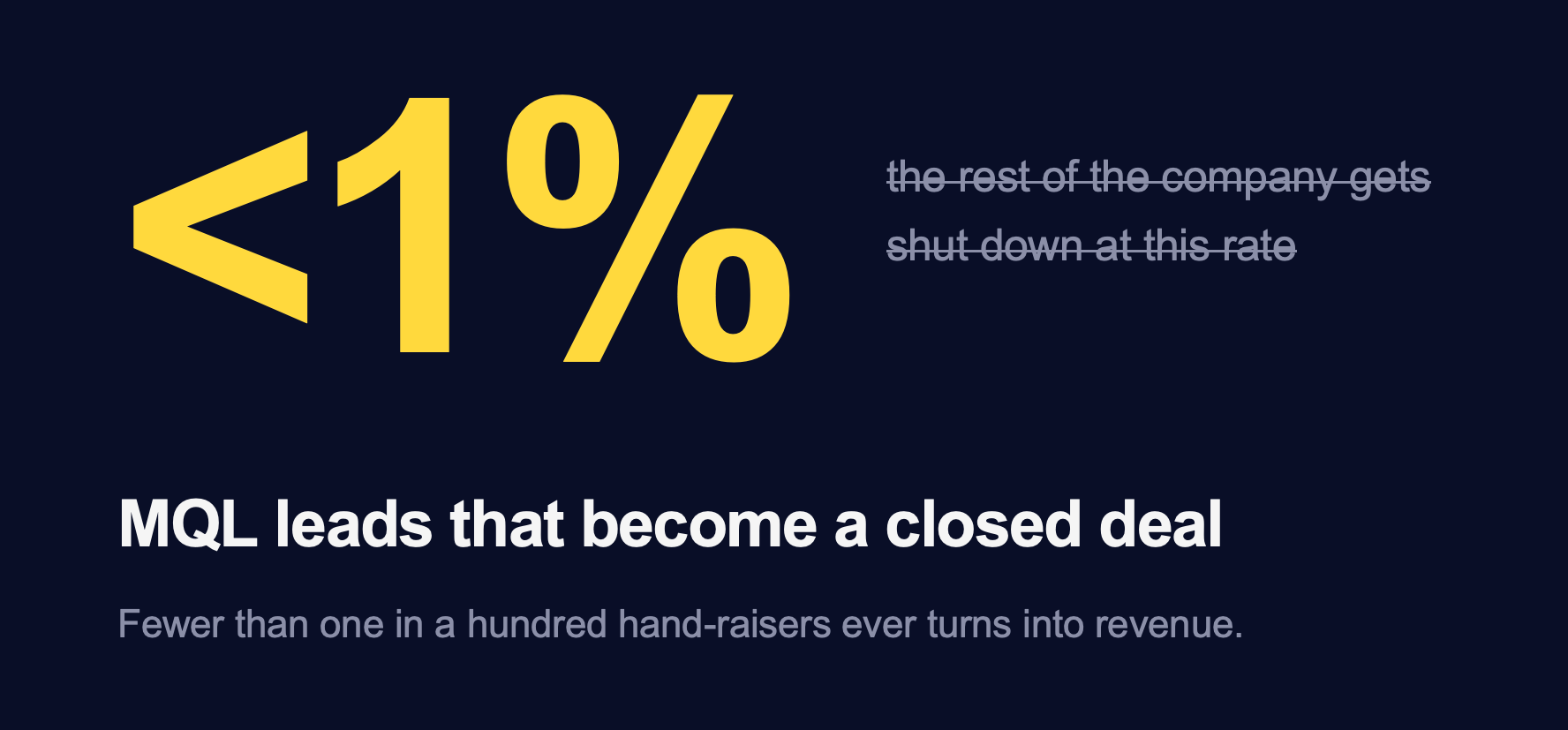
In a traditional B2B lead funnel, the typical conversion from inquiry to closed won is under 1%. That’s lesser than one deal for every 100 people who showed interest.
Now step back and think how you would feel about this number in any other scenario. If your factory scrapped 99 out of the 100 units it produced, you would not be putting money into producing more units. But marketing teams did exactly this for years and got away with it because the MQL did have one redeeming quality - it was quantifiable. You could put it on a slide, the more budget you spent it would climb further up and your weekly reviews were sorted. Now your quarterly reviews, they were managed by quieter conversations you had in smaller rooms.
The MQL does not lie. It is a measure of marketing effort. But effort does not always translate into revenue.
What actually died
The MQL shouldn’t be done away with. You absolutely need to know how many inquiries were registered.
What should go is the assumption that one lead is one buying decision.
Let me paint a picture of how a B2B purchase happens. Someone in operations hits a wall and rants about it in Slack. A colleague recommends a tool they vaguely heard about in a conference. A third person posts the competitor’s tool which is more lucrative. Two weeks later finance is in loop as the cost is out of budget. All of this has happened before the vendor even knows the company exists. By the time one of them in this chain fills the lead form, the decision is already made and the people who were a part of it will not be captured by anyone’s CRM.
The MQL points towards the one person who downloaded your brochure or filled the lead form, scores them and ships this off to sales as the key decision maker, oblivious to the others who were part of the decision.
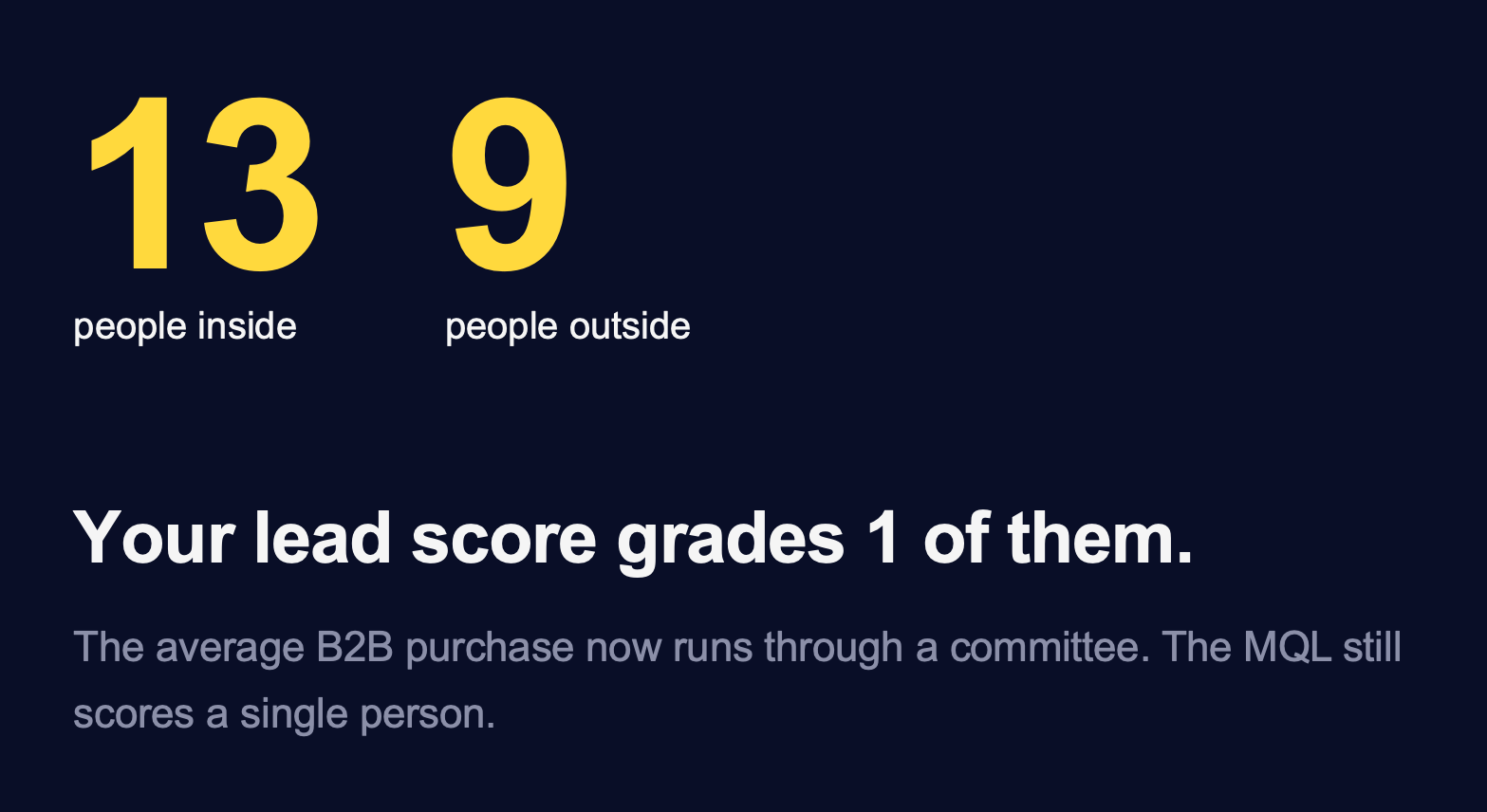
The average B2B purchase decision now runs through 13 internal stakeholders and nine external influencers, per Forrester’s State of Business Buying 2026. Before you write that off as admin bloat, the same study found 94% of buyers in groups of six or more say the size actively helps them - more eyes, easier validation, a smoother path to sign-off. Big groups are not the problem. They are exactly how corporates cushion themselves by having more people sign on the dotted line.
The MQL did not become irrelevant because the scoring got tough, it was because it attributed itself to one person for a decision that was made by an entire committee.
The part the obituaries skip
This is where I get to call out what the sponsored articles won’t.
The replacement being offered is the MQA - Marketing Qualified Account. Stop scoring the person and score the whole account instead. Sounds like the obvious fix doesn’t it.
The reality is far from that.
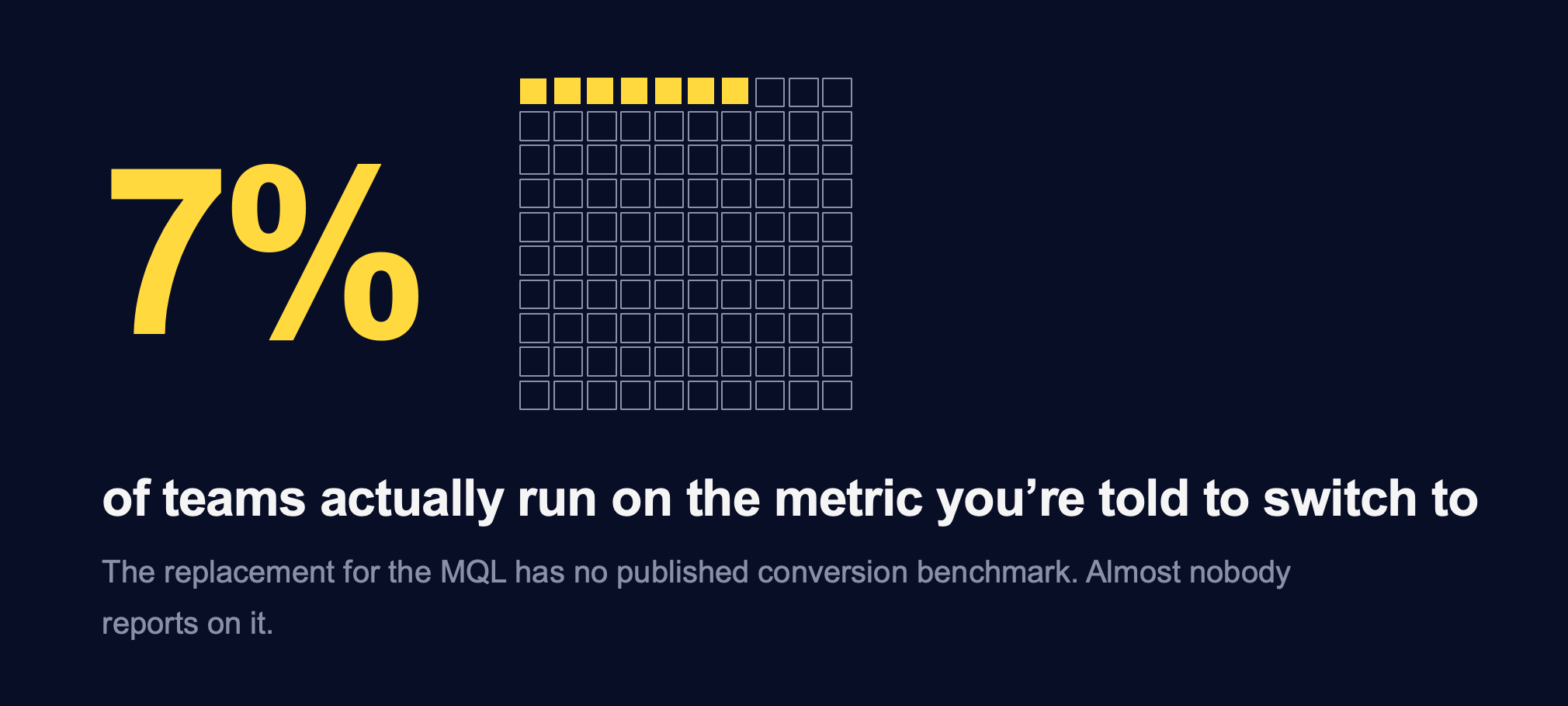
Here’s the detail everyone conveniently leaves out of their slides - almost nobody uses the MQA. In 6sense’s own 2025 metrics survey, just 7% of demand gen teams use MQAs as their primary success metric, and only 13% take ABM-sourced closed-won revenue to the board. The metric that’s supposedly replacing the MQL is mostly a thing people say on stage and not really reporting to their stakeholders.
It gets worse. The MQL at least comes with a brutal, honest number attached, the under-1% from earlier. The MQA has no published conversion benchmark at all. So the pitch is: drop the metric that’s proven to fail, adopt the one that hasn’t shown any proof of it woking, and buy a platform to run it. This is, crudely put, the actual argument in the articles.
And look at who’s making it. The “MQL is dead” line has been pushed hardest by the vendors, 6sense and Demandbase and Terminus among them, who sell the account-based machinery you’d need to report the new metric. Even Demandbase, the name most attached to the MQA, eventually published a piece admitting the industry may have ditched the MQL too fast, and now suggests running both at once.
I’m not saying all critics are wrong. The good ones are right, which is what makes this hard. Jon Miller co-founded Marketo, the company that turned the MQL into an entire industry, and he now calls the old “budget in, MQLs out” model a gumball machine that stopped paying out. Kerry Cunningham, who spent years as a SiriusDecisions analyst, gave the whole apparatus its name: the “MQL-Industrial Complex”, the tools and benchmarks and agencies all profiting from lead production whether or not revenue ever gets booked. That’s a real and useful description.
Know where Cunningham works these days. 6sense. He isn’t wrong about the disease. He just also happens to sell the cure. Both of those can be true, and in a market this cluttered, figuring out who has their skin in the game in the thing they’re telling you is the real skill.
What to do now
Stop counting all the form fills, white paper downloads and webinar attendees as genuine leads. Look for the account where 3 or more people are conveying the same problem within the same few weeks. That cluster of finance, operations and the eventual lead all implying the same thing is the only signal that can predict a deal.
You don’t need an expensive platform to begin. Buy the tools only when you know what you want to track, not before it.
The MQL maybe dead. Just don’t take the obituaries at face value when the person giving it is also selling you the replacement.
Next week
The metric fight has a sequel, and it’s about money. Next week I’m getting into B2B pricing: how “seat-based pricing is dead” became the most repeated sentence of 2026, who’s genuinely rebuilt their model versus who just rewrote their pricing page, and how to tell which side you’re on.
Want it on Monday morning? Subscribe. It’s free.