

It is late, I am writing this in bed with a laptop that is slowly cooking my legs, and I have just spent twenty minutes doing the exact thing this whole piece is about. I needed a tool. A boring one, scheduling software. And without thinking I opened a chat window, typed “compare the three best options for a small team,” read the answer, and picked one. I did not visit a single vendor website. I did not fill in a form. Nobody in any marketing team anywhere has the faintest idea I just chose them.
That is the whole problem in one small bedtime story. And if it is how you buy, it is how your buyers buy too.
So here is the hot take, and I will say it plainly before I back it up. Your funnel does not start at the top. It starts before the top, in a place you cannot see, and by the time anyone shows up in your analytics the important part is already over.
Let me show you what I mean, because this is the kind of thing that sounds like a slogan until you watch it happen.
The meeting that already happened
Picture a real buying decision. Not the tidy one in your funnel diagram, the actual one.
A product manager at a mid-size company has a problem. On Tuesday she asks an AI assistant to lay out her options. It gives her four names and a quick pros-and-cons for each. She drops two of them into her team’s Slack with a “anyone used these?” One colleague replies with a name that was not even on the list, because his old company ran it and liked it. Someone else posts a link to a comparison they saw on a podcast. A week later, in a planning call, she says the words “I think we should look at [vendor],” and the room nods.
Notice what has happened here. A decision has formed. A favourite has emerged. A name has been spoken out loud in the meeting that actually matters. And not one piece of it touched anything you could track. No ad click. No form. No “how did you hear about us.” When she finally lands on your pricing page two weeks later and your analytics logs a tidy little “direct” visit, the work is finished. You are not at the start of her journey. You are at the end of it, watching the closing credits and calling it the trailer.
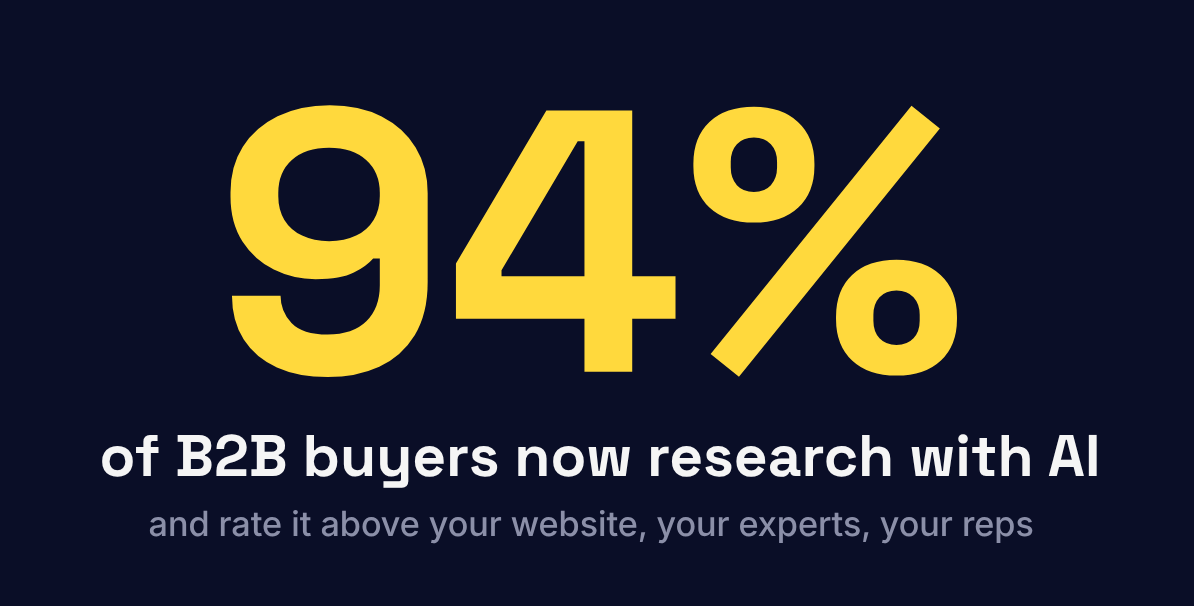
This is not a fringe behaviour. It is the median. Forrester’s State of Business Buying, 2026 found that 94% of B2B buyers now use generative AI somewhere in their buying process, up from 89% the year before. And the more telling number underneath it: buyers named AI and conversational search as a more meaningful source than vendor websites, product experts, or sales reps. Read that twice. They trust the machine’s summary of you more than they trust you.
The number that should ruin your quarter, gently
Here is the stat I would put on a poster if I were running your marketing team.
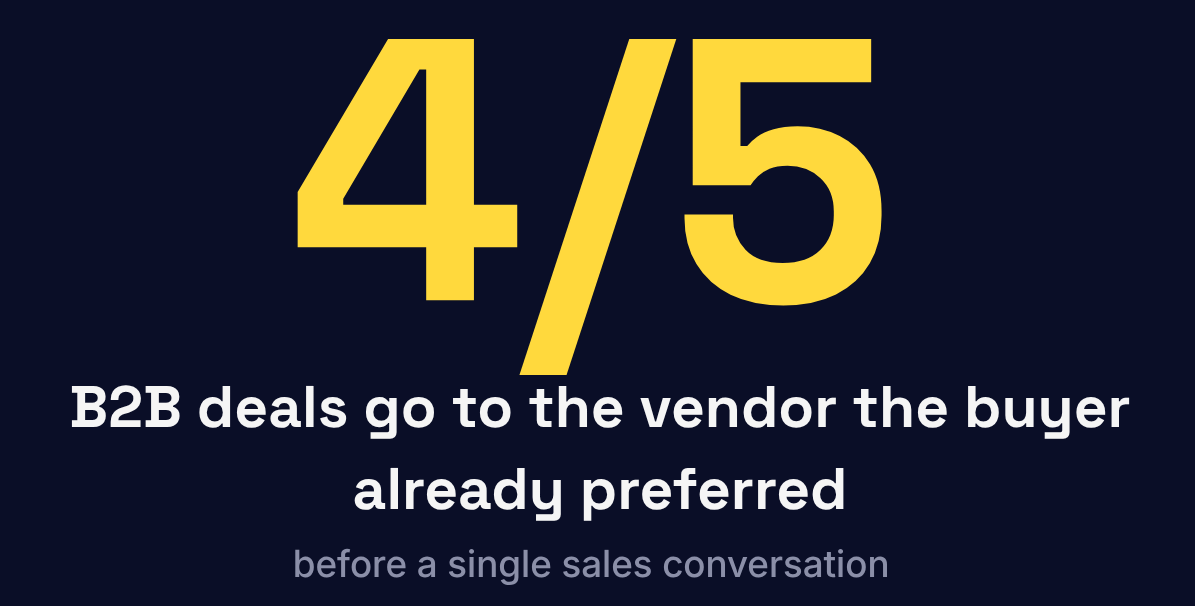
According to 6Sense’s 2025 Buyer Experience Report, the winning vendor is already sitting on the buyer’s shortlist on day one, ninety-five percent of the time. Roughly four out of five deals go to the vendor the buyer already preferred before a single sales conversation took place. Buyers do reach out a bit earlier than they used to, sure. But they reach out to confirm a choice, not to make one.
And before you tell yourself this is a one-year blip, it is not. The 2024 version of the same study found 81% of buyers already had a preferred vendor at the moment of first contact, with most of their requirements locked before they ever raised a hand. Two years running, same result, thousands of buyers each time. This is not a trend you can wait out. It is just how buying works now.
Sit with what that does to your pipeline maths. Your SDRs are calling people who have, four times out of five, already quietly decided. Your “request a demo” form is not the opening of a relationship. It is a buyer double-checking a decision they made in a Slack thread you will never read.
So when your sales team grumbles that the leads are bad, they are half right and entirely wrong. The leads are not bad. The leads are late. Lead quality is usually a lead timing problem wearing a disguise.
Where the journey actually lives
Marketers gave this hidden territory a name a while back. The dark funnel. It is an ugly phrase but a useful one, and it covers everything that shapes a buying decision without leaving a trace you can measure. Slack and Teams chats. WhatsApp forwards. A name dropped at a dinner. A podcast. A review site read in an incognito tab. And now, sitting on top of all of it, an AI assistant quietly assembling the shortlist.
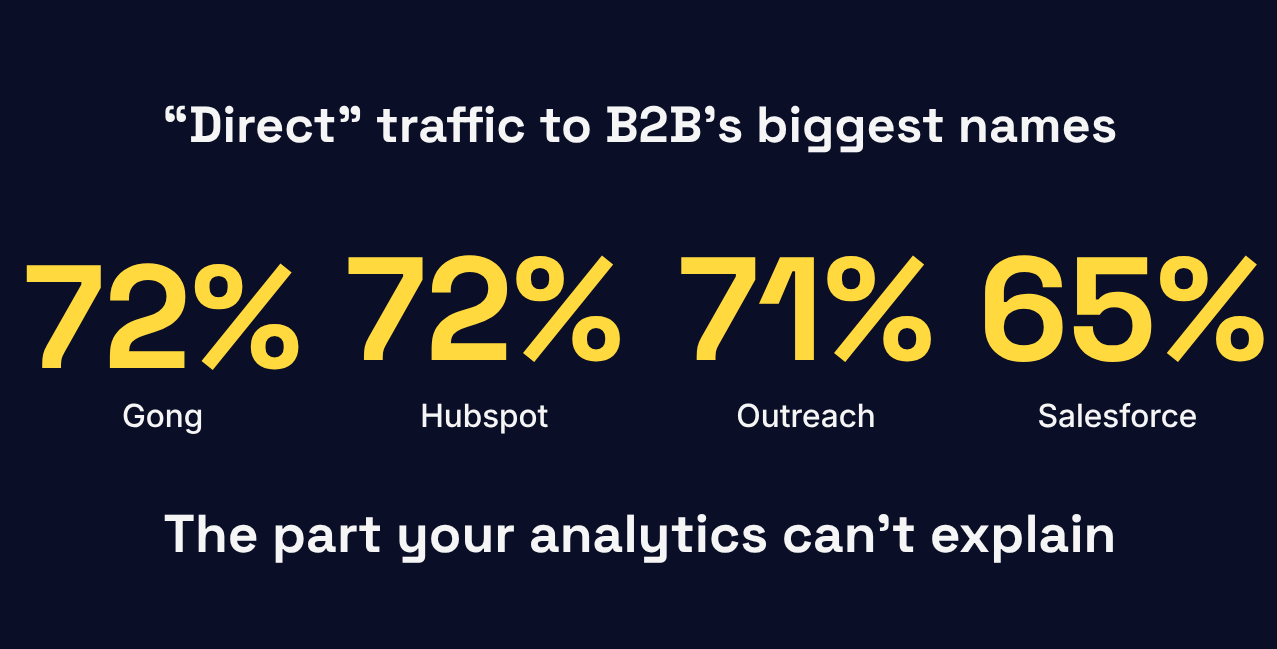
If you want to see the size of it, look at where traffic to the most aggressively marketed companies in B2B actually comes from. Similarweb pulled the numbers and the share that arrives as plain “direct” traffic, with no traceable source attached, is staggering. Gong, 72.1%. HubSpot, 71.6%. Outreach, 71.1%. Salesforce, 64.5%. These are companies with enormous, sophisticated marketing machines. And for most of them, two-thirds of the people showing up arrived through a door nobody can see.
“Direct” does not mean someone typed your URL from memory. Mostly it means attribution gave up. It is the label your analytics slaps on a visit when the real story happened somewhere it could not follow. Two-thirds direct traffic is not a measurement success. It is a measurement white flag.
And the dark funnel just got a powerful new resident. Those AI research tools are not a niche habit anymore. The top few of them now pull billions of visits a month between them, with one of the popular ones, Perplexity, growing its traffic roughly seven times over in two years. Your buyers are doing their most important research inside a system that has no record of your sales funnel, no retargeting pixel, and no obligation to send anyone your way. You cannot buy your way in. You cannot retarget your way in. You are either in the answer or you are not.
It is not as tidy as “the robots decide now”
I want to be careful here, because the lazy version of this argument is “AI runs B2B buying now,” and that is not quite true. It is more interesting than that.
Buyers do not trust the machine blindly. The same Forrester work found a real streak of scepticism about AI accuracy. Some buyers came away more confident for having used it. A meaningful chunk came away less confident, because they hit answers that were wrong or thin. So what do they do? They take the AI’s shortlist and they go validate it with humans they trust. Peers. Old colleagues. A Slack community. A friend who ran the thing two jobs ago.
Which means the buying group you are actually trying to win over is bigger and more scattered than your CRM will ever show. Forrester puts the typical decision at thirteen people inside the company and nine outside it. Your form captures one of them. The other twenty-one are off in the dark, talking about you in rooms you are not in, using language you did not write.
So the funnel does not begin with an AI answer either. It begins with a question a buyer asks a machine, and then a second question they ask their network to check the first one. The whole decisive stretch happens between those two questions, in the dark, before your analytics records a thing.
So what do you actually do about it
This is the part where a worse newsletter would tell you to buy an attribution tool that promises to “illuminate the dark funnel.” Do not. You cannot floodlight a dark funnel. The whole point is that it resists tracking, and chasing perfect attribution into private Slack channels is a way to spend a year and a budget learning nothing.
The shift is harder and simpler than buying software. You stop trying to measure the invisible journey and you start trying to influence it. A few honest moves:
Get into the AI answer. When a buyer asks an assistant to compare options in your category, you want to be one of the names it returns. That is a content and reputation job, not an ad-buying one. It means publishing things specific and clear enough that a machine can extract you and a human can verify you. Vague thought-leadership soup does not get cited. A sharp, sourced, genuinely useful piece does.
Be mentionable in the dark. The currency of the dark funnel is the offhand recommendation, the name someone drops in a thread because you were useful to them once. You earn that by being worth mentioning, not by being easy to track. Communities, real expertise out in the open, a product people actually like talking about.
Ask the one question your analytics cannot. On every discovery call, every form, every won-deal review, ask it plainly: how did you really first hear about us. The answers will not match your dashboard, and that gap is the most honest market research you will ever get for free.
Stop judging your channels on a thirty-day last-click window. If most of the journey is invisible and the typical buying cycle runs the better part of a year, last-click attribution is not just imperfect, it is actively lying to you. It hands all the credit to the final “direct” visit and none to the eight months of dark-funnel influence that produced it.
The uncomfortable bit
Here is what I think most teams get wrong, and it is not a tactic, it is a posture.
We were all trained to believe that what you cannot measure, you cannot manage, so we quietly decided the measurable part was the whole game. We poured the budget into the trackable slice at the bottom because it gave us clean dashboards, and we told ourselves the dark part was small. It is not small. It is most of it. We built an entire discipline around the ten percent of the journey we can see and called the other ninety percent “brand,” and filed it under nice-to-have.
The funnel you can see is real. It is just not the start. It is the receipt. By the time someone is a trackable lead, the decision that mattered was already made in a place you were not invited. Your job is not to light up that place. Your job is to be the name that gets spoken there when you are not in the room.
That is the work. It is slower and less satisfying than a dashboard, and it is the only thing that actually moves the part of the funnel that decides who wins.
What comes next
This week was the funnel that starts before the funnel. Next week I want to make it concrete by pulling apart a company that won the dark funnel on purpose, with almost no budget, before anyone had a name for it.
The company is Clay, and it is one of the fastest-growing B2B companies of the last few years. The interesting part is not how fast it grew. It is how it grew: by finding its first real customers inside a single online community, one careful message at a time, and turning that into a flywheel everyone else is now trying to copy. I am going to show you exactly which moves you can steal. No hype, just the mechanics.
Before you go, try the experiment I started this with. The next time you buy something for work, watch how you actually do it. Notice the chat window, the Slack message, the colleague’s offhand recommendation. Then go look at where your own buyers show up in your analytics, and ask yourself how much of their real journey you are seeing.
Probably the receipt. Almost never the decision.
Monday GTM is a weekly newsletter for B2B founders and growth teams. One practical playbook, teardown, or hot take, every Monday. No fluff. No filler. Just the frameworks that actually move the pipeline.
Next up: how Clay, one of the fastest-growing B2B companies of the last few years, built its entire go-to-market inside a single community, and what you can copy from it.
See you then.
Key data points in this post are linked inline to their original sources.