

Every client I have spoken to in the past month has asked me a version of this question - how do I get cited by AI? The FOMO is tangible in their voices as they do not want to delay getting on the AEO hype train and wanted my opinion on what should go under their 2027 AI visibility plan. And honestly I did not have answers to these questions. I did try to throw some light on this in this piece on buyers researching through AI before they reach you. But now, I had my own new set of questions - is this just hype or is it something worth investing marketing budgets on? If it is not just hype, what should an organisation work on and what line items should they include in their budget?
So, I went looking for the answers.
Google answered this in May and nobody noticed
On 15 May 2026, Google published a guide to optimising for generative AI features. On the same day, it also clarified that its spam rules now cover AI answers. The first line of that policy now includes “attempting to manipulate generative AI responses in Google Search”.
The two entries sit next to each other in Google’s own changelog, which is where I found them. Google’s stated reason for writing the guide is the part I keep going back to. It is there to help people work out how to optimise, “and what they can ignore”.
So the help and the warning turned up on the same day, deliberately.
The list of things you do not need to buy
There is a section in that guide headed, more or less, here is what you do not need to do. Five things.
llms.txt. If someone has charged you to add one, Google Search does not read it. Google’s own wording is that it “will neither harm nor help your site’s visibility or rankings in Google Search”. People clearly kept arguing about it, because Google went back on 15 June and added another note saying the same thing more slowly.
Chopping your pages into small chunks. Not needed. There is no ideal page length either.
Rewriting your content so a machine can follow it. Also not needed.
Chasing mentions. Google names this one directly and is politely unenthusiastic about it.
Piling on structured data. Not required for AI answers, and there is no special markup to add.
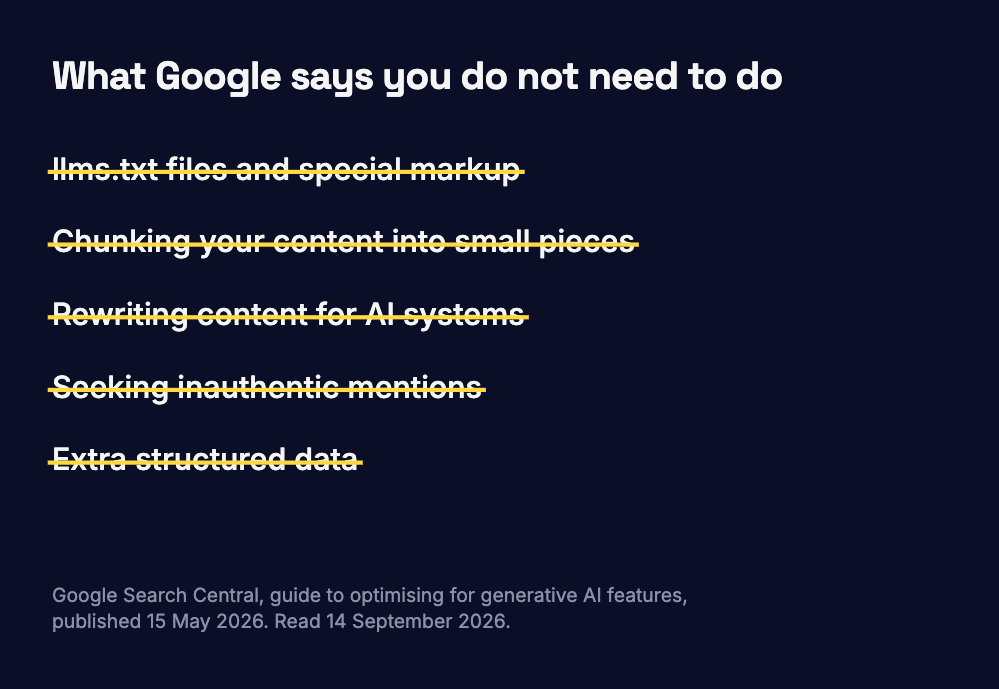
Now read that list again as a shopping list, because that is what it is. Google went further on 5 June and published a page about third-party SEO tools and advice that names “AEO or GEO tools” as a category to be careful with, and says flatly that no third-party tool can see its ranking data or promise you an outcome.
I will be honest here and say that I was quite taken aback when I saw this list. It is quite the opposite of every “best SEO practices” that has been drilled into us for a decade.
The bit everyone has been getting slightly wrong
Worth slowing down here, because most of the coverage has smudged this.
The scaled content abuse policy still says the offence is producing pages “for the primary purpose of manipulating search rankings”. Those words have not changed. The link to AI answers is made in the optimisation guide instead, which says that spinning up a separate page for every possible way someone might phrase a question, in order to push into rankings or AI responses, breaks that policy.
Two sentences, two documents, one idea. And the policy adds that it applies “no matter how it’s created”. So this is not a rule against writing with AI. It is a rule against volume with nobody at the other end.
Then Microsoft wrecked my theory
I had a neat argument going. Google is the only one who has written any of this down. Then I opened Bing’s documentation and had to throw it away.
The Bing Webmaster Guidelines now say, in their opening line, that they cover how Bing surfaces content across Bing, Copilot and grounding API results. Follow them and your pages are eligible to be indexed, ranked and cited. Fail them and you can lose “eligibility for grounding experiences”, or be dropped from the index altogether.
Microsoft then does something Google has not. It uses the word GEO, defines it as content being eligible for citation in AI answers, and adds the sentence that never makes it into a vendor deck: neither SEO nor GEO guarantees you anything.
On manipulation it is more blunt than Google. Content “should be created for users, not to manipulate ranking systems or trigger citations or AI responses”. Trigger citations. That is the precise thing a large part of this market is selling.
It also gives you switches Google has not. One tag (NOARCHIVE) keeps your content out of Copilot answers entirely. Another (NOCACHE) limits Copilot to your title and link. There is even a way to mark which parts of a page Bing is allowed to quote, using the data-snippet attribute.
Every time I mention Bing in a meeting, clients are usually in a hurry to dismiss it or ask me how relevant is it anyway. And I always correct them that a lot of organisations and hence their customers use Copilot or Bing at work, and then they ask me to go over the slide again.
Where the two of them flatly disagree
Put the documents side by side and they tell you different things.
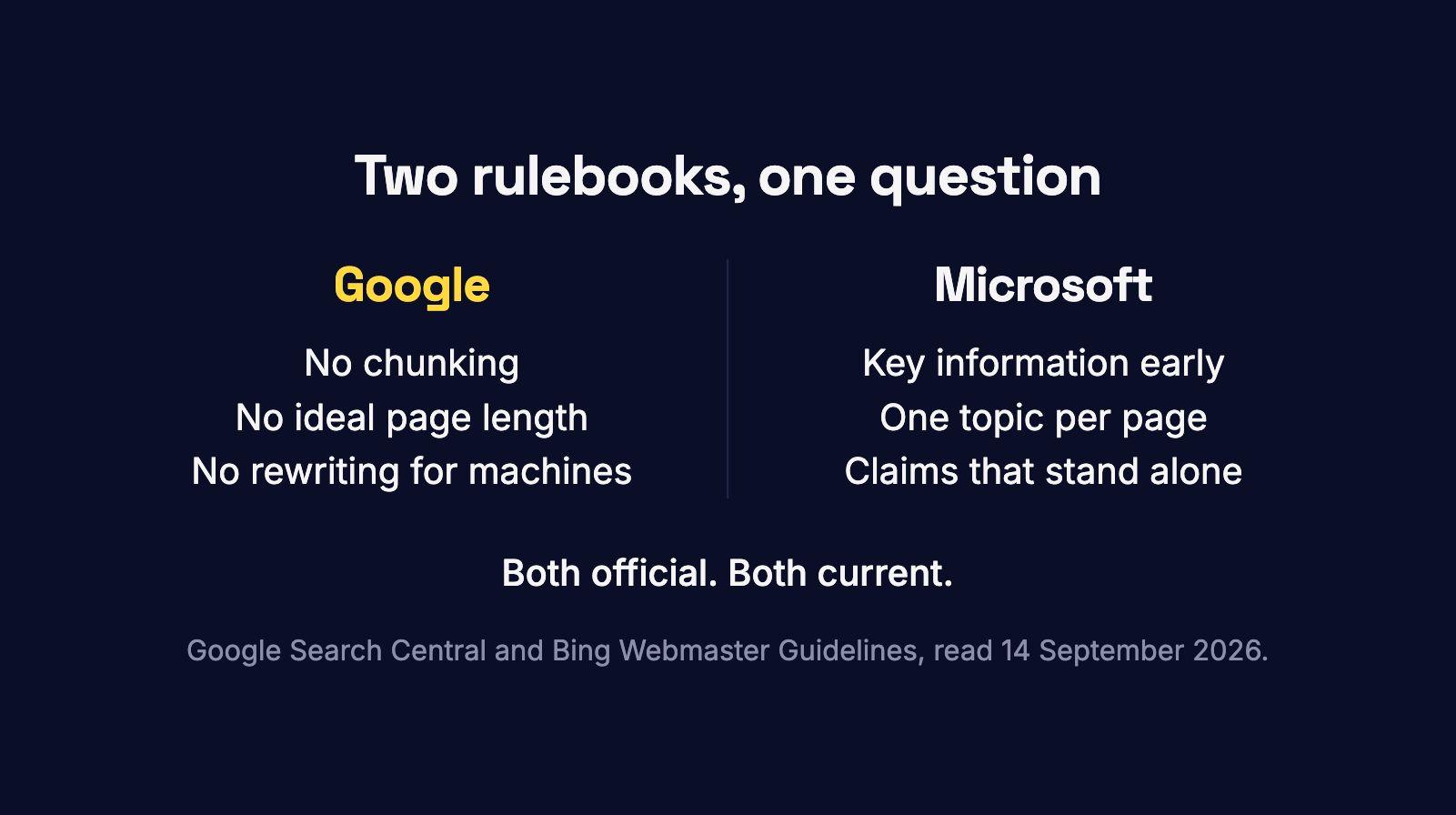
Google says do not restructure anything for AI. No chunking, no ideal length, no writing for machines.
Bing ties structure straight to eligibility. Get to the point early. One topic per page. Name things the same way each time. Make sure a claim stands up on its own, without the reader needing the rest of your site to decode it.
Neither of them is wrong. They are running different systems. But if someone handed you a single AI content checklist, they wrote it as though one answer exists.
The other three did not write rules at all
Now the ones your team actually talks about.
OpenAI’s page for publishers is a door policy. Let the search crawler in. Use noindex if you would rather your links were not shown. Block the training crawler if you want to. For measurement, ChatGPT tags referral traffic with a UTM parameter, and that is the whole offer.
Anthropic’s is the same shape. Three crawlers, what each one is for, what happens if you block it.
Perplexity’s is mostly firewall configuration, plus one sentence worth knowing. When a user asks it something, Perplexity “generally ignores robots.txt rules”.
Not one of the three publishes anything about what makes content eligible, what counts as gaming their answers, or how you would ever know it worked. I am not saying they owe you that. I am saying you should know it before you put a number in front of a CFO.
What you can actually measure
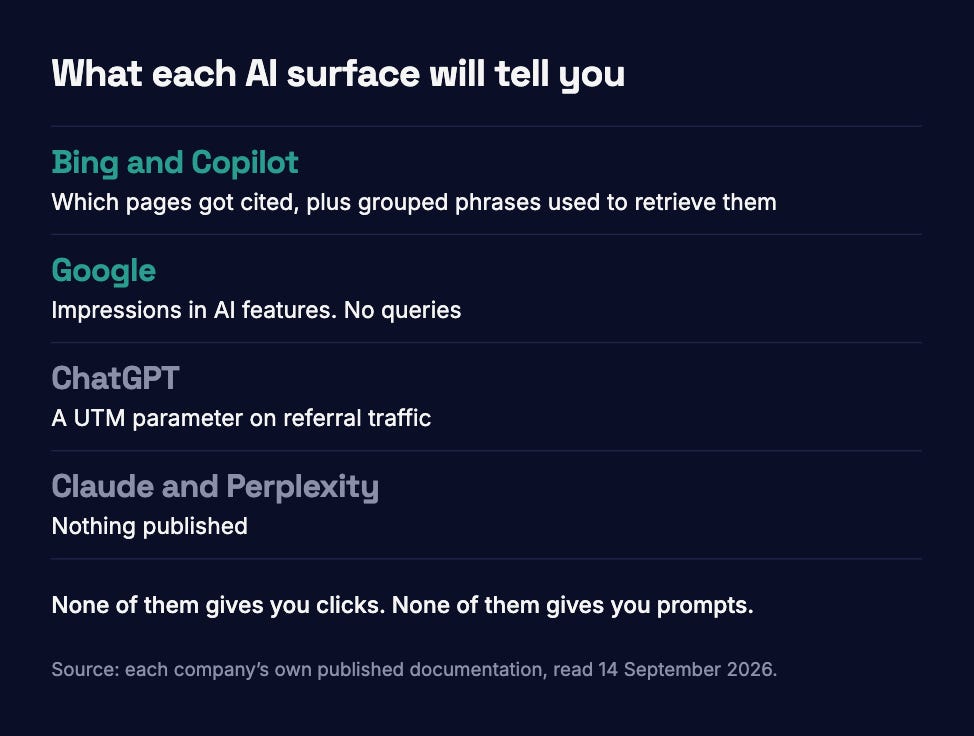
Microsoft’s AI Performance report gives you the most, and is still careful about it. It says plainly that it “does not measure rankings, authority, performance, or importance”, that the phrases it shows you are grouped rather than real queries, and that it will not tell you why a particular page got used.
If your 2027 plan has a line in it called AI-influenced pipeline, it is an estimate. We have done this before with a metric everyone eventually agreed to stop believing.
What I would actually put in the plan
Start with the question that never gets asked first. Which of these surfaces do your buyers use? Not all four. If you sell into Microsoft-heavy enterprises, Copilot is sitting inside Word, Outlook and Teams all day, and it happens to be the one surface with both a published rulebook and real retrieval data. If you sell to developers, it is Claude and ChatGPT, and neither will tell you anything at all. Answer that before you buy a tool.
Then fund the overlap. Where Google and Bing agree, you are on safe ground, and what they agree on is almost disappointingly ordinary. Write something original. Get your facts right. Make it easy to follow.
Bing’s structural rules only apply to Bing, so fund those if Copilot came up in the first question and leave them alone if it did not.
If you only take one thing from all this, take the defund list, because Google has already written most of it for you. One caution, and it matters. Google saying llms.txt does nothing is a statement about Google. Nobody else has said either way. That is proven for one surface, not four.
It is worth holding the whole thing up against what your sector already spends on search before anyone adds a fresh line to it.
What none of this proves
Every document here is a company describing its own machinery. None of it can be tested from the outside. Nobody outside these companies can check how any of these systems choose their sources, and that includes me.
Both publishers have a stake, too. Google telling you to ignore third-party tools and use Search Console suits Google very nicely. That does not make it untrue. It means a rulebook tells you what a company says it wants, which is not proof of what it does.
It is still more than three of them have given you.
The useful bit is not any single rule. It is that you can now tell the difference between someone quoting a rulebook and someone inventing one, and checking costs you about fifteen minutes.
None of this is settled, and there is still nobody neutral keeping score.
So the honest answer to the question my clients keep asking me, how do I get cited by AI, turns out to be another question. By which one. Two of the four will tell you what they want from you. Two will not tell you anything at all.
That is a thinner answer than anyone wants to put in a 2027 plan. It is still a better basis than funding all four as though they were one channel, which is roughly what most plans are about to do. And the part that survives all of it is the part nobody can sell you: knowing how your buyer actually behaves, and writing the thing that deserves to be quoted.
If this was useful, subscribe. Free, every Monday.
One question, and I would like an actual answer in the comments: which of these four surfaces did you actually pick for 2027, and what did you use to decide?
Every document referenced above was read directly on 14 September 2026. Google’s pages carry last-updated dates of 5 June, 10 July and 28 August 2026. Bing’s webmaster guidelines and AI Performance documentation, OpenAI’s publisher FAQ and Perplexity’s crawler page were read the same day. Anthropic’s page is dated 7 April 2026.
Monday GTM is a weekly read on how B2B go-to-market actually works, for the people doing the work. No theory, no fluff. Just what holds up when you look closely.