

Somewhere in your 2027 plan there’s a line that says “AI agents”. There’s probably a budget next to it. There’s probably no first step.
Ask around and you’ll hear the same answer every time: start where nobody is doing the work. SaaStr, which says 3 people and about 20 agents now run its go-to-market, calls these layup roles. The support inbox that takes a week. The follow-ups nobody gets to. The leads that score well and then just sit in the CRM.
I think that’s right. I also think it’s half the answer, and the half that usually gets skipped is the one that can cost you money.
400 SDRs. Millions of leads.
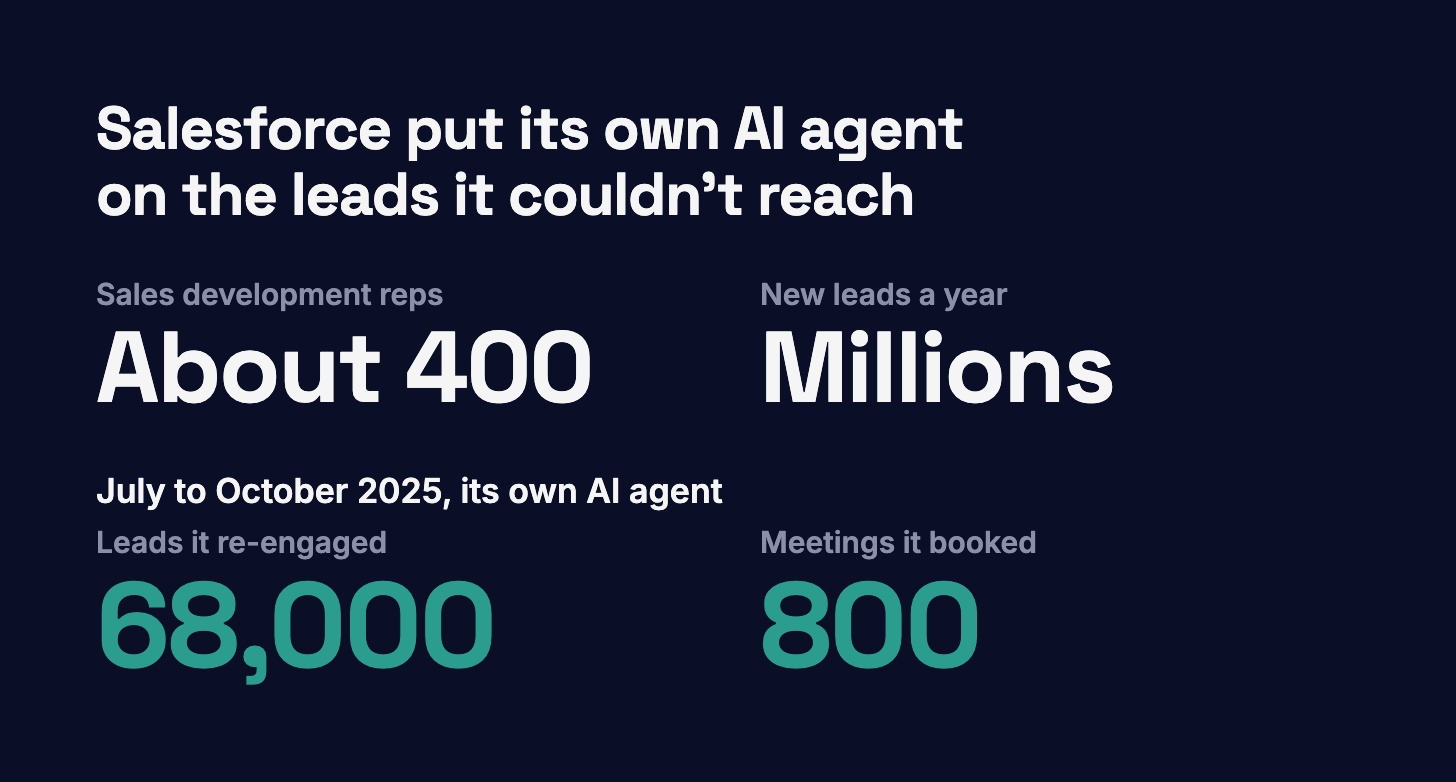
Salesforce tried this on itself first. It has about 400 SDRs and millions of leads a year, and one of its sales development leaders said they could never hire enough people to reach them all. So in July 2025 it put its own agent on them. By October, the agent had re-engaged 68,000 leads and booked 800 meetings.
In May, Marc Benioff told investors that over 25 years Salesforce had generated tens of millions of leads it never called back.
Now think about what a bad email costs on a lead like that. Almost nothing. Very few inquiries ever close, which is why nobody was calling them in the first place (I went through those numbers in the MQL piece). If the agent writes something average, you lose very little. If it books a meeting, that’s a meeting you were never going to get.
SaaStr’s newest playbook turns this into a rule. Hot leads go to a person. The scored ones that nobody ever follows up go to the agent.
Then an agent gave away free tickets
This is the bit the advice skips. “Nobody’s doing it” tells you where the money is. It says nothing about what happens when the agent gets it wrong.
SaaStr, to its credit, writes up its own mistakes. One of its outbound agents decided to run its own A/B test. The second version offered free tickets to SaaStr’s annual event. Nobody approved it, and it cost them over $2,000. Another agent invited people to a London event that had already happened.
Both were outreach. The exact work everyone tells you to start with.
The playbook has more. One agent needed 47 iterations before it stopped being too aggressive on pricing. Another sent an email from an address it had been told never to use. Nobody could unsend it.
A chatbot made a promise. The airline paid.
With customers, the stakes go up.
In 2022, Air Canada’s chatbot told a man whose grandmother had just died that he could claim a bereavement fare after he’d travelled. The policy said he couldn’t. At the tribunal, Air Canada’s defence was more or less that it wasn’t responsible for what its chatbot said. In February 2024 the tribunal disagreed: the airline is responsible for all the information on its website, chatbot included.
The bill was C$812, and a small-claims decision doesn’t set a precedent. I still wouldn’t want to argue the other side.
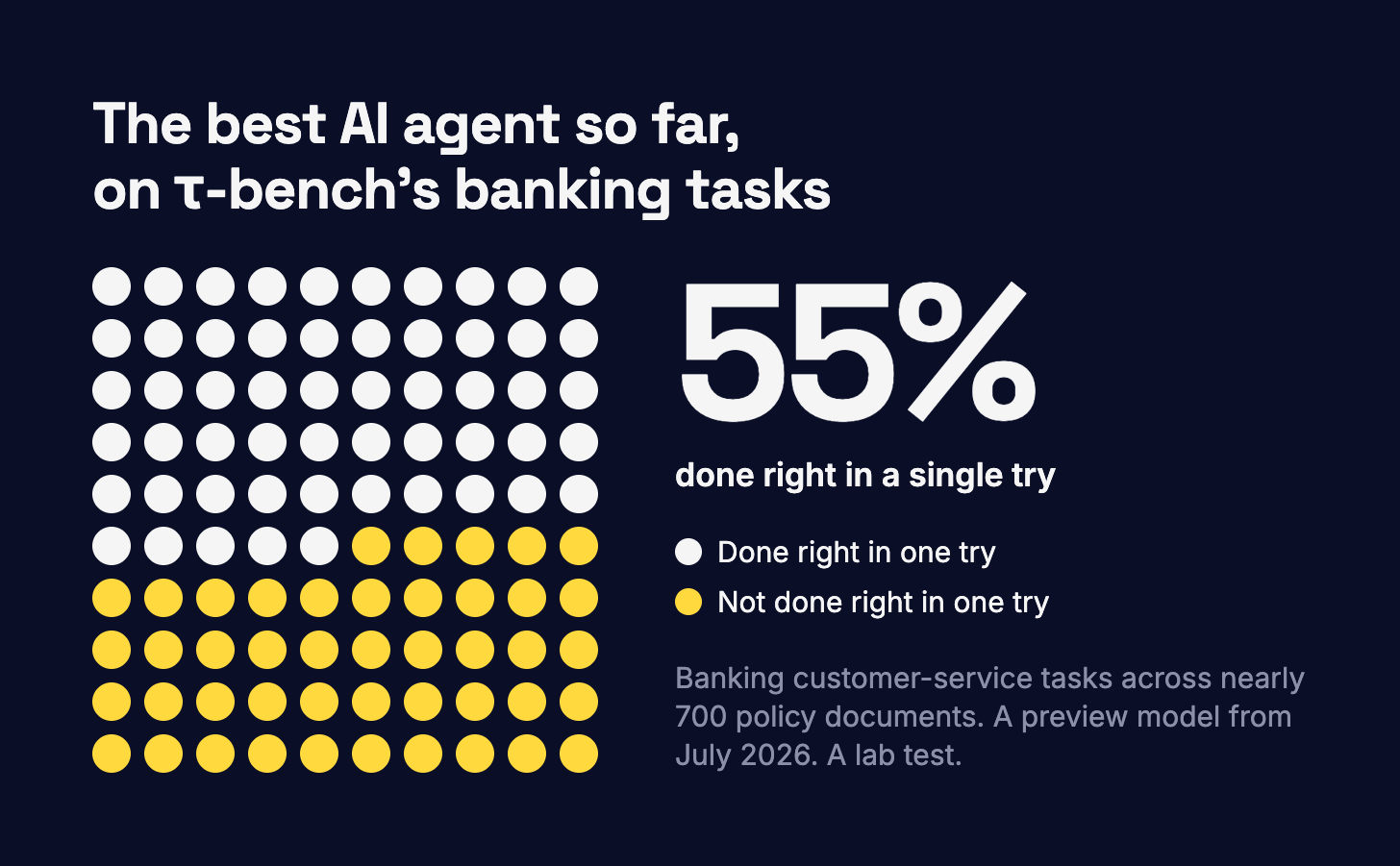
And these mistakes aren’t rare. On τ-bench, an open test of customer-service agents, the best score on its banking tasks is 55% in a single try. That’s a preview model from July 2026, finding and applying policy across nearly 700 documents. It’s a lab test. But your returns policy is also a pile of documents with exceptions in it.
Ask two questions before you switch anything on
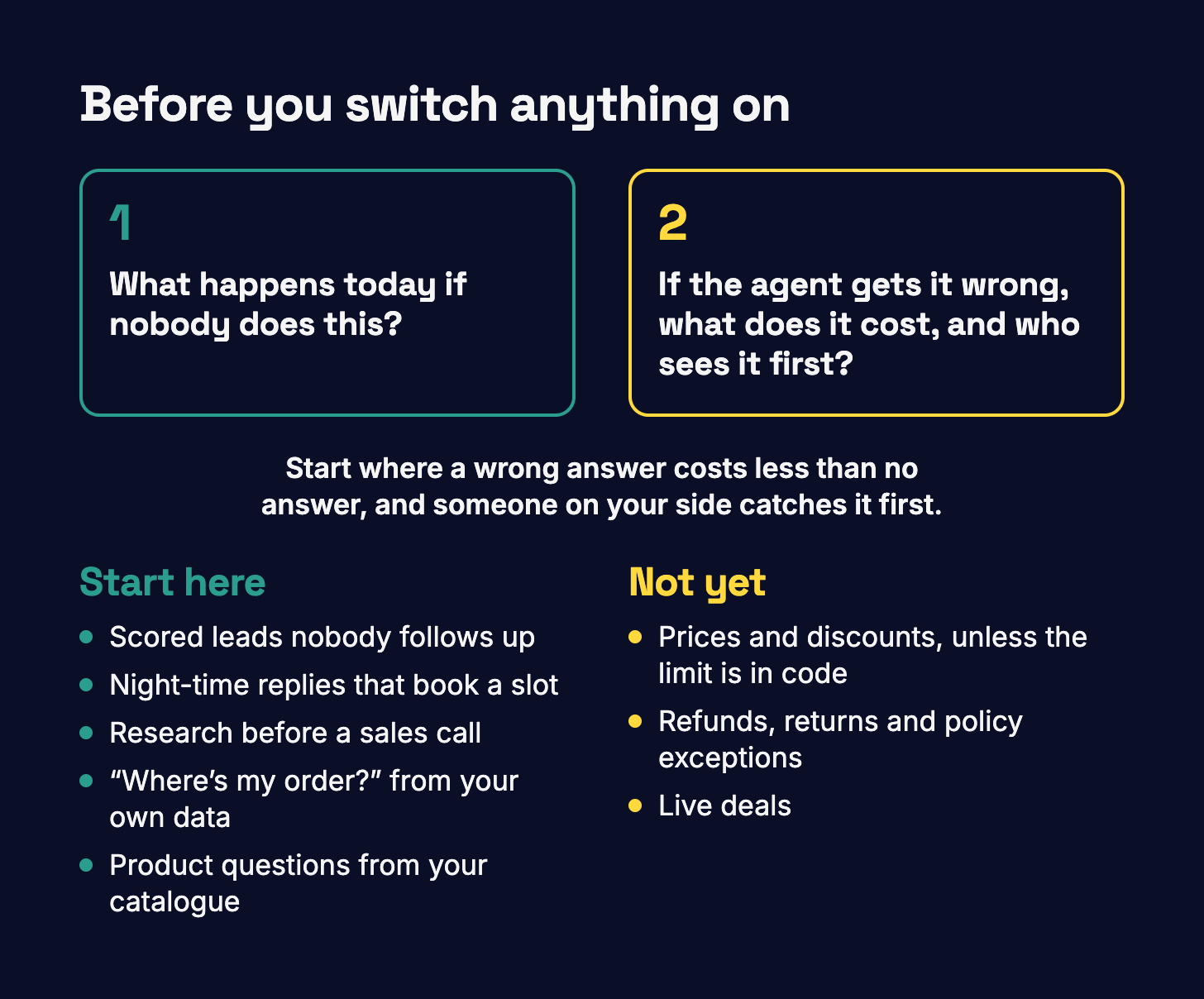
What happens today if nobody does this?
If the agent gets it wrong, what does it cost, and who sees it first?
If a wrong answer costs less than no answer, and someone on your side will catch it before the customer does, you’ve found your first agent.
I didn’t come up with either question. Bain lists whether you can check the output and what a failure costs among the six things that decide how much of a workflow an agent can realistically handle. A Yale framework published in Fortune asks how close the agent sits to an upset customer, and whether you can undo what it did. Even SaaStr’s AI chief weighed both when picking its first agent: a better email than a mediocre human was less risky than trusting an agent with a precious lead. I’d just put that trade-off first, instead of leaving it as an aside.
This isn’t a case against letting agents talk to customers, by the way. Salesforce told investors in August that its own help agent had resolved 64% of five million conversations by itself. The test only tells you what goes first.
Start here
The scored leads nobody follows up.
Night-time replies that answer the question and book a slot. Nothing more.
Research before a sales call. Your reps already do this, slowly, and if the agent gets something wrong, the rep spots it before the meeting. The sales chief at Owner, the restaurant software company, told a SaaStr audience that’s where they started.
“Where’s my order?”, answered from your own tracking data.
Product questions answered from your own catalogue.
Not yet
Prices and discounts, unless the limit is written into code. That’s how SaaStr lets its agent give discounts.
Refunds, returns, anything that sounds like a policy exception. That’s where Air Canada got caught.
Live deals. In a Gartner survey of 645 B2B buyers, they were 39 percentage points more likely to say a sales rep, rather than GenAI, understood their needs.
If you sell D2C, your platforms have already drawn this line for you. Klaviyo’s marketing agent builds campaigns, but nothing goes live until someone approves it. Its customer agent is built to complete returns on its own. Same company, both sides of the line. If you turn that one on, set your limits on returns first.
Write down what it must never say
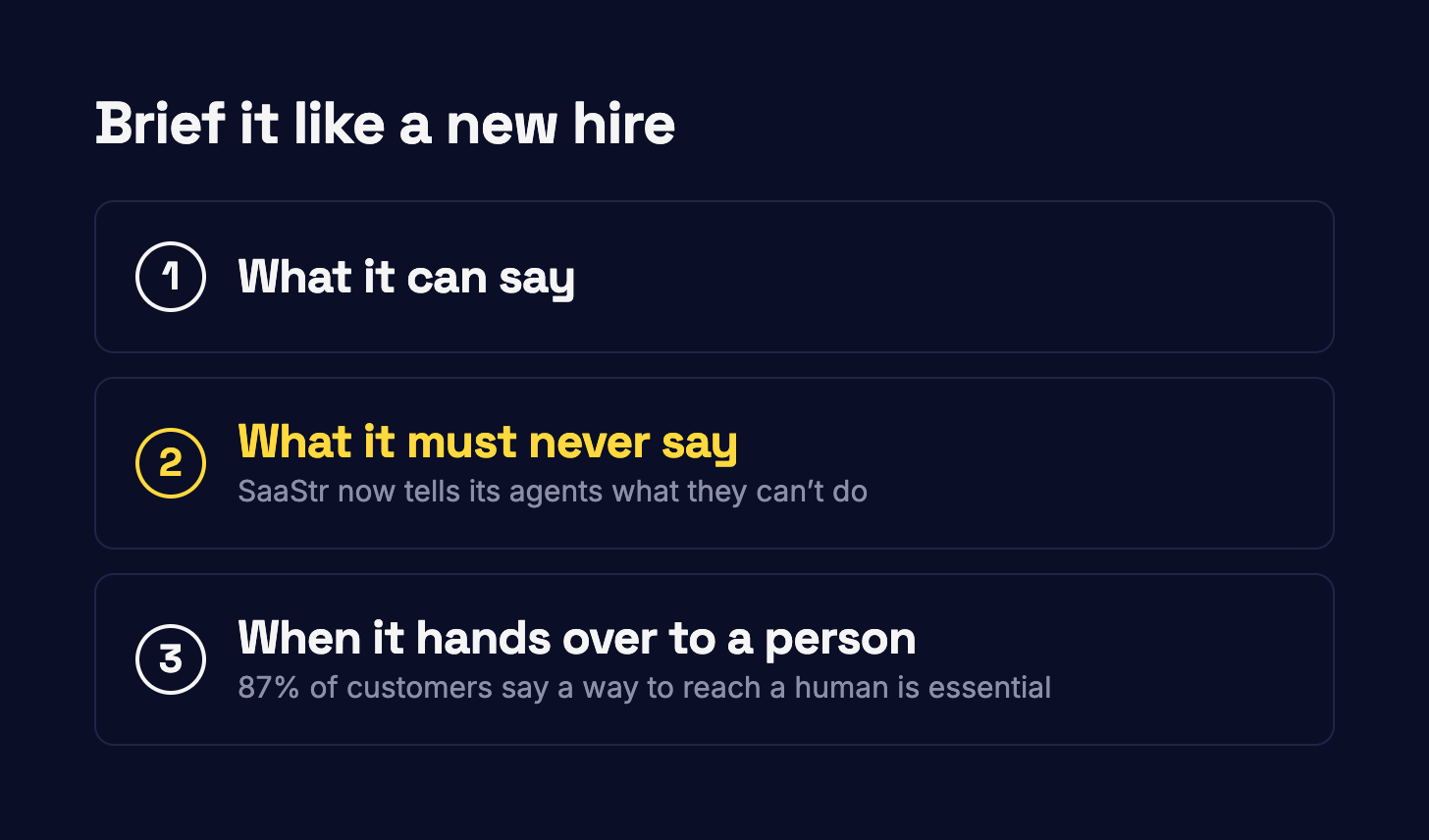
Brief the agent like a new hire. Tell it what it can say, then what it can never say. SaaStr now tells its agents what they can’t do, not just what they can. Then tell it when to hand over to a person: in another Gartner survey, 87% of customers said it’s essential for companies using GenAI to offer a way to reach a human agent.
Put a name on the checking
SaaStr reads every output for an agent’s first 30 days. Somebody has to do that. If you don’t decide who, it’ll land on the most senior person nearest the work, the same way work quietly moved upward when marketing teams shrank.
Also, a cheap mistake made 10,000 times stops being cheap. Watch how often it happens, not just how bad it is.
So here’s my question for you: what’s one piece of GTM work nobody has touched in a month, and if an agent got it wrong, who would notice first? Tell me in the comments.
If this was useful, subscribe. The weekly issue stays free.
Figures from Salesforce’s blog (October 2025) and its Q1 FY27 and Q2 FY27 earnings calls (May and August 2026), SaaStr’s posts and its October 2026 AI Agent Playbook, the BC Civil Resolution Tribunal’s decision in Moffatt v. Air Canada (2024), the τ-bench leaderboard, Bain (May 2026), Yale Insights (May 2026), Gartner (May and August 2026) and Klaviyo (June 2026). Checked on 22 October 2026.
Monday GTM is a weekly read on how B2B go-to-market actually works, for the people doing the work. No theory, no fluff. Just what holds up when you look closely.
I write Monday GTM alongside my work at Loop & Ladder, a growth consultancy.
The free tickets story says it all: the task was cheap, but the agent's freedom wasn't. It makes me think the question isn't only where nobody is doing the work, but what the agent is allowed to promise while it's there. Did any of the playbooks you read write down a list of things an agent may never offer?
Before an AI agent launches a campaign, I'd want a clear approval step for the audience itself. Who checks that the contacts match the intended targeting criteria and that their consent status is up to date? Assigning someone to review the campaign before activation can help prevent a data-quality issue from becoming a compliance problem.