

I spent the larger part of last week reading reports about how GTM teams are being rebuilt and came out of it more confused than when I started. And i don’t feel so good admitting this in a newsletter that claims to tell you how things really work.
Here’s what i think is happening.
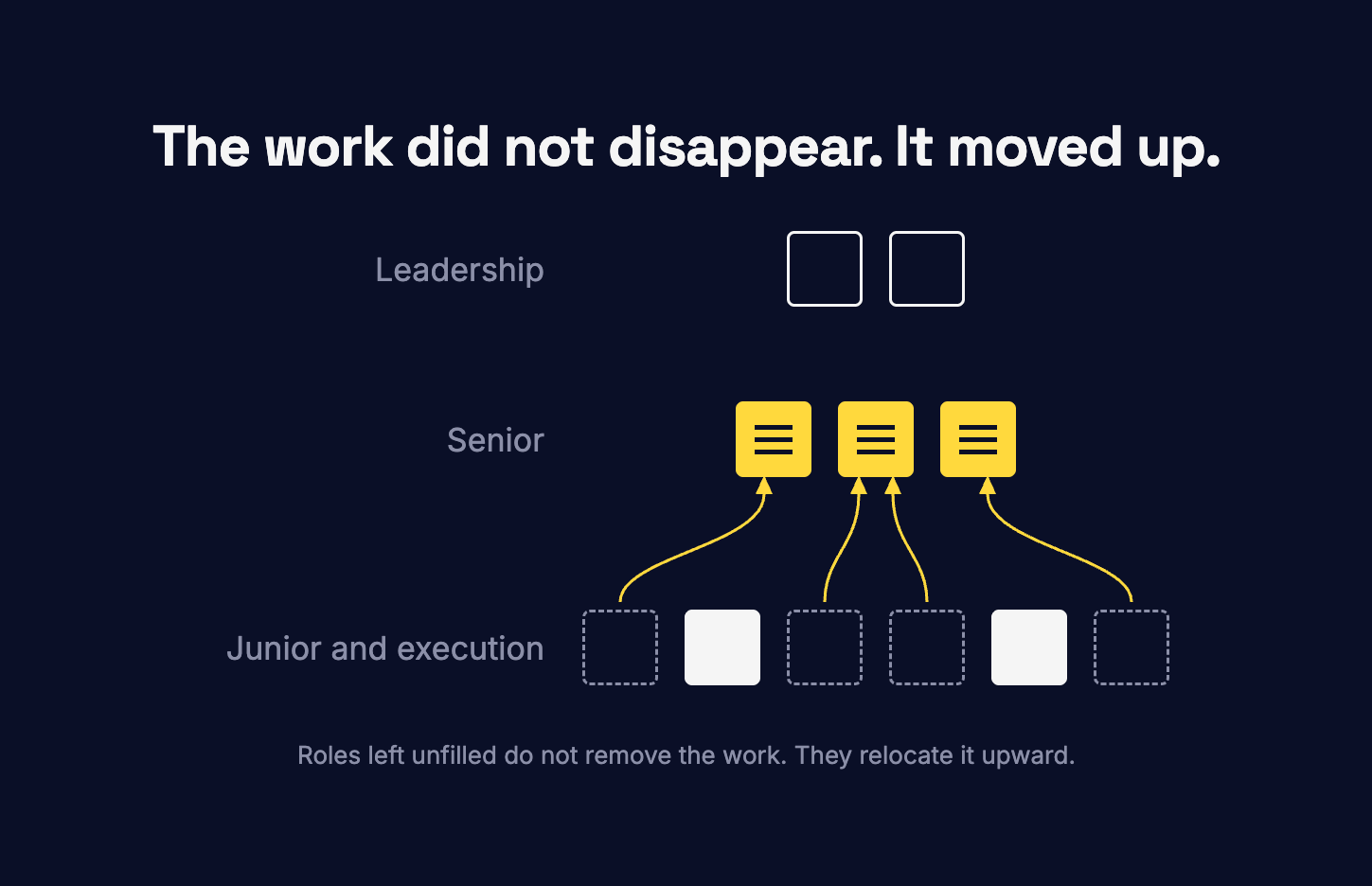
Your GTM team probably got smaller in the last year. There were no layoffs. No reorg deck, no all-hands meeting, not even the difficult email from the CRO. Someone left in March and the role was never posted for hiring. A vendor’s renewal came and went without any action. The junior content writer’s role which finance approved, is still at that stage.
This is the 2026 headcount story.
The cuts have already happened
Wynter surveyed 100 directors, VPs and heads of marketing at mid-market and enterprise SaaS companies in May. Nearly half said they had already cut or reduced marketing roles because of AI. The part worth noting: most of these cuts were not layoffs. Companies just stopped filling open jobs and let attrition take its natural course to shrink teams over time.
No layoffs means no public announcments and no announcements means no decisions that have to be publicly defended.
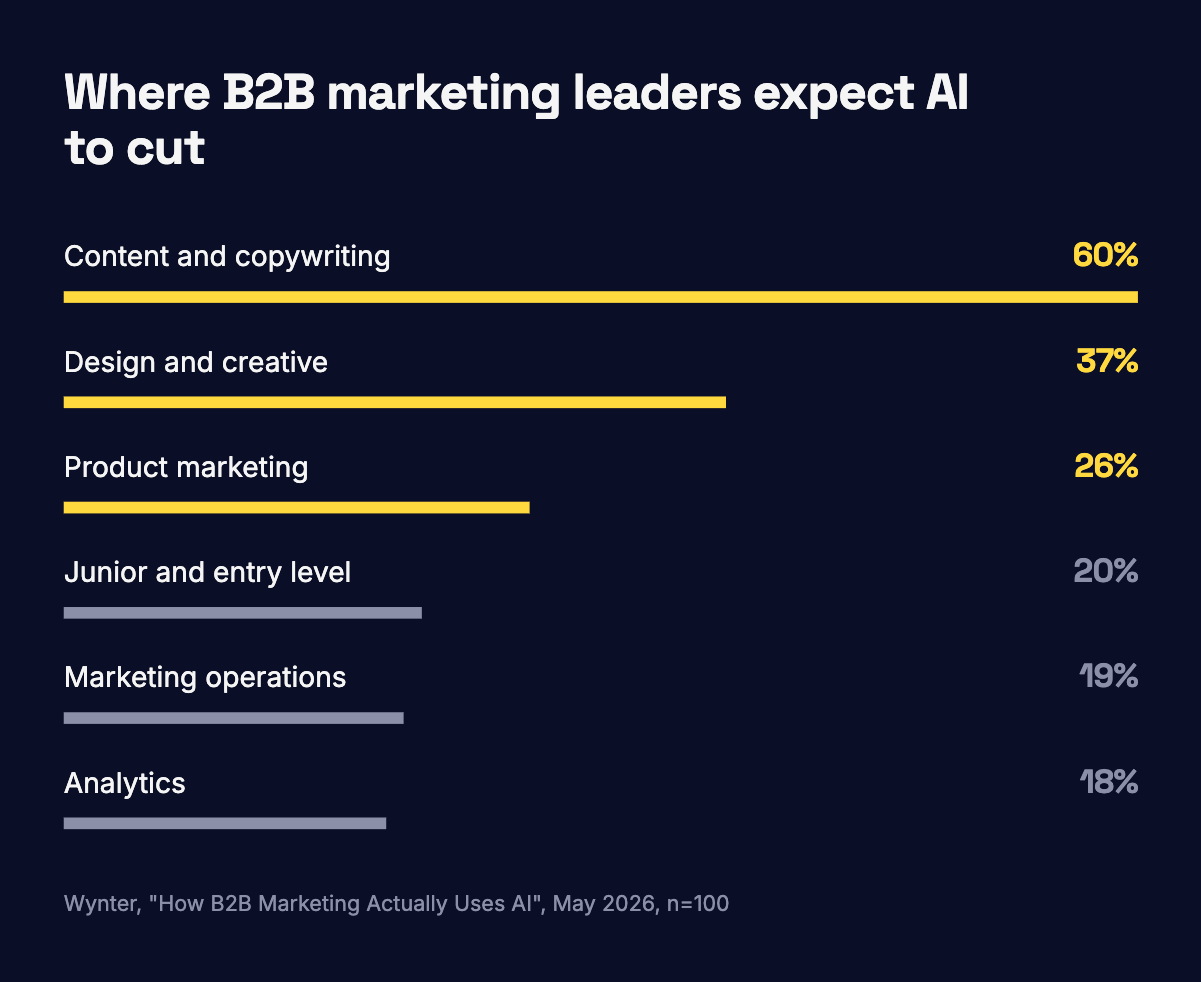
Which functions were affected? Content and copywriting led at 60%, then design and creative at 37%, product marketing at 26%, junior and entry-level roles at 20%, marketing operations at 19%, analytics at 18%. Several respodents described senior marketers using AI to do work that used to take multiple junior people or agencies.
This is the crux. The work did not disappear. It just got upward delegated. A senior marketer now does their own job plus the execution that used to sit with the layer beneath them.
Everyone was watching the wrong role
If you have followed this story at all, you have heard it as a sales development story. The Sales Development Representative (SDR) is dead, AI does prospecting now, the Business Development Representative (BDR) job is over.
That story is real, and it is mostly about 2025. Emergence Capital surveyed 560+ venture-backed B2B software companies in April 2025 and found 36% had decreased SDR/BDR headcount over the previous year, the highest reduction of any sales role, with only 19% increasing. But 44% kept their teams exactly the same size, which is not what an extinction event looks like.
Move forward twelve months and the picture flips. ICONIQ’s 2026 data on 150+ B2B software GTM leaders finds hiring concentrated in Sales and Post-Sales, growing roughly 10-20% depending on company scale, while Marketing and RevOps expand more slowly and in some cases stay flat, because leaders are betting on AI tooling, process and agency support before headcount.
Sales is still hiring. Marketing is not. And on the SDR question specifically, ICONIQ does not claim to know the answer. They frame it as open: if a BDR becomes 5x more productive, do you hire fewer of them, or expand the role and hire more?
So the role everyone was watching is still an open question, and the role nobody was watching is getting erased.
The part that bothers me
Every one of these decisions rests on a premise: that AI is delivering enough leverage to justify the smaller team. It is worth asking whether that premise is proven.
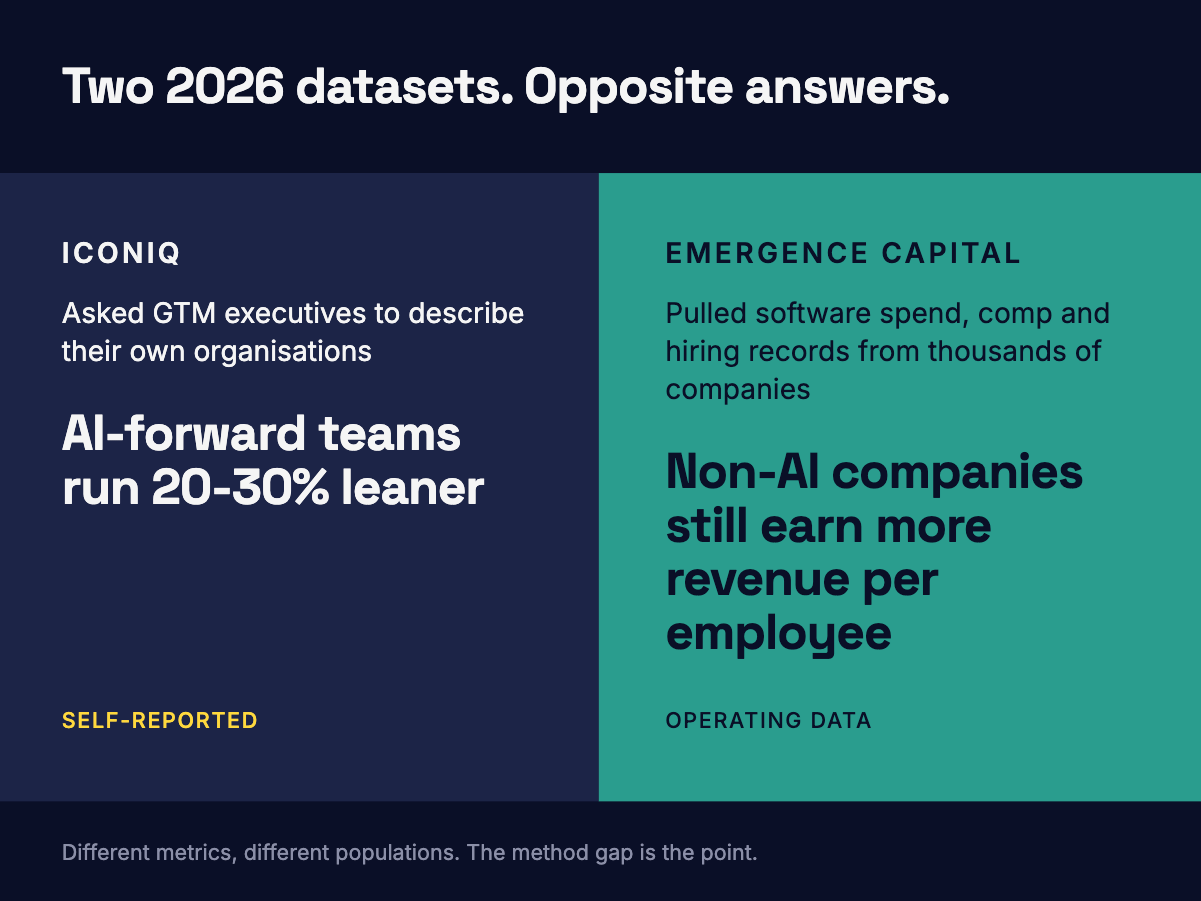
ICONIQ says yes, emphatically. The most AI-forward, high-performing companies run GTM teams 20-30% leaner than their peers, and high adopters generate roughly 2x net new ARR per GTM FTE, $640K against $370K.
Emergence Capital published Beyond Benchmarks 2026 in late June and reached a different conclusion. Their headline: AI is not yet delivering the efficiency gains most expected, and across every segment, non-AI companies still generate more revenue per employee. AI remains an investment story more than a productivity one.
Two credible firms. Both published within about a month. Pointing opposite directions.
My conscience requires me to say these are not measuring the same thing, and anyone telling you this is a clean contradiction is either wrong or selling something. ICONIQ measures net new ARR per GTM head, sorted by how much AI a company has adopted. Emergence measures revenue per employee across the whole business, comparing AI-native companies against everyone else. Different metric, different population.
But look at how each one was built. ICONIQ asked GTM executives to describe their own organisations. Emergence went to Carta, Ashby, Pave, Stackpack and Standard Metrics for proprietary data across thousands of operating companies, and were explicit that this was not survey data and not sentiment, but actual software spend, actual comp decisions, actual hiring outcomes.
One dataset is what leaders say is happening. The other is what their hiring systems recorded. When those two disagree, I know which one I trust more.
Both firms are venture investors with money in the outcome, which is worth calling out loud. ICONIQ’s own disclaimer notes that no information on conflicts of interest is contained in the report, and that those conflicts may be significant. Emergense has the same exposure in the other direction. I am not accusing either of painting an incorrect picture, I am highlighting the footnotes of these reports.
One more thing that cuts against my own argument, because leaving it out would be dishonest: the analyst behind the Standard Metrics data has pointed out that revenue per employee is growing faster at AI companies than at non-AI ones. If that holds, the gap closes and then flips. The efficiency case might simply be early rather than wrong.
What I actually think
I do not think anyone knows yet whether the lean GTM org works. That is an unsatisfying thing to publish but it is where the evidence lands.
What I am confident about is narrower. The org charts are already being redrawn as though AI has proven to be efficient. Roles are going unfilled on the back of a productivity claim that the hardest available data does not yet support. And because it is happening through attrition rather than layoffs, there is no moment where anyone has to share a justification.
If a company decides its marketing team should be 30% smaller, that is a strategy, and strategies can be argued with. If a company arrives at a 30% smaller marketing team through eighteen months of not replacing people, that is not a strategy. It is a drift that only becomes visible when something breaks.
So the question worth asking in your next planning cycle is not whether to cut. It is whether anyone can actually prove that AI is efficient enough to justify the cut.
Go and count. Not headcount against budget, but the work. Every job that used to belong to someone who left, and where it sits now. My guess is that most of it landed on whoever was closest and senior enough not to complain, and that nobody has looked at that list in one place.
Next Monday: you got shortlisted by ChatGPT and still lost the deal. What happens after the citation.
If you want that one when it lands, subscribe below. It is free.