

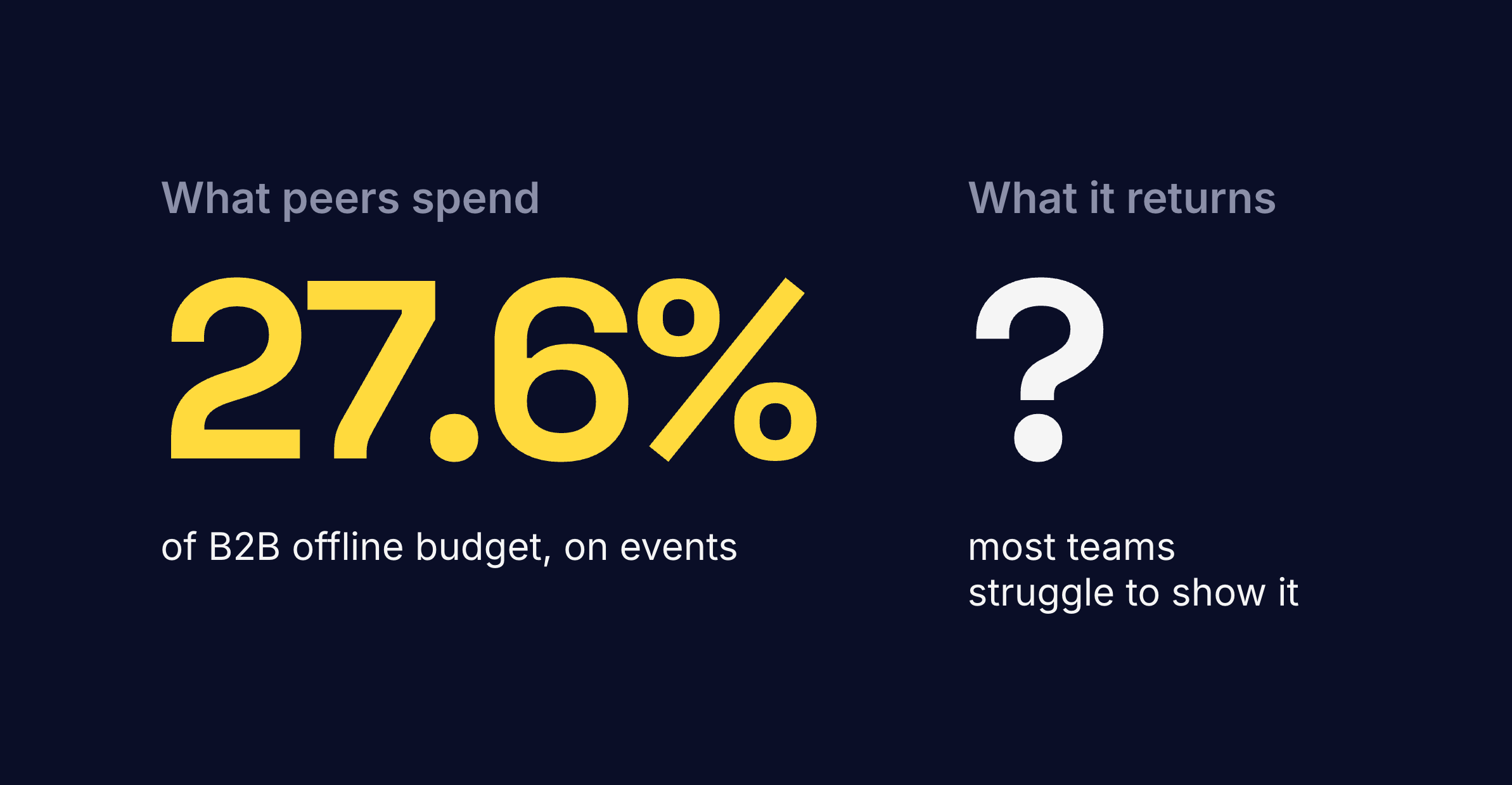
In September, when I went through the 2027 budget benchmarks, B2B CMOs were putting 27.6% of their offline budget into events. I called it the number to defend your events line with.
It does that job. It tells your CFO what everyone else is spending. What it can’t tell anyone is what the money comes back as, and that’s usually the next question in the room.
The line is also under more pressure than 27.6% makes it look. Across all 401 CMOs in Gartner’s 2026 survey, B2B and consumer together, events took the biggest share of offline budgets: 23.1%, up from 19.4% a year earlier. And when the same CMOs listed the channels they planned to cut, events came second, right after sponsorships.
So the biggest offline line is also near the top of the cut list. Before yours gets defended or cut, it’s worth knowing what the evidence behind it actually looks like. I went and checked.
What the people running events admit
Every year, Forrester asks B2B event teams how it’s going. The 2026 round went to 417 marketing and events leaders at companies around the world, just over half of them in North America. Three of their answers are worth reading together.
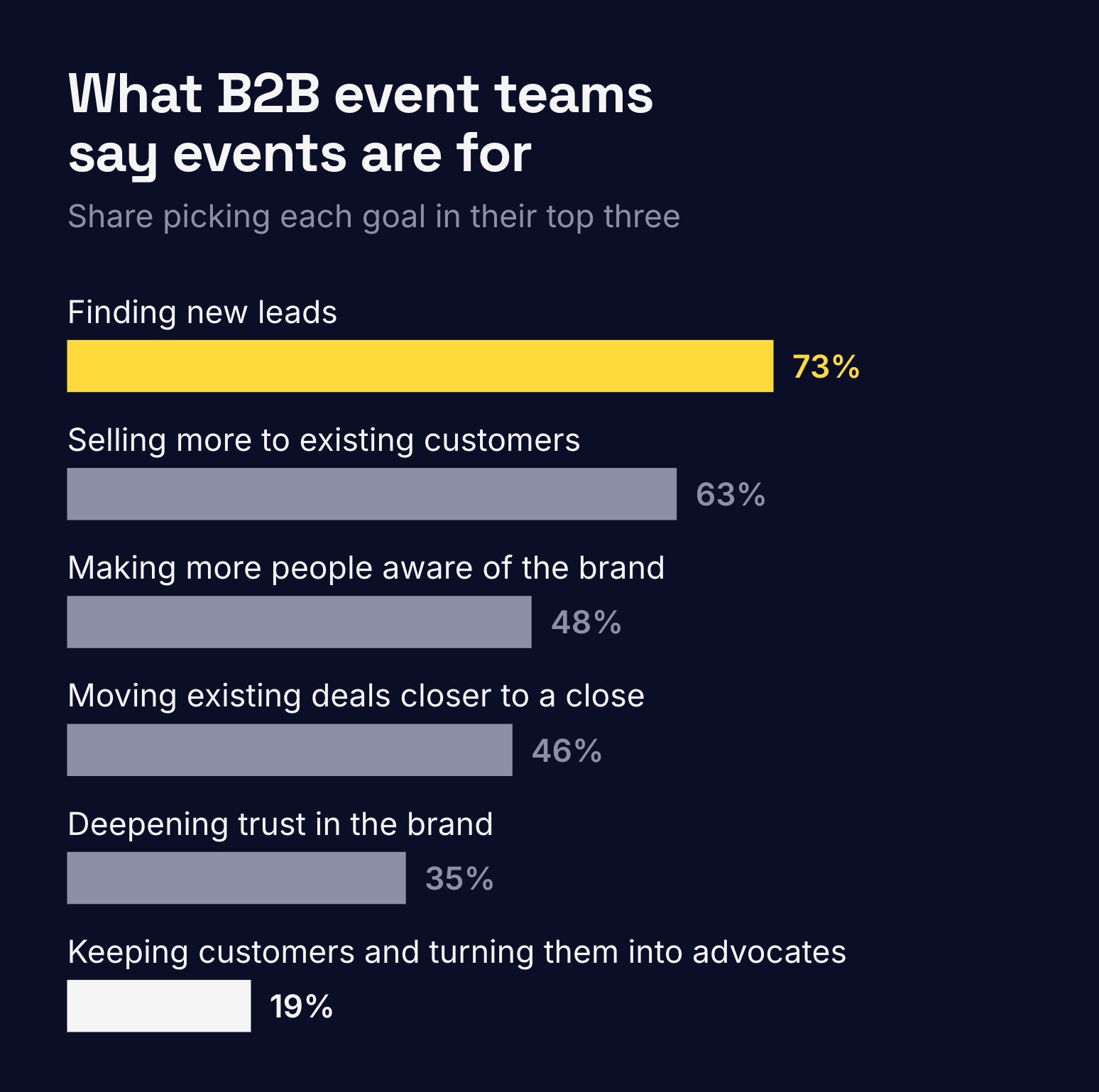
The first is what events are for. Asked to pick three goals, 73% chose finding new leads and 63% chose selling more to existing customers. Keeping customers engaged and turning them into advocates came last, at 19%.
The second is how they’re measured. 44% said they measure impact. The rest are split: 30% track plenty of numbers but struggle to show it, 21% count activity, meaning attendees and booth scans, and 4% don’t measure at all. Forrester’s own summary is that most organisations struggle to show event impact.
The third is who’s convinced. Around half of event teams say their events are working. CMOs are less sure. Forrester’s analyst put the share of CMOs who agree at 38% in June and at a third in September. Whichever number you take, it’s a minority, and it’s the person who signs next year’s budget.
You probably know how the week after a show goes. The scans land in the CRM on Monday. Sales calls the handful that look hot, the rest go into an email sequence, and by the quarterly review the event is being credited with pipeline nobody can separate from deals that were coming anyway. It’s the same trap as counting webinar attendees as leads, just with better catering.
Who writes the ROI numbers
Most of the event ROI figures you’ll come across in planning season are published by people who sell events. Nobody’s hiding that. They have the data, and they have a reason to share it.
SaaStr’s pitch to its own sponsors this year took registrations running at 142.9% of the previous year and turned them into “+42% more leads”, with more badge scans and more pipeline to follow. And back in 2016, Freeman, an events company, bought the research firm Exhibit Surveys, saying it would help clients “prove out the immense value” of what it calls brand experiences.
None of that makes their numbers wrong. They’re just answering a different question from yours. An organiser needs you to book again next year. You need to know whether the sales that followed would have happened anyway.
So I put those numbers aside and went looking for studies that compared what happened with an event against what happened without one.
The two studies that actually checked
There are two, and neither is new.
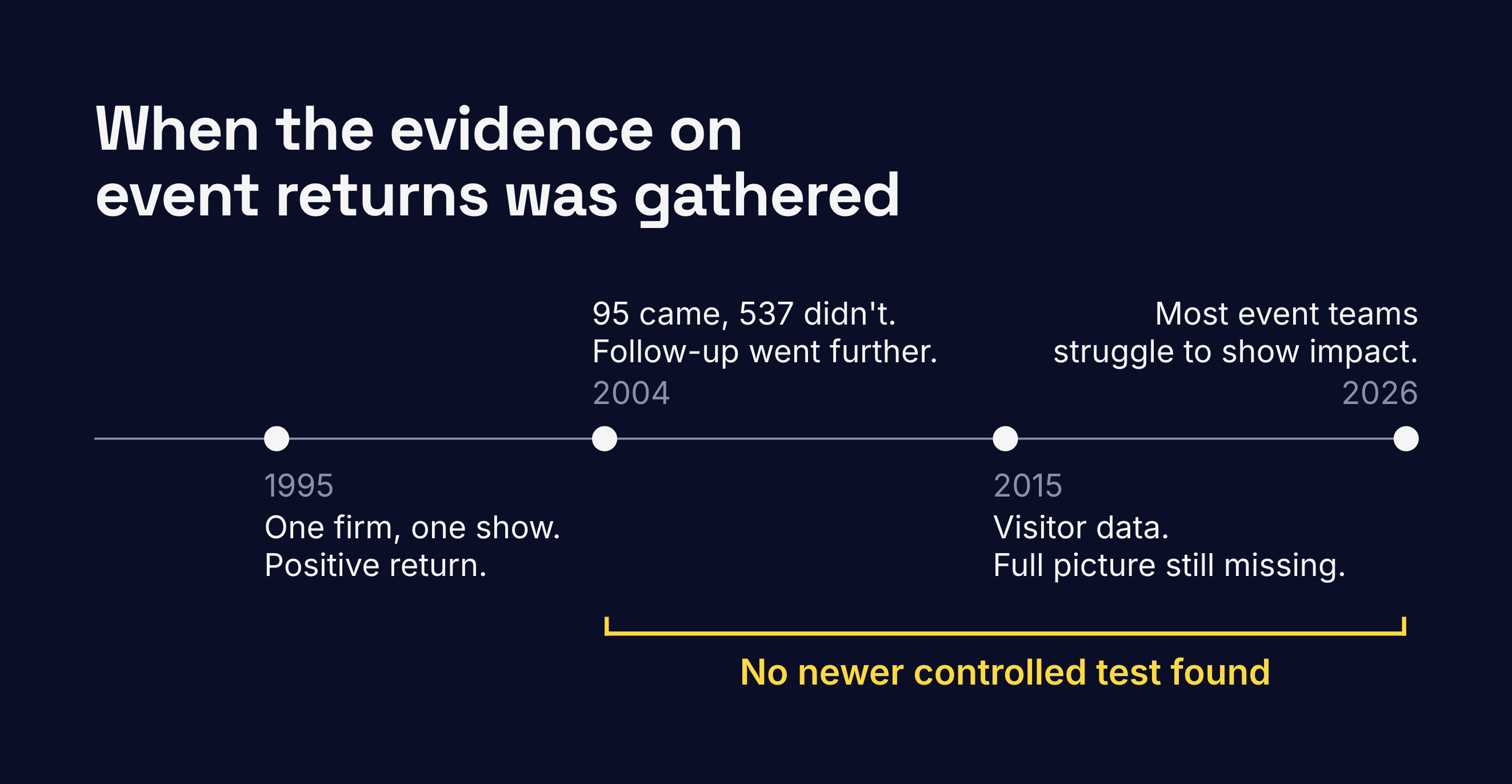
The first was published in the Journal of Marketing in 1995. It followed one lab equipment maker, Restek, at a single trade show where it launched two products, and tracked the sales that came in until the end of August 1993. The show made a positive return. The authors are careful about how far that goes, though: one firm, one show.
It was also supported by the Trade Show Bureau, the exhibition industry’s own research body at the time, and one of the four authors worked at a firm that did research for the events industry. That doesn’t make it wrong. It’s just worth knowing when you weigh it.
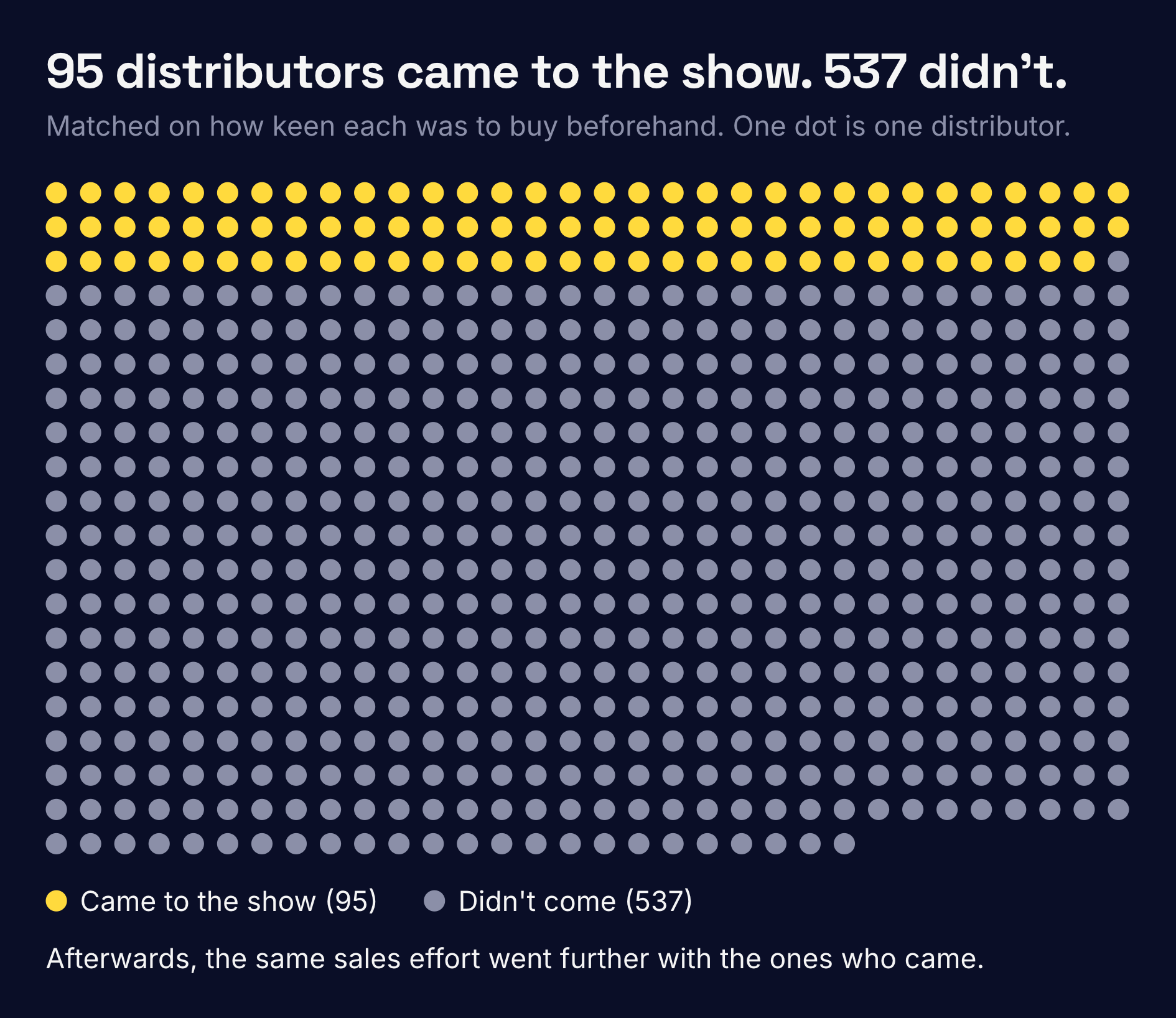
The second is the one I’d put in front of a CFO. Published in 2004, it looked at a machinery maker, Delta Machinery, and its distributors. Of those, 95 came to a trade show and 537 didn’t. The researchers matched the two groups on how keen they were to buy before the show, so the comparison was fair. Then they watched what happened when the sales team followed up.
Following up with the distributors who’d seen the product at the show was more productive: the same sales effort went further. Profit was higher when the show was paired with the right amount of follow-up, and the study suggests sales to the distributors who came were more profitable.
That’s the whole finding, and it’s more useful to me than any ROI figure on a vendor’s slide. The value turned up after the event, in how well the follow-up worked. The scan count never came into it.
I looked for a newer study like this and couldn’t find one. The newest related work I found, from 2015, used visitor data from several shows attended by one Fortune 500 company, and its authors said up front that a full picture of how trade shows turn into leads and sales was still missing. So as far as I can tell, the most recent study that compared an event against a group that didn’t go is 22 years old.
My honest reading: events probably do pay back, roughly the way those studies found. Almost nobody measures them that way, though. The number most teams carry into the budget meeting is one those studies never even used.
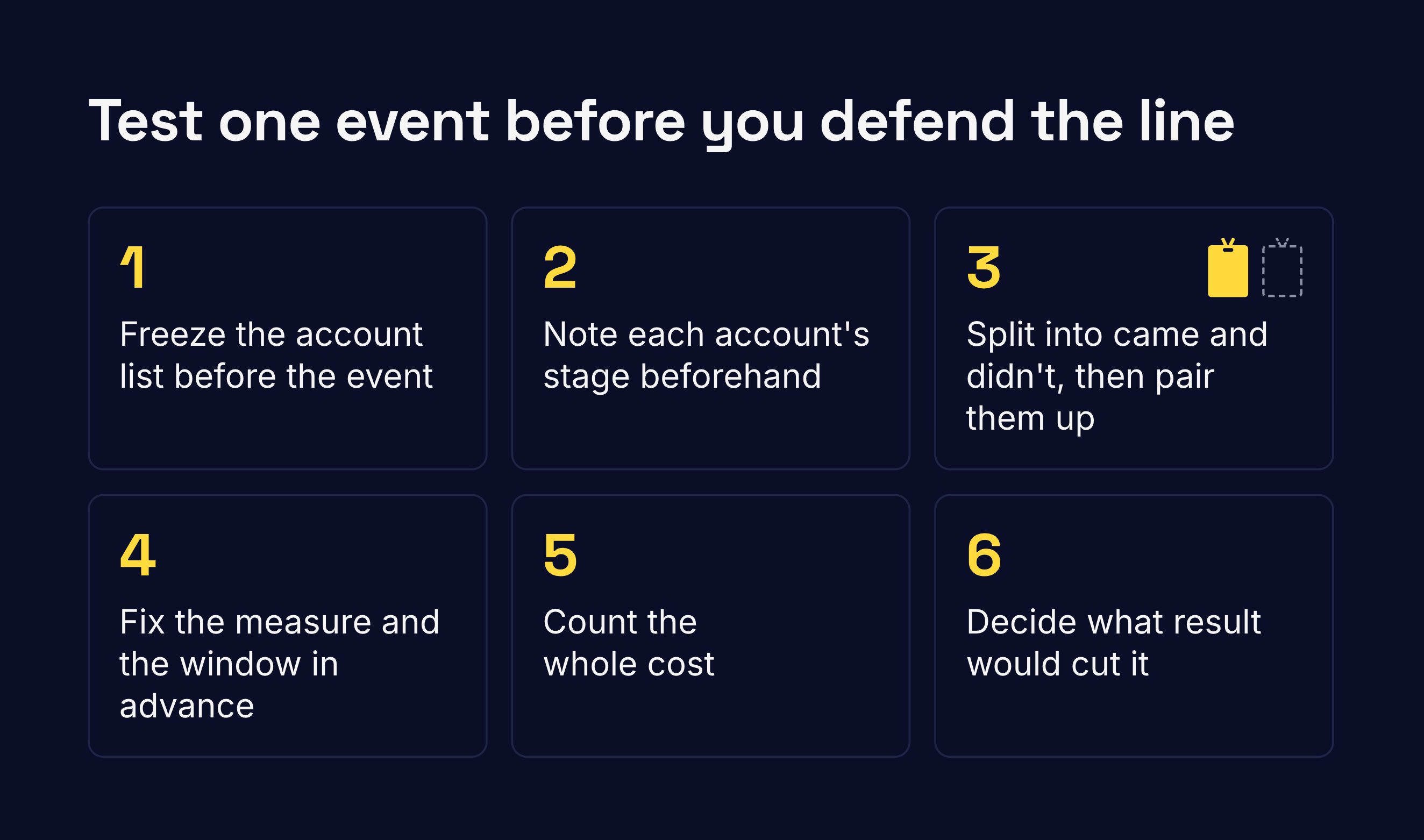
Test one event before you defend the line
You don’t need to test your whole calendar. Pick one event in the first half of 2027 that costs enough to matter, and set it up the way the 2004 study was set up.
Write the account list before the event. Every account you want in the room, invited or targeted, fixed before anyone registers. That list is your whole experiment.
Note where each account stands beforehand. Open deal or not, which stage, when you last met. The 2004 study matched distributors on how keen they were before the show, and your CRM stage is the closest thing you have to that.
After the event, split the list in two. The accounts that came and actually spoke to your team go in one group. The ones that were on the list and didn’t come go in the other. Then pair them up, stage for stage and size for size.
Pick your measure and your time window before the event, not after. How many meetings each deal needed, win rate, deal size and days to close, over six months, is a sensible start. What you’re checking is simple: did the follow-up go better with the accounts that came?
Count the whole cost. Booth, travel, the staff days nobody invoices, the dinner. The 1995 study weighed the costs against the extra profit from the sales that followed, and that’s the only kind of ROI a finance team will sign off.
Decide in advance what result would make you cut it. If nobody can name that number, the test is just decoration.
Forrester’s advice to event teams is to connect their event platform to the CRM, and teams that have done it report being more satisfied, 62% against 37%. Do it, because it makes steps 2 to 4 much easier. But being satisfied isn’t the same as getting a return, and a connected platform doesn’t compare anyone with anyone.
What the test won’t tell you
It won’t catch everything. A small event means small groups, and small groups give noisy answers, so treat one result as a signal rather than a verdict. It won’t see brand effects that take years to show up. And the accounts that chose to come were probably keener to start with, which is exactly why step 2 matters. Skip the pairing and the event gets the credit for interest that was already there.
It will still tell you more than the scan count ever has.
Tell me in the comments: the last time a big event was reviewed, was it compared with the accounts that didn’t come, or only with its own badge scans?
Gartner’s figures come from its 2026 CMO Spend Survey as reported by Chief Marketer on 24 June 2026. Forrester’s come from its Q1 2026 State Of B2B Events Survey, from posts on its blog on 25 June and 11 September 2026 and from its findings deck, distributed by fielddrive. The two field studies were published in 1995 and 2004. Every figure above was checked on 28 September 2026.
Monday GTM is a weekly read on how B2B go-to-market actually works, for the people doing the work. No theory, no fluff. Just what holds up when you look closely.
I write Monday GTM alongside my work at Loop & Ladder, a growth consultancy.