

I run a marketing consultancy and a lot of my clients are plagued by the same conundrum - AI has made software cheap and easy enough to build that their customers will stop buying it from them. Every category that has a workflow in it will be replaced by something a competent team creates in an afternoon.
These are serious problems to have and I wanted to placate my clients. More importantly, I wanted to know if it was true, so last week I went looking for who is actually saying it.
The number you see everywhere
The figure doing most of the work in this argument is that 35% of enterprises have already replaced a SaaS tool with custom software. It is everywhere. I found it repeated in 9 of the first 10 results I opened.
It comes from a report published in February by Retool, and Retool’s own page is straightforward about where it came from: a survey of 817 Retool customers and builders. People who had already bought a platform for building internal software were asked whether they build internal software.
That is not a scandal. It is a perfectly normal customer survey and the company disclosed the sample plainly. The problem is what happened to it afterwards. Most of the pages repeating the number had quietly changed “35% of teams” into “35% of enterprises”, and almost none of them mentioned who was surveyed. A number about one company’s customers became a number about the economy in about a fortnight.
I have written before about how two benchmark numbers can look like a disagreement when they are really just two different sets of companies, so I will not do that again here. But the pattern is the same, and it is worth noticing that the most-cited datapoint behind “AI is killing SaaS” is a vendor’s customer list.
The companies that actually did it
So I went looking for real cases, and there are real cases.
Palantir told investors in May that it had replaced what it called its old expensive CRM with an AI-first system built on its own platform, in a few months, and that the people using it loved it. GoDaddy said it was testing the replacement of smaller third-party SaaS tools with internally built solutions, particularly across corporate functions. C.H. Robinson said it was scaling its own custom-built AI agents instead of stitching third-party products together.
These are not hypotheticals. Somebody’s renewal died inside each of them.
Now look at who these companies are. Palantir and GoDaddy sell software. C.H. Robinson mentioned its 450 in-house engineers and data scientists in the same breath, and said outright that this is what lets it move faster than a buy-and-integrate model.
These are not customers who found a clever tool. They are engineering organisations with the capacity to build, insourcing work they were always capable of insourcing, and doing it faster than before. That is a change in speed. It is not evidence that your mid-market accounts are about to do the same thing.
The place I expected to find the panic
If software companies genuinely believed their customers were about to build the product themselves, there is one place they would have to say so.
Public companies file a 10-K every year, and in it they list the things that could damage the business. That section is written by lawyers, reviewed by auditors, and read by people who sue. Companies put uncomfortable things in it precisely because failing to disclose a known risk is worse than disclosing it. If the ground were shifting, this is where it would show up first, in cautious language, before anyone said it out loud on a stage.
The SEC publishes a full-text search over all of it, free. So I counted.
Every number below is the count of filings containing that exact phrase, form type 10-K, filed between 1 January and 31 August of the year in question. I held the window identical across all seven years so that a partial 2026 is measured against the same partial window everywhere else. Set those dates yourself and you will get these figures back.
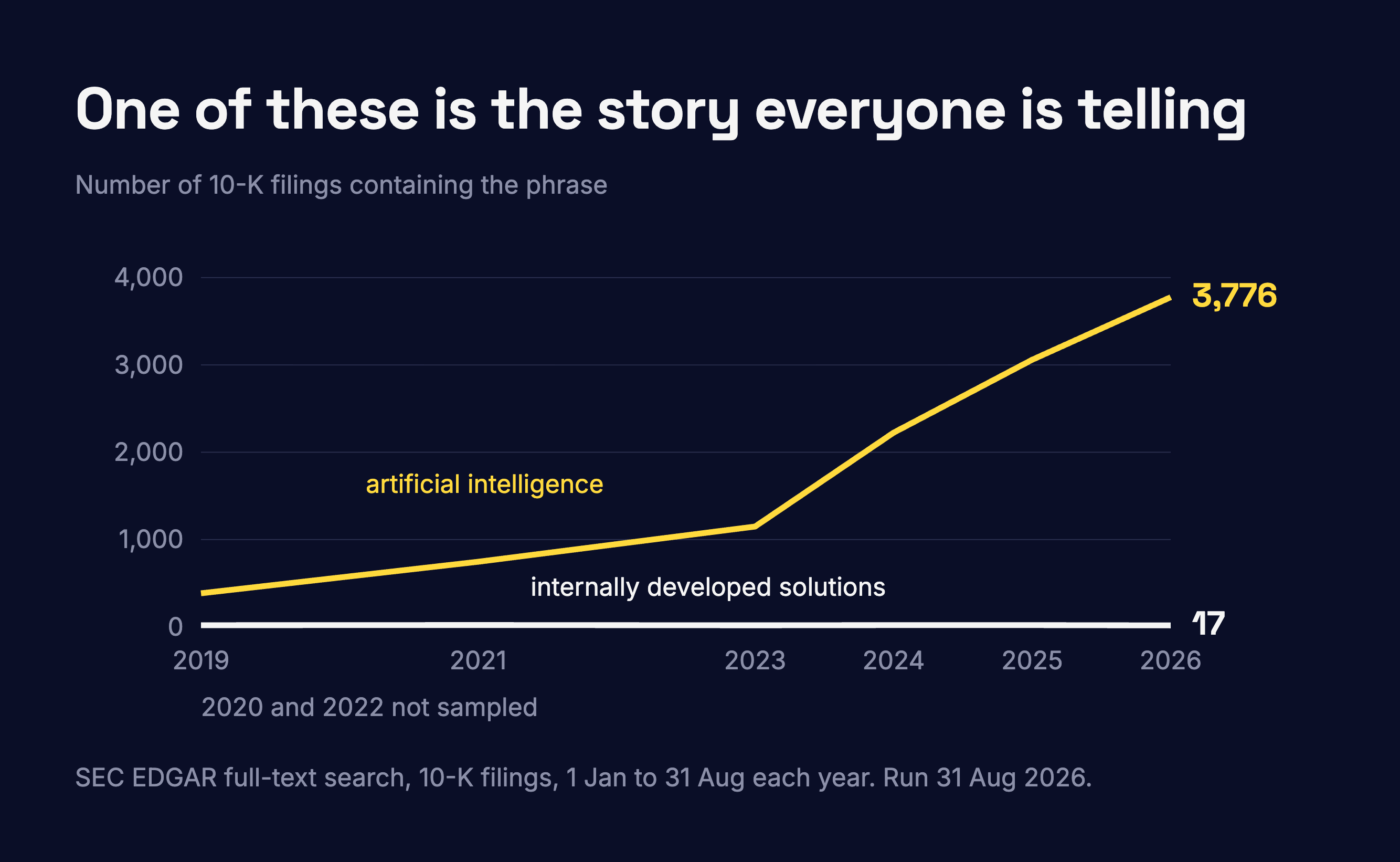
Mentions of “artificial intelligence” in 10-K filings went from 384 in 2019 to 3,776 in 2026. “Generative artificial intelligence” went from appearing in nothing at all to 603 filings. Software companies are clearly not quiet about AI.
Then I counted the other thing. “Customers may choose to develop” ran 18 filings in 2019, 20 in 2023, 16 in 2025 and 22 in 2026. “Internally developed solutions” went 19, 21, 18, 20, 20, 17. “Internally develop” peaked in 2023 and has come down since. “Develop their own solutions” peaked in 2024 at 37 and has fallen to 26. “Build rather than buy” appears zero times, in every year I checked.
The pool those come from is stable. Roughly 6,000 10-K filings mention software each year and that number has barely moved since 2019, so this is not an artefact of more companies filing.
Seven years. A tenfold rise in how much these companies talk about AI. And no change at all in how many of them warn investors that customers might build the product instead.
The part where I nearly got this wrong
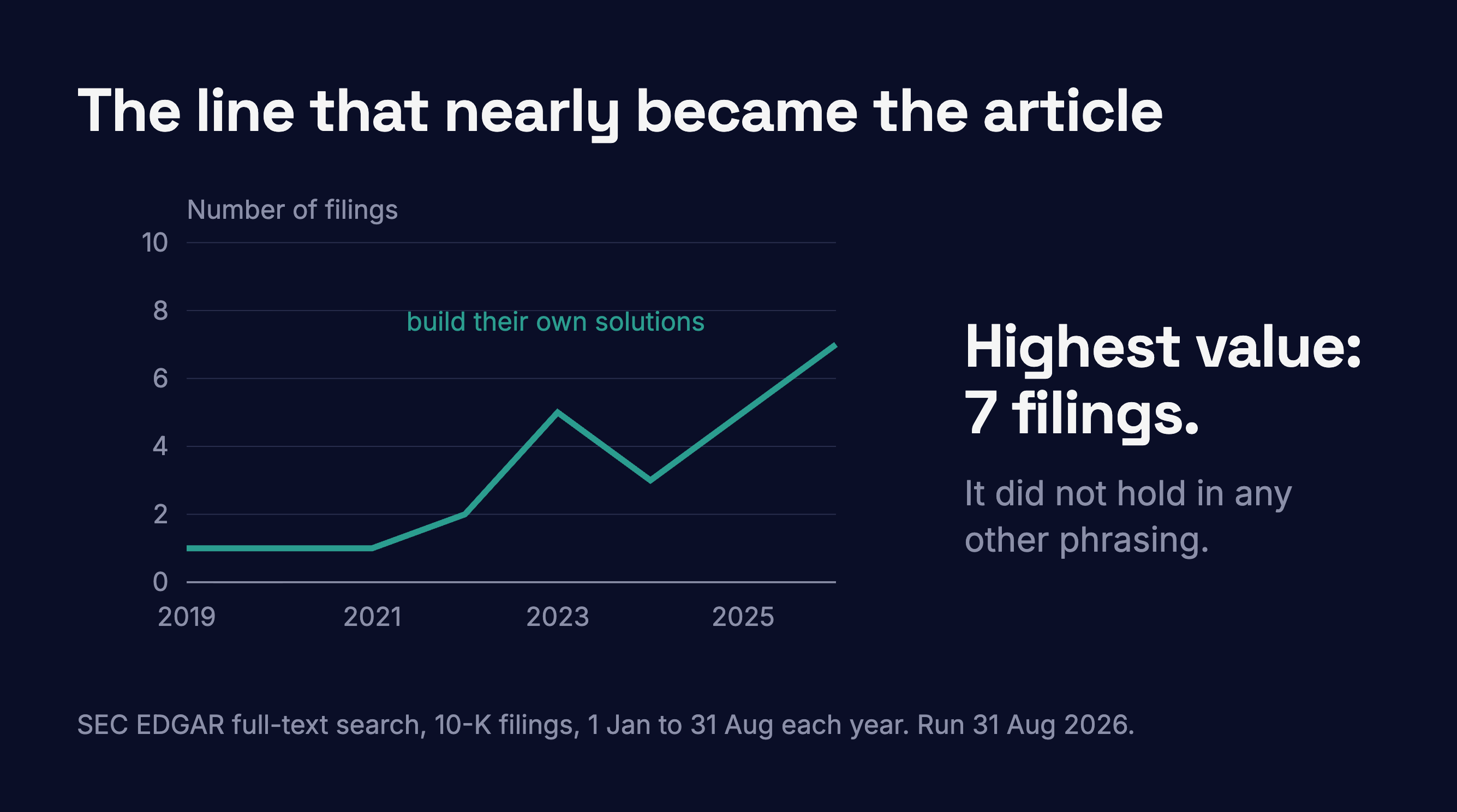
The first phrase I searched was “build their own solutions”. It went 1, 1, 1, 2, 5, 3, 5, 7 across those same years. A rising line, in the right direction, sitting exactly where I wanted it to sit.
If I had stopped there I would have written the opposite article, and it would have been more fun to read. Vendors are quietly warning investors about the thing they will not say publicly. It is a good piece. It is also wrong, because that line moves from one filing to seven, and one filing is a rounding error, and it did not hold in a single other phrasing I tried afterwards.
I am telling you this because it is the whole method. A number moving is not a finding until you have checked whether it moves anywhere else. You can rerun all of this yourself in a browser in about ten minutes, and I would rather you did than take my word for it.
What the market did while everyone was declaring it dead
Gartner has the enterprise application software market growing 13.7% this year, reaching $740 billion by 2029, and its most recent forecast has that growth continuing in double digits into 2030.
One honest caveat, because it cuts against me slightly. A good part of that growth is enterprises buying AI capability inside their applications, which is not the same as the old categories holding steady. Some of that money is going somewhere new. But it is still going out of the door and into someone’s software, and it is not being redirected into internal builds at anything like the scale the narrative suggests.
So what is actually happening to you
Here is what I think is going on, and it is worse than the version where you can dismiss the whole thing.
Your customers mostly cannot build it. What has changed is that they now believe they could.
That belief does not need to be correct to cost you money. It shows up as a procurement team asking what your product does that an internal team could not do in a quarter, and it shows up in the renewal as a number rather than an argument: a discount, a shorter term, a seat count trimmed at the edges, a two-year deal that becomes a one-year deal.
And none of it is visible to you, because you do not lose those deals. You keep them, slightly worse. There is no closed-lost reason code for a customer who decided you were replaceable and negotiated accordingly. The strongest version of the threat is the one that never produces an event your CRM can record.
This is the same shape as something I have argued here before. When a deal you thought you had won goes quiet inside the buyer’s own review process, the loss is real and it is invisible in the pipeline. This is that, moved one stage later and made permanent.
What to do about it, given that it is a belief and not a build

Beliefs are answered with evidence, and you are almost certainly not carrying the right evidence.
The first thing is to stop selling against a competitor and start selling against the internal build, because it is now in most competitive sets whether or not you have put it there. That means knowing, specifically and per account, what the thing costs to maintain rather than to make. The build is not the expensive part and never was. It is the second year of it: the integrations someone has to keep alive, the compliance surface, the person who leaves.
The second thing is to work out which of your accounts can genuinely do this. It is not many, and it is knowable. Engineering headcount is a real signal and you can see it from outside. So is whether the thing you sell sits in a corporate function, where a rough internal version is tolerable, or in the revenue-critical core, where it is not. Palantir replacing its own CRM is the uncomfortable case, because that is nobody’s admin tool. But Palantir also employs the people who built it.
The third is a measurement problem more than a marketing one. If the cost shows up in renewal terms rather than lost deals, then someone has to be watching term lengths and discount depth as a competitive signal instead of a finance one. I do not think most GTM teams have anyone doing that, and it is a cheaper thing to start than a repositioning.
What I would not do is build the ROI calculator. Everyone reaches for that here, and a spreadsheet that proves your product is cheaper than a build is a spreadsheet your buyer knows you commissioned.
The annoying part about this whole ordeal is that the narrative, albeit overstated, is still going to show up on your quarterly reports. Put the internal build into your competitive set and sell against it properly, and the belief stops quietly costing you money.
So here is what I actually want to know. The last time a renewal came back worse than you expected, did anyone write down that the customer thought they could build it themselves? Or did it go into the system as pricing pressure and get forgotten? Tell me in the comments, because I suspect almost nobody is recording it.
If this was useful, subscribe. It is free, it lands every Monday, and that is the whole ask.
Filing counts were run on 31 August 2026, using the search parameters set out above. All other sources were checked on 7 September 2026.
Monday GTM is a weekly read on how B2B go-to-market actually works, for the people doing the work. No theory, no fluff. Just what holds up when you look closely.