

When a software company files to go public, the coverage writes itself. Someone runs the valuation. Someone counts the retention. Someone always finds the dividend the sponsor paid themselves on the way out, and that one gets the most attention because it is the most fun to write about.
All of that happened to Entrata in June. It filed to list on the NYSE, it is a 23-year-old property management software company out of Lehi, Utah, and Silver Lake owns most of it. The breakdowns were good. Jason Lemkin’s is the one most people in B2B will have read, and it is worth your time.
It runs about 4,000 words and never once mentions the sales and marketing line. Neither did anything else I read.
Quite evidently, i want to talk about the sales and marketing line.
The number nobody quoted to you
Here it is, straight off the income statement. You can check every figure yourself, because it is an audited document sitting on EDGAR for free.
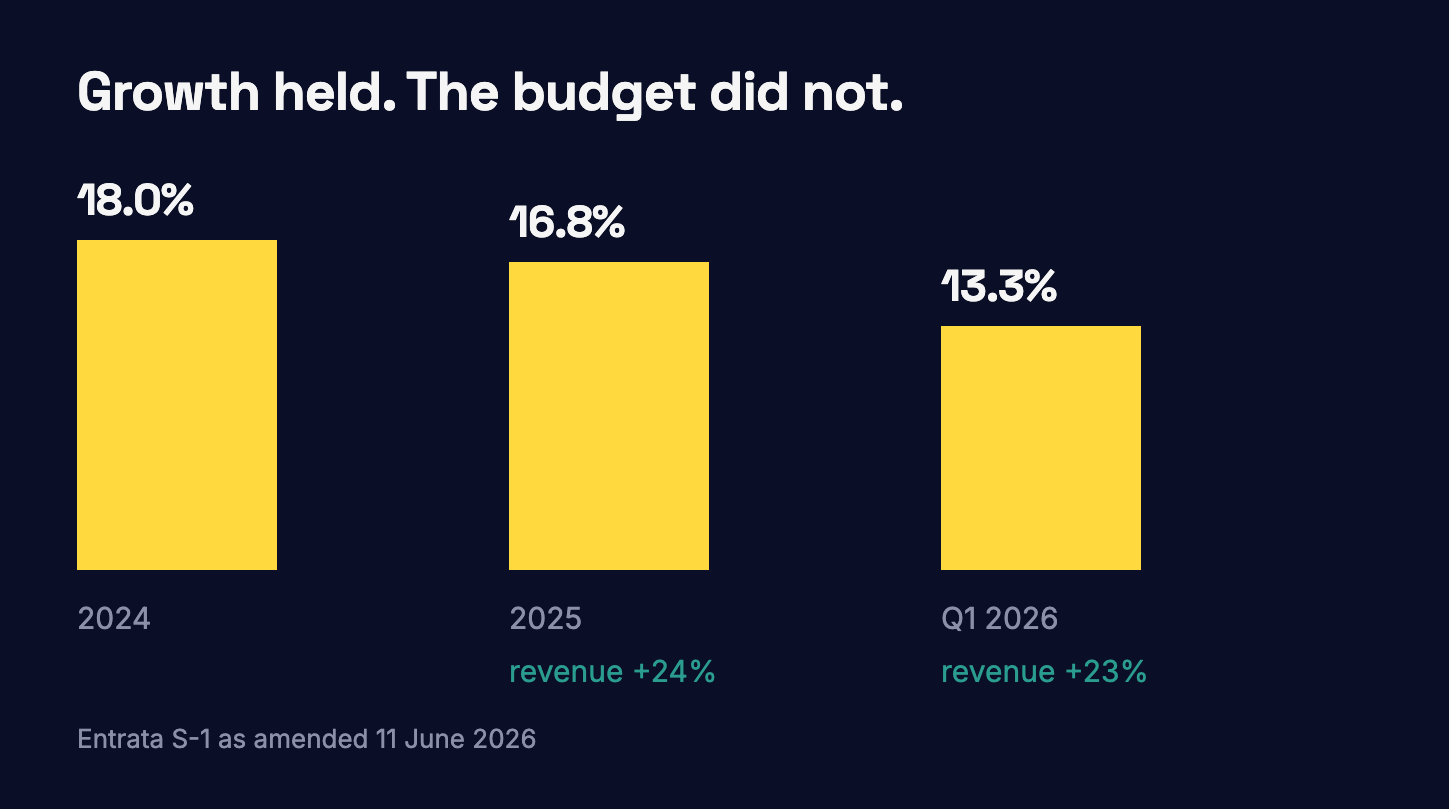
In 2024, Entrata spent 74 million dollars on sales and marketing against 412 million dollars of revenue. That is 18%.
In 2025, it spent 85.7 million against 509.3 million. That is 16.8%, in a year revenue grew 24%.
In the first quarter of 2026, it spent 19.1 million against 143.5 million. That is 13.3%.
Revenue in the quarter grew 23% year on year. Sales and marketing spend grew 5.6%.
Read those numbers again, because it is the whole gist of this piece. Revenue up 23%. The budget that is supposed to produce revenue, up 5.6%.
I have sat in planning rooms where the model ran the exact opposite way, and i suspect you have too. You want 25% revenue uptake next year, you work back from the pipeline you need, divide by your conversion rates, and arrive at a number for media and headcount that climbs faster than the revenue target does. That is the usual path. Growth costs money, and it needs that money in advance.
Entrata is running the other way, and it did not get there by cutting costs. It got there by building a revenue base that mostly does not need an acquisition event.
How they built it
Before i talk about the mechanisms, let me tell you what makes them absolutely necessary.
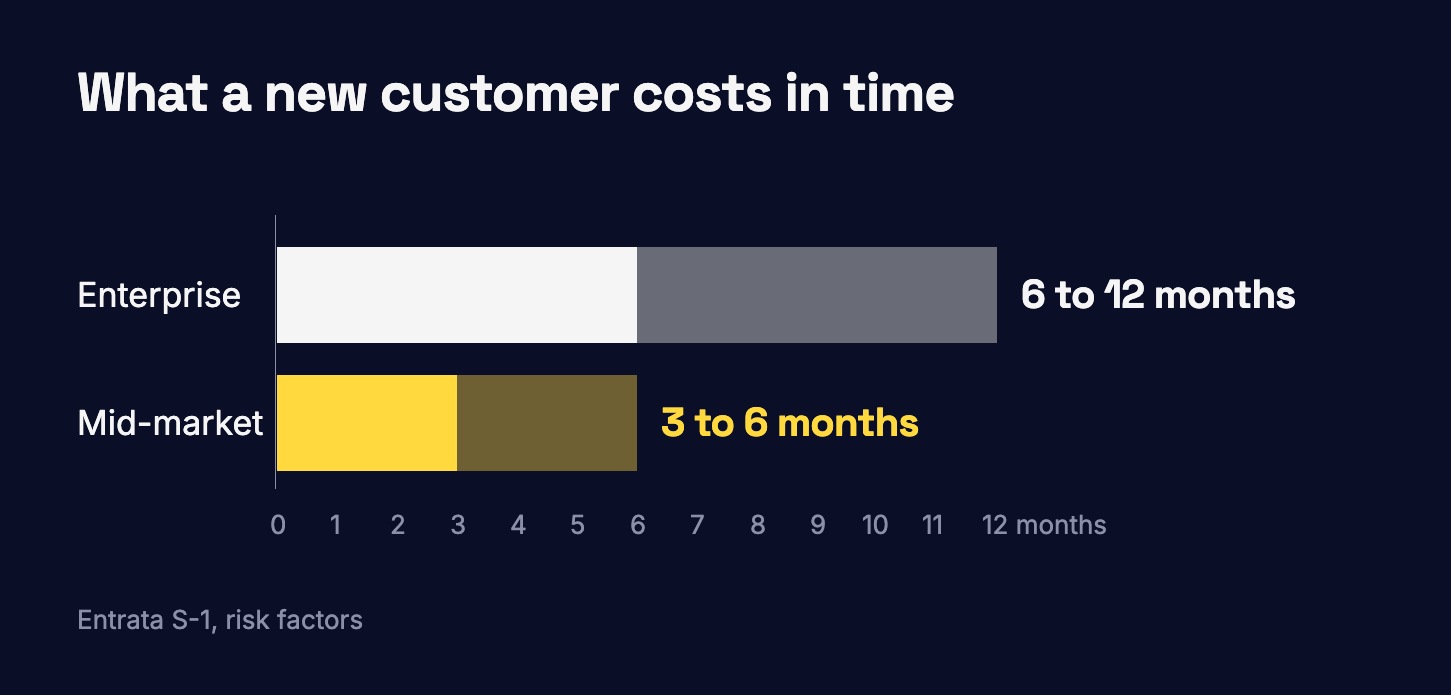
Entrata discloses its sales cycles in the risk factors. Six to twelve months for enterprise customers, three to six for mid-market. It describes high costs and unpredictability, and says it is often required to spend significant time and resources educating operators whose existing systems are deeply embedded in how they work.
Which means the falling sales and marketing line is not a company that got good at acquisition. It is a company that knows exactly what the cost of acquisition is and structured itself to need less of it.
Now the three mechanisms, and not one of them is a marketing tactic.
They chose customers whose portfolios grow on their own. The filing’s industry section carries the two numbers that matter. New multifamily construction added roughly 2 to 3% a year to the total US unit base across 2023 and 2024. Over a longer window, the top 50 operators on the National Multifamily Housing Council’s list grew the units they manage by 48% since 2020, an 8% compound rate. The market barely grew. The big operators grew a lot, by taking units off smaller ones.
Entrata sells to those operators. 233 of its customers were above 500,000 dollars of annualised recurring revenue at the end of 2025, up from 183 a year earlier, and those customers were 84% of total ARR. When one of them buys a portfolio, the units land on a platform they already run, under a contract that already exists. Nobody had to sell anything.
They made the money arrive with the rent. Every customer on the Operating System is contractually required to use Entrata’s payment solution for payments processed through it. The filing states this twice, once in the glossary and again in the risk factors. Contracts generally run three to five years. So the revenue is not waiting on a renewal conversation or an upsell meeting. It arrives monthly, when residents pay rent, whether or not anyone at Entrata did anything that month.
And it counts. The glossary defines annualised recurring revenue to include those payment processing fees, on the basis that rent reoccurs by nature, and it is careful to exclude the usage fees it judges episodic. Subscription revenue goes up when somebody sells something. This goes up when a customer wins a portfolio.
The fee is also flat per transaction, with credit cards the only exception, so it tracks the number of payments rather than their size. The filing reports rents down 1.1% year on year and 5.2% off their 2022 peak, and almost none of that reaches this line. Vacancy would, and vacancy is the risk the filing actually names.
They split the motion and said so out loud. The company describes a scaled inside-sales team covering mid-market operators, with dedicated teams on the large enterprise ones, and says the point of the split is keeping customer acquisition costs disciplined. It also says expansion inside existing relationships happens at near-zero incremental acquisition cost. That is not marketing language. It is a company telling its future shareholders precisely which revenue it pays to get and which revenue it does not.
I argued a few weeks ago that expansion revenue was never something your GTM team built, that top-quartile retention was mostly your customers hiring people and your contracts raising prices on schedule. Entrata is the version where somebody chose it deliberately. Same mechanism. Opposite intent.
The part I think should bother you
So far this is a flattering read, and i do not want to leave it there, because the filing contains a number that undercuts the story being told about this company.
The attractive statistic in the coverage was the ARPU ceiling. Average revenue per unit is 216 dollars a year. Entrata’s highest-ARPU customers pay around 580. Roughly 2.7 times the average on the same platform, which does look like the entire expansion opportunity sitting in one number.
The filing’s own footnote says those highest-ARPU customers generated approximately 3% of total revenue in each of 2024 and 2025.
It then takes that same 580 dollar figure, multiplies it across all 23.4 million multifamily units in the United States, and arrives at a serviceable market of 13.6 billion dollars.
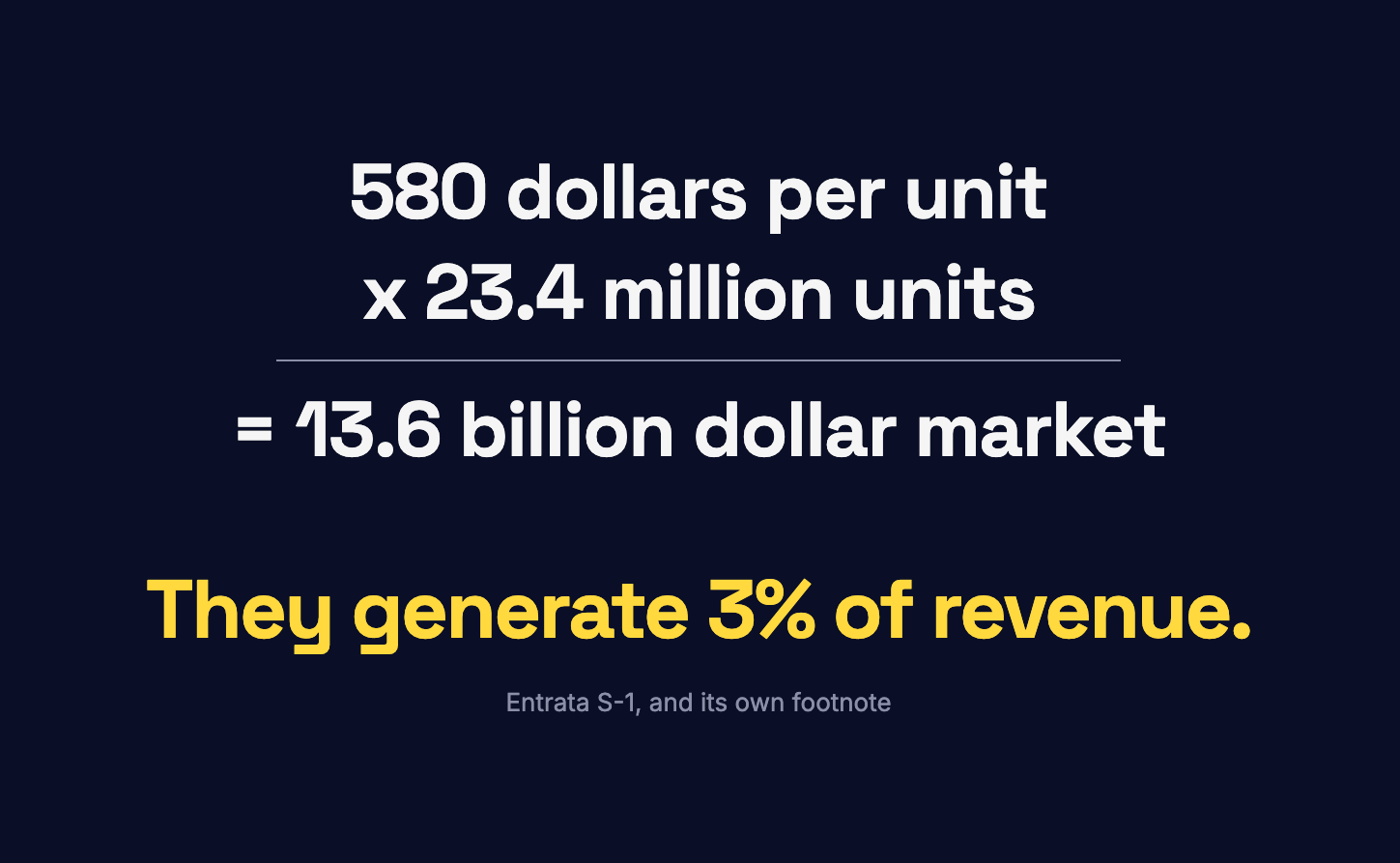
I am not saying the number is wrong. It is disclosed properly, the footnote is right there, and market sizing in an S-1 is the most optimistic honest thing a company can produce. My read is that a market estimate built on the spending pattern of 3% of your revenue base is a hope rather than a forecast.
There is one more, small, and nobody has mentioned it. Entrata reports gross retention of 99% in 2024 and 97% in 2025. The glossary says that figure excludes property churn, meaning a customer terminating a specific property without penalty when that property changes owner or operator. The reasoning given is that ownership changes sit outside the company’s control, which is fair enough. It still means the retention number has a whole category of loss carved out of it, and the filing says so plainly. Most benchmark comparisons you will see against those figures are not comparing the same thing.
What I would actually take from this
Not the tactics. You cannot force your customers onto your payment rails on Monday morning, and if you sell into a consolidating market you already know it.
The transferable question is narrower and a bit uncomfortable. Work out what share of next year’s revenue growth arrives without a person making it happen, and what share needs a campaign, a rep, a renewal call. Most teams cannot answer that, because the reporting is built around what marketing sourced rather than around what would have turned up anyway.
The second question follows from it. When you last chose a segment, did anyone ask whether those customers were growing? Not whether they had budget, or a pain, or an obvious use case. Whether their own unit count, headcount, transaction volume, whatever your pricing attaches to, was going up on its own. That is the decision doing most of the work in Entrata’s numbers, and it was taken years before any of it showed up on an income statement.
It is also a quieter version of the argument about what unit you charge for. Picking the meter matters. Picking customers whose meter runs up without you matters more.
Where this could be wrong
Quarterly figures are after all quarterly figures. 13.3% is one three-month period, and the full-year 16.8% is the more conservative anchor, which is why I have kept both in front of you.
A company can also under-invest in acquisition and not pay for it until later. New logos still cost money to win, the filing is candid that attracting new customers is a genuine risk, and a business whose growth leans on its customers expanding inherits their bad years along with the good ones. If the large operators stop consolidating, this can go downhill fast.
I have spent a lot of this year reading about GTM teams getting smaller, roles quietly disappearing through attrition, and efficiency claims nobody can substantiate. This filing is the first document i have read all year that shows the efficiency and then shows the machinery underneath it. Not because the company is unusually honest. Because it had to be signed.
Next week i am looking at how next year’s marketing budget actually gets built, and specifically at what gets defunded to pay for the AI line. The 2026 data says the money is coming out of agencies and out of retention. Most teams will make that trade without ever writing it down as a decision.
Every figure above, linked or not, comes from Entrata’s Form S-1 as amended on 11 June 2026, checked on 5 August 2026. It is one long document with no internal anchors, so rather than send you to the same page 17 times I have linked only the four passages worth going to find.
Monday GTM is a weekly read on how B2B go-to-market actually works, for the people doing the work. No theory, no fluff. Just what holds up when you look closely.