

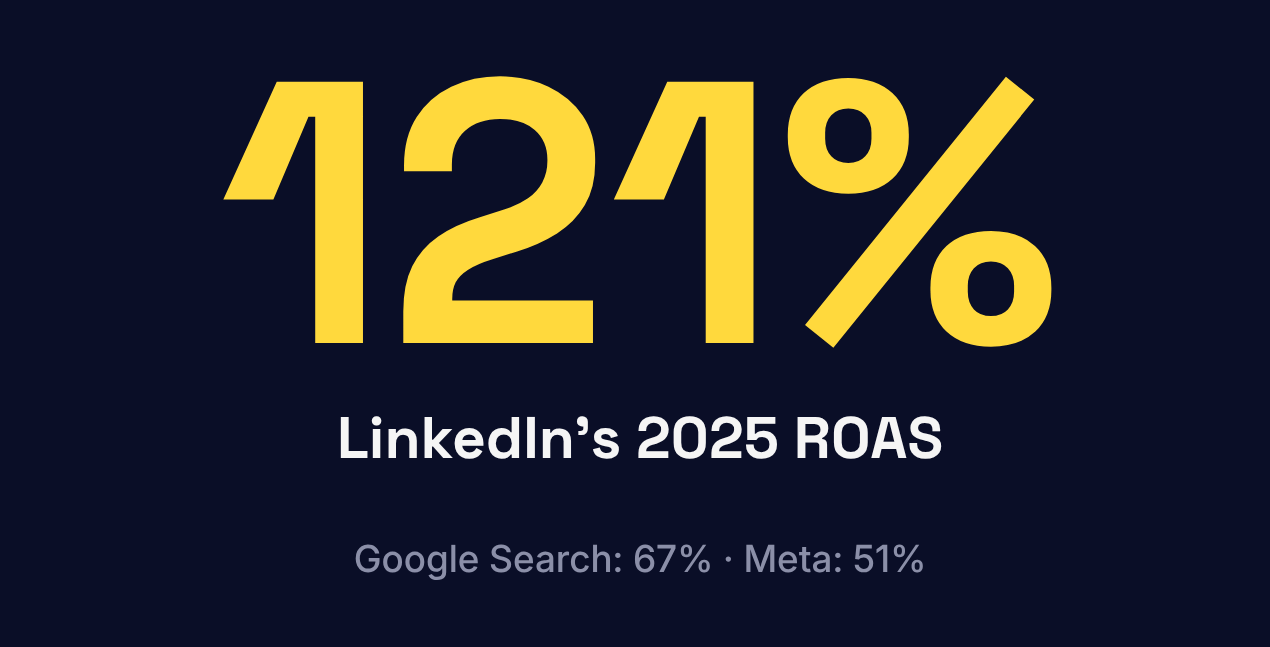
Here is a number that should reframe how you think about your entire paid budget.
In 2025, LinkedIn was the only major paid channel that delivered a positive return on ad spend for B2B — 121%. Google Search came in at 67%. Meta at 51%. The top quartile of LinkedIn advertisers hit 279%.
Read that again. Every other channel you are running lost money on a blended basis. LinkedIn made it.
This is the part where most marketers get defensive about LinkedIn, because they ran a campaign once, saw an $11 CPC, and decided the platform was a scam. I understand the reflex. LinkedIn is the most expensive paid channel in B2B by almost every on-platform metric. The CPMs are roughly three times Meta’s. The clicks are brutal.
But here’s what eight-plus years watching B2B teams burn paid budgets taught me: the people who think LinkedIn is too expensive are measuring the wrong thing. They are looking at cost per click when they should be looking at cost per closed deal. And on that metric, the only one that pays your salary, LinkedIn is not the expensive channel. It is the only one that works.
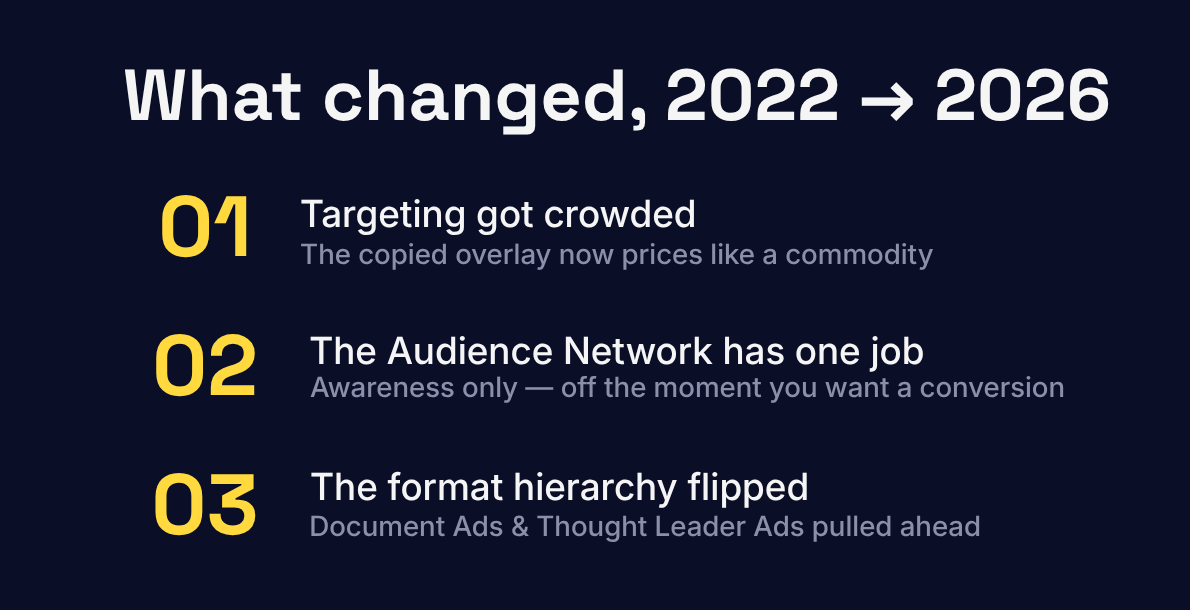
The catch is that how you make it work changed. Three things shifted between 2022 and 2026, and if you are still running the LinkedIn playbook everyone copied off the same five agency blogs in 2022, you are paying premium prices for a motion that stopped compounding.
Let’s fix that. We are going to do it through a framework I laid out a few weeks back - the GTM Canvas, which maps any B2B go-to-market onto twelve boxes across four layers. LinkedIn Ads lives inside two of them: Channels (where your buyers are, and how you reach them) and Acquisition Metrics (how you know it’s working). Those are the two boxes we are going to fill in properly.
First, the baseline you are actually working with
Before the three shifts, the numbers so you have something to benchmark your own account against. These are 2026 figures, triangulated across roughly half a dozen independent sources, not one agency’s hero numbers.
CPC: $5–12 for Sponsored Content, pushing $15–25 when you target the C-suite.
CPM: around $30–50, with LinkedIn’s own 2026 benchmark sitting at $33.80.
CPL: $60–175 for lead gen, with a cross-industry average of $94 - up from $87 the year before.
Lead Gen Form conversion: roughly 10–13%, versus 2–6% on a landing page. The pre-filled form is the single biggest friction-remover on the platform. Use it.
The practical budget floor: the technical minimum is $10 a day, but $50–100 a day is the real floor before you have enough data to make a decision. Below that you are not running a campaign, you are buying a hunch.
Keep one number in your head above all others: CPCs rose 9% year-on-year, the steepest jump since 2022. That rise is not random. It is the direct symptom of the first shift.
Channels, Part 1 — the targeting everyone copied stopped working
This is the box where most LinkedIn budgets quietly die.
The move everyone learned in 2022 was simple: layer job title and seniority. Target “Director and above” in “Marketing” at companies with “200–1,000 employees,” and congratulate yourself on a tight, decision-maker audience. Every agency taught it. Every founder copied it. Which is exactly why it stopped working.
Think about what happens when every B2B advertiser targets the same narrow pool of senior people. You are all bidding in the same auction, for the same few hundred thousand inboxes, on the same handful of attributes. LinkedIn runs a second-price auction, the more of you crowd into the same audience, the more each impression costs all of you. That 9% CPC rise is not LinkedIn getting greedy. It is sustained demand for the same senior-level inventory, with the steepest increases - B2B SaaS +11%, IT and cybersecurity +12%, financial services +10% - landing in exactly the verticals where everyone adopted the same targeting recipe. The overlay didn’t stop working because it was wrong. It stopped working because it became crowded.
LinkedIn itself will now tell you, in its own targeting guidance, that job-function targeting is too broad and that over-layering attributes collapses your audience below the delivery threshold. When the platform is gently telling you your favourite tactic is a problem, the tactic is a problem.
So where did the edge go? It moved off LinkedIn’s firmographic filters and onto your own data.
The teams winning in 2026 are not describing their ICP to LinkedIn through dropdowns. They are showing LinkedIn their ICP, by feeding it first-party seed data and letting the model find the rest:
Matched Audiences: upload your target account list and LinkedIn matches it at 95%-plus on company lists, 70–85% on contact lists. This is the foundation layer for any serious ABM motion.
Predictive Audiences: seed the model with your closed-won customers and it builds a lookalike of likely converters. The payoff is real: 21% lower CPL on average versus standard interest or job-title targeting. The catch is that it needs clean seed data, at least 100 conversions, ideally 500-plus, to train on. Garbage seed, garbage audience.
This is the single targeting move most teams are still leaving on the table. The dropdown overlay is a commodity now; everyone has it, so it prices like a commodity. Your customer list is proprietary. Nobody else can bid on it. That is the whole game.
And while we are here, stop chasing audience size. A tight, high-intent audience of 10,000 beats a broad 200,000 every time. The proven ranges: 50,000–400,000 for prospecting, 10,000–50,000 for retargeting, 1,000–30,000 for ABM. Density is the metric. Reach is vanity.
Channels, Part 2 — the Audience Network is worth it, for exactly one job
Here is a change almost nobody uses correctly.
The LinkedIn Audience Network extends your ads off-platform, onto partner apps and sites. For years the advice was to leave it switched off, because off-platform impressions felt like leakage. That advice is now half-wrong, and the half that’s wrong is worth money.
The Audience Network runs at 35–50% lower CPMs than the in-feed inventory - roughly $16–22 against $33.80. That is a serious discount on reach. But, and this is the part people miss, the click-through and conversion rates both drop off-platform. So the economics only work for one job.
The Audience Network is not a CPM hack you bolt onto every campaign. It is an awareness lever. Net economics tilt positive for upper-funnel awareness work and negative for lead gen, unless you have built creative specifically for the off-platform placement. Run it for reach at the top of the funnel. Switch it off the moment you are asking for a conversion. And switch it off entirely for ABM, it dilutes the tight account targeting you worked to build.
The mistake isn’t using the Audience Network. The mistake is using it for the wrong box on the Canvas.
Channels, Part 3 — the format hierarchy flipped
The third shift is the quietest, and it changes what you should actually be putting in the feed.
For years the default was the Single Image Sponsored Content ad - a clean graphic, a headline, a Lead Gen Form. It still works. It is no longer what works best. Two formats now beat it on the only metric that matters, cost per qualified lead.
Document Ads. The carousel-style download - a guide, a benchmark report, a framework. CPL runs 30–40% lower than a generic lead form, because the prospect is trading their details for something they actually want, not just raising a hand. They double as cheap retargeting-audience feeders - content downloads cost $5–12 each.
Thought Leader Ads. You sponsor a post from a real person’s profile - your founder, your head of product - instead of the company page. The numbers are not subtle: click-through 2–5 times higher than brand-sponsored content. The catch is that the creative has to be native to that person’s actual posting voice. Rebranded marketing copy with a face slapped on it gets ignored, and people can smell it.
Meanwhile the cheapest formats are a trap. Text Ads have the lowest CPC at $2–6 and the worst click-through on the platform. Cheap is not the same as efficient. It never was.
The pattern across all three shifts is the same one the Canvas keeps hammering: the lazy default is now the crowded, expensive option, and the edge has moved to the thing that takes actual work.
Acquisition Metrics — measure the channel by what it is, not what it looks like
This is where I lose half the room, because the metric LinkedIn looks worst on is the one most people judge it by.
LinkedIn’s CTR sits at 0.44–0.65%. Google Search runs 2–5%. By that number alone, LinkedIn looks broken. But CTR is a vanity metric on a channel where the entire value proposition is who clicks, not how many. A 0.5% click-through from verified decision-makers is worth more than a 4% click-through from whoever Google’s keyword match dragged in.
The Canvas rule holds: if a number changes and you don’t know what to do about it, it is not a metric, it is a data point. On LinkedIn, three numbers earn their place.
Cost per SQL, not cost per lead. CPL is the number everyone reports because it is easy. It is also nearly useless on its own. The metric that ties spend to pipeline is cost per sales-qualified lead, and that is what you defend your budget on.
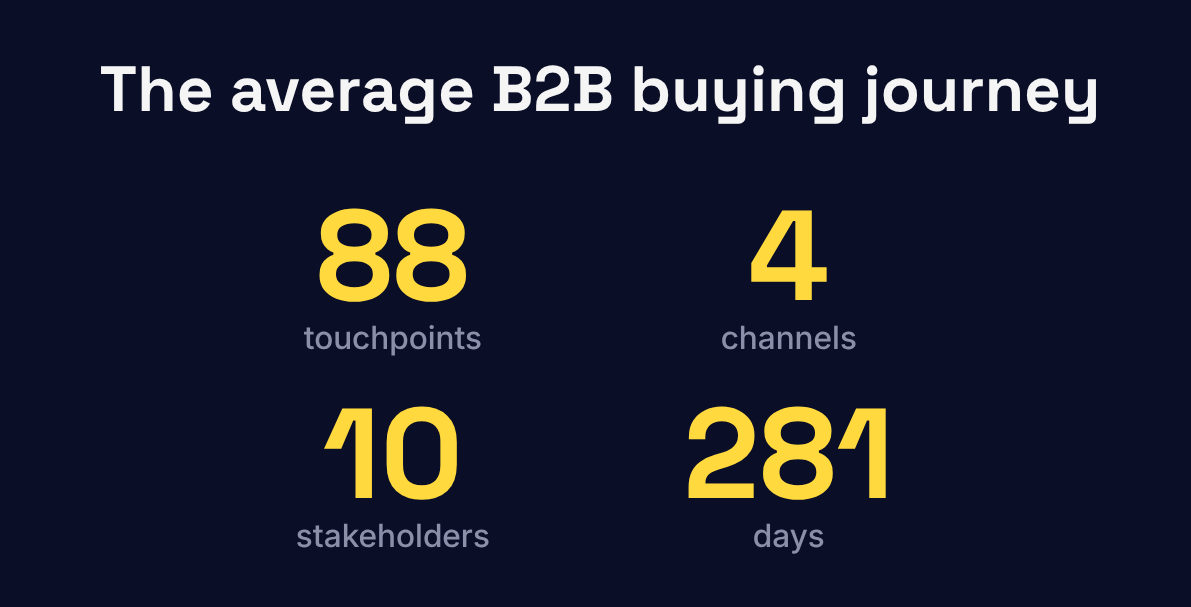
Pipeline-to-spend, measured over the real cycle. Here is the stat that should change how you report LinkedIn entirely. Dreamdata’s 2026 analysis found the average B2B journey runs 88 touchpoints, across 4 channels, with 10 stakeholders, over 281 days, from first LinkedIn impression to closed revenue. If you judge LinkedIn on a 30-day last-click window, you will systematically conclude it doesn’t work, and you will be wrong, because you measured a nine-month channel with a one-month ruler.
A brand-versus-generic split. The most uncomfortable number in the research: branded campaigns returned $12.99 in ROAS against $0.68 for generic ones - a roughly 19x gap, across 1,400-plus campaigns analysed by LinkedIn’s own B2B Institute. Even on a “performance” channel, the ads where your brand is prominent crush the ads where it isn’t. If you are running stripped-back direct-response creative because a growth thread told you brand is fluff, you are leaving an order of magnitude on the table.
The one mistake I see every time
Teams treat LinkedIn as a slot machine. They put money in, pull the lever, check the CPC the next morning, panic, and turn it off.
LinkedIn is not a slot machine. It is the slowest, most expensive, highest-quality channel in your stack, and it only pays out if you measure it on its own clock. You need 60–90 days minimum before the channel has told you anything true. The first 30 are just the learning phase. Most teams kill the campaign in week two, right before the data would have started meaning something.
The channel works. The 121% ROAS is real. But it is the reward for patience and first-party data, not the default outcome of switching ads on. The teams that win on LinkedIn in 2026 are not the ones spending the most. They are the ones feeding it their own customer list, building for the right funnel stage, and measuring on the cycle the buyer actually moves through.
Everyone else is just bidding against each other for the same crowded inbox and calling the bill LinkedIn’s fault.
What comes next
This was Channels and Acquisition Metrics - two boxes of the Canvas, one channel deep. Next week we go up a level, to the box that decides whether any of your channels matter in the first place: GTM Motion.
More specifically, the trap inside it. There is a funnel everyone draws that starts at “awareness” and ends at “closed.” In 2026, that funnel is a lie. It starts a long way before the part you can see, and most of the buying decision is made somewhere you are not even measuring. That’s the hot take. Bring your assumptions; I’m going to take a few of them apart.
One thing worth doing this week: go look at whether your best campaign is seeded with your own customer list or with LinkedIn’s dropdowns. That one check will tell you most of what you need to know.
Monday GTM is a weekly newsletter for B2B founders and growth teams. One practical playbook, teardown, or hot take, every Monday. No fluff. No advice. Just the frameworks that actually move the pipeline.
Next up: Your B2B funnel doesn’t start where you think it does. A hot take on the dark funnel, AI-led buyer research, and why your first touch isn’t your first touch.
See you then.
Key data points in this post are linked inline to their original sources.