


Most marketing teams I have worked with do not have a GTM strategy.
They have a wishlist.
It is buried in the folders in a Word doc or a deck somewhere. It is a bulleted list or a Smart Art that says LinkedIn ads, upsell to existing customers (or low hanging fruits as we like to call them), maybe a podcast, a PR roadshow, some SEO. Definitely a referral program because someone on the leadership team heard that they work really well.
This is not a strategy. It’s anxiety dressed up as a plan.
I know because I spent 8+ years in fintechs, B2B platforms and a global consulting practice working with really smart people building these wishlists, spending hours discussing them and then running around fetching approvals, finally executing them and then 6 months later wondering why nothing compounded. The issue was not in the effort. We worked 60 hour weeks on them. The issue was that no one forced us to answer 12 specific questions pertaining to our product in a single sitting.
So now I built a framework to force the answers. I call it the GTM Canvas, and it fits in one page.
What the GTM Canvas is (and isn’t)
12 boxes, 4 layers and 1 rule that holds it all together - everything has to be answered in one sentence.
The one sentence restriction is the whole point. If you cannot answer it in a sentence, you do not have a strategy, you have a wishlist. It is the difference between “we will run paid ads and do some content marketing and a partnership” and “we acquire customers through a single inbound motion that runs on LinkedIn Ads targeting the Head of RevOps in Series B fintechs.”
The second is a strategy. The first is what makes people call the marketing team a cost centre.
The Canvas doesn’t tell you what the right answers are for your product. No framework can do that. What it does tell you, and brutally so, is where the gap is. When you sit down to fill it, you may notice that you have left 3 or 4 boxes blank — not because you forgot, but because you haven’t thought about them yet. This is the real work. The Canvas just points it out to you.
Most B2B GTM frameworks I have seen, stop at acquisition. It will walk you through the target customer persona, the positioning, the channels and then tumble down to the finish line. It may mention retention as an after-thought as it would be weird not to. This is because most of these companies treat the customer as a prey they are hunting and once it is shot down, the work is done. That’s a grave mistake and more so in 2026. Because the honest truth is this, in a world where your customer can onboard themselves, self-serve through the pricing and cancel in two clicks, the experience IS the go-to-market. You don’t get to separate the two anymore. The product is the pitch, the onboarding is the close and the first support ticket is your renewal discussion.
This is why the Canvas has a fourth layer most GTM frameworks don’t. I will get to it.
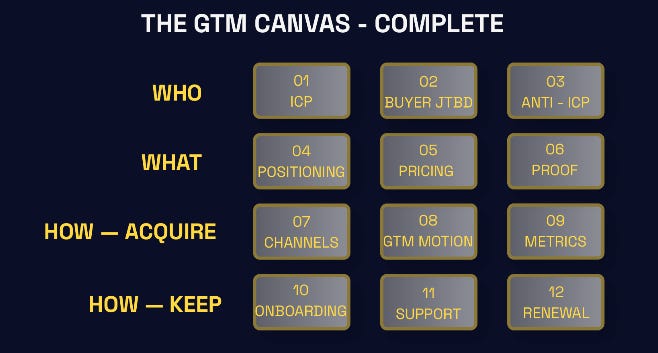
Layer 1: WHO
The foundation. If you get this wrong, then nothing else matters.
1. ICP
Who you’re selling to, with the precision of a sniper, not a shotgun.
“Mid-market SaaS companies” is not an ICP, it is a category. “Series B to Series D funded SaaS companies with 100-400 employees, a RevOps lead on the team, with a sales cycle greater than 45 days” is an ICP. You should comfortably be able to list down 10 companies with your ICP. But if you can list two thousand, you haven’t narrowed it enough, and if you can only name three, then you have narrowed it beyond the point of a reasonable market. The right ICP will give you anywhere between a few dozen to a few hundred companies, sharp enough to launch a focused attack and broad enough to build the business at scale.
I have watched B2B teams waste months trying to sell to every customer that showed the faintest interest because they were afraid to pick a lane. In my experience, this fear of missing out is the biggest cost to a B2B company, not over-hiring, not picking the wrong agency or the wrong CRM. It is refusing to choose.
2. Buyer JTBD
The job the buyer is hiring your product to do.
It is not the features. Not even the outcome your marketing team promised the product will deliver. It is the actual job. The Head of Marketing does not buy an email marketing tool to make “email engagement better”. She buys it because her CMO asked her last week why the pipeline is low, and she wants a new chart for the next board meeting deck. She wants your product to make the chart look better.
Once you see it this way, the messaging writes itself.
3. Anti-ICP
What your product has explicitly decided not to be.
This is the box most teams decide to skip, and it is the one that gives most clarity once filled in. Anti-ICP isn’t just “who you do not sell to”. It is the buyer types you are refusing, the use cases you are turning away from, the features you decided not to build, the problems you are telling your customer isn’t your job.
Netflix’s Anti-ICP is live sports, user generated content and someone whose average viewing time is less than 5 minutes. This is not target market exclusion. This is Netflix declaring what it has decided not to be and that’s why it is so clarifying.
When you call out your Anti-ICP, three things happen immediately. Your sales team stops wasting time on bad-fit leads, your product team stops building features for buyers you would never close and your marketing team finds their edge because nothing is sharper than a brand that says it is “not for everyone.”
Layer 2: WHAT
The offer. What you actually hand to the buyer.
4. Positioning
The one statement that tells the buyer why you exist.
It’s not your mission, vision or tagline. It is the statement the buyer would use to describe you to a peer. “It’s like Stripe but for insurance payouts” is a positioning. “Empowering the future of commerce through innovative solutions” is a war crime.
The litmus test: can your positioning statement be sometimes confused for your competitors’? If yes, then you haven’t positioned yourself, you have described.
5. Pricing model
Not the price, the mechanism.
Per seat, usage-based, flat or hybrid; the pricing model is the single biggest GTM decision that most founders make without realising they are making it. The per seat model locks you in the “land-and-expand” mode - you start with one team, then another and then the whole company. Your sales team’s job essentially becomes adding more seats. Usage based model flips the script. You make $500 in one month and $50,000 in the next month, which sounds amazing until your finance team sits down to forecast your revenue and realises they can’t. Flat pricing is the easiest to sell but it leaves serious money on the table when a buyer would have happily paid 5x of what you are asking. Each model requires a different motion downstream, which means you cannot pick channels or structure teams unless you have decided on this.
I have watched B2B teams rebuild their entire GTM motion because they changed the pricing model midway. And honestly this is the single most expensive pivot in B2B which no one even acknowledges as a pivot and brushes it under the rug as a simple “tweak.”
6. Proof
The three things you can say to make the buyer choose you.
Customer logos, case study numbers, a methodology you developed that no one has. Whatever the three things are, they need to be specific and verifiable. “Trusted by industry leaders” is not proof. “Customers spend 3.5% less and close their books 8x faster after switching” is proof. That’s the number Ramp shows every buyer, and it’s the reason their sales team doesn’t have to fight for attention.
If you have fewer than three, you’re pre-proof. And that’s okay, it just means your GTM motion needs to be built around creating proof, not leveraging it. Those are two different strategies and both are valid.
Layer 3: HOW (ACQUIRE)
The motion that brings them in.
7. Channels
The two or three places where your ICP lives in scale.
Two or three channels, not ten. If your answer in this box is “omnichannel” or a “mix of paid, organic and community”, then you don’t have channels, you have FOMO. The question is not “where can we reach our ICP?” The question is “where can we reach them frequently, at the lowest cost and with enough intent that it compounds?”
Most early stage B2B companies need only one channel to work, two if they are lucky. Three is a luxury that most companies haven’t earned yet, I say yet because there is no harm in running 3 channels eventually. The mistake is starting with three. Anything more than two channels in the early days is the sound of a budget being set on fire.
8. GTM motion
Product-led, sales-led, hybrid, community-led and why.
The simpler version of this question is who does the selling, the product or a human? If your product is simple, has an ACV below $5,000 and the buyer can realise the value in the first session, then the product can do the selling. This is PLG. If your product has an ACV above $25,000 and the buyer has to convince a procurement committee headed by the CFO, a human has to do the selling. That’s sales led. The awkward gap between $5K and $25K is where the hybrid motion resides, and this is where most founders get stuck pretending they have picked when they haven’t.
The mistake I see most often is founders picking PLG because it is trendy, and later realising that their ACV and product complexity does not support it.
9. Acquisition metrics
The two or three metrics that tell you acquisition is working.
Not a dashboard with forty-seven metrics. Just two or three. Usually: CAC, CAC payback, and one leading indicator specific to your motion (MQL-to-SQL conversion rate, trial-to-paid rate, pipeline-to-closed-won rate). The rule: if a number changes and you don’t know what to do about it, it’s not a metric, it’s a data point. Delete it.
Layer 4: HOW (KEEP)
This is the layer most frameworks exclude. It is the one that decides whether your GTM compounds or leaks.
Here’s the thing about B2B in 2026: you don’t really win customers anymore. You rent them. And the rent is due every month, every quarter, every renewal date. The first sale is just the trial. The real sale is the renewal and it’s happening quietly in the background whether you’re paying attention to it or not.
A customer who churns in month three doesn’t just cost you the rest of their contract. They cost you everything you spent to acquire them, they cost you the word-of-mouth you would have earned if they had stayed, and they cost you the case study you were going to build around them. A leaky bucket doesn’t just lose water, it discredits the tap.
So here are the three boxes that decide whether the bucket holds.
10. Onboarding
How a new customer reaches value for the first time, and how fast.
Time-to-value is the most underrated metric in B2B. If a customer signs up on Monday and hasn’t experienced value by Friday, they are gone. Not dramatically, just quietly. They will stop logging in, miss the first follow-up email, and by the renewal date they will have forgotten why they bought you in the first place.
Onboarding isn’t just a welcome email. It is the whole first experience - the sign-up, the first setup, the first “aha” moment, the first measurable win. Your job is to stitch that journey to be as short and as un-skippable as possible.
11. Support and service
How issues get resolved, and how trust compounds over time.
I am going to say something that will sound strange coming from a marketing newsletter - your support experience IS marketing. And possibly the most important kind. Every time a customer hits a wall and you help them through it beautifully, you have just earned another year of trust. Every time you don’t, you have just written the first draft of their churn reason.
In B2B especially, support is where the brand promise gets tested. Everything before the sale is words. Everything after it is actions. And in an AI-assisted world where a lot of support is becoming self-service or bot-first, the companies that still invest in a human touch at the hard moments are going to win disproportionately. Trust is the last moat.
12. Renewal trigger
The moment the customer decides to stay or leave.
Not the renewal date itself, the moment the decision actually gets made. Sometimes that is six months before the contract ends. Sometimes it is during a failed onboarding in week two. Other times it is the day your account manager quits. Your job is to know when that moment is in your business, and to architect the whole customer experience around reaching it on the right foot.
If you cannot name the renewal trigger for your product, you are not doing retention. You are hoping.
How to use the Canvas
Here is the thing I wish someone had told me the first time I tried to build a GTM strategy: the Canvas isn’t a plan. It’s a diagnostic.
Sit down with a blank version. Give yourself one uninterrupted hour, phone in silent, Teams shut, you know the drill. Try to fill in all twelve boxes with one sentence each. You will probably get through six or seven before you hit the first one you can’t answer. That’s the box that needs work. That’s the one your strategy is missing.
The boxes you can fill in fast are the ones you already have conviction about. The boxes you cannot fill in are the ones where your team is going to disagree in three months and you’re going to lose a quarter sorting it out. Catching that disagreement now, in a one-hour exercise, is worth more than any playbook I could write for you.
Do it with your co-founder. Do it with your head of product. Do it alone at 11pm with a cup of coffee that’s gone cold, if that’s your thing. Just do it before you spend another dollar on ads.
The one mistake I see every time
Founders fill in the Canvas and then lock it in a drawer.
The Canvas is a living document. Your ICP will sharpen as you start selling. Your channels will prove themselves or fail. Your pricing model will get tested by actual buyers who push back on it. The answer in each box will evolve, and if you are not revisiting the Canvas every quarter, you are working with instruments that were calibrated six months ago.
The best GTM teams I’ve been part of have the Canvas pinned to a wall - physical or digital - and they update it the way engineers update architecture diagrams. Not because it is pretty but because it’s the single source of truth for what the business is trying to be.
What comes next
Every post on Monday GTM from here on out is going to reference back to this Canvas in some way. When I tear down Notion’s GTM strategy next Monday, the company that raised at an $11B valuation in 2021 and then spent four years quietly growing the business big enough to actually deserve it, I will be using these twelve boxes to do it. These twelve boxes are the shared language for everything that follows, and I will keep pointing back at them.
The Canvas is the shared language for everything this newsletter is going to do.
So just try the exercise. One hour. Twelve boxes. One sentence each. No prep, no preamble.
You’ll learn more about your GTM strategy in that hour than you will from a month of reading Substack posts about it. Including this one.
Monday GTM is a weekly newsletter for B2B founders and growth teams. One practical playbook, every Monday. No fluff. No advice. Just the frameworks, teardowns, and hot takes that actually move the pipeline.
Next Monday: How Notion raised at an $11B valuation in 2021, and then spent four years quietly growing big enough to deserve it. A GTM teardown using the Canvas we just built.
See you then.
Key data points in this post are linked inline to their original sources.