

I recently wrote an article on how to build the marketing budget for next year. After the writing was done and I hit schedule, I realised I skipped a major part of B2B marketing - partners. It is funny how partner marketing is always an afterthought in B2B marketing discussions.
You will hear it in your own planning session, usually late, after the paid budget has been fought over twice. We need another 15% of pipeline from somewhere. What about partners. And then it goes quiet, because nobody in the room can say what a good partner actually looks like.
That is not laziness. The industry has never agreed. So I went and read what the four biggest partner programmes in software actually ask for. Not the summaries, not the agency blogs. The programme documents themselves, sitting on the companies’ own sites, free and open to anyone with an afternoon.
They disagree. Not about details. About the first question.
The question nobody asks out loud
Every partner programme is a ladder and every ladder has a bar. Whether that bar is the same for everybody is the real question, and almost nobody says their answer out loud.
Picture two agencies doing identical work. One sells into a market where the vendor already has a sales team, an office and a brand people recognise. The other sells somewhere the vendor has none of that and the buyer has never heard the name. Same pitch, same hours, nothing like the same difficulty.
A revenue threshold flattens all of that into one number. Forrester has made this point about tiering generally: revenue is still the main thing that moves a partner up, and it leaves smaller partners, and partners in smaller markets, stuck below the top tier while doing everything right.
So you pick. One bar for everyone, and accept that it rewards whoever drew the easiest territory. Or adjust it, and then defend what you adjusted for.
Four companies made that call in public. They picked four different things.
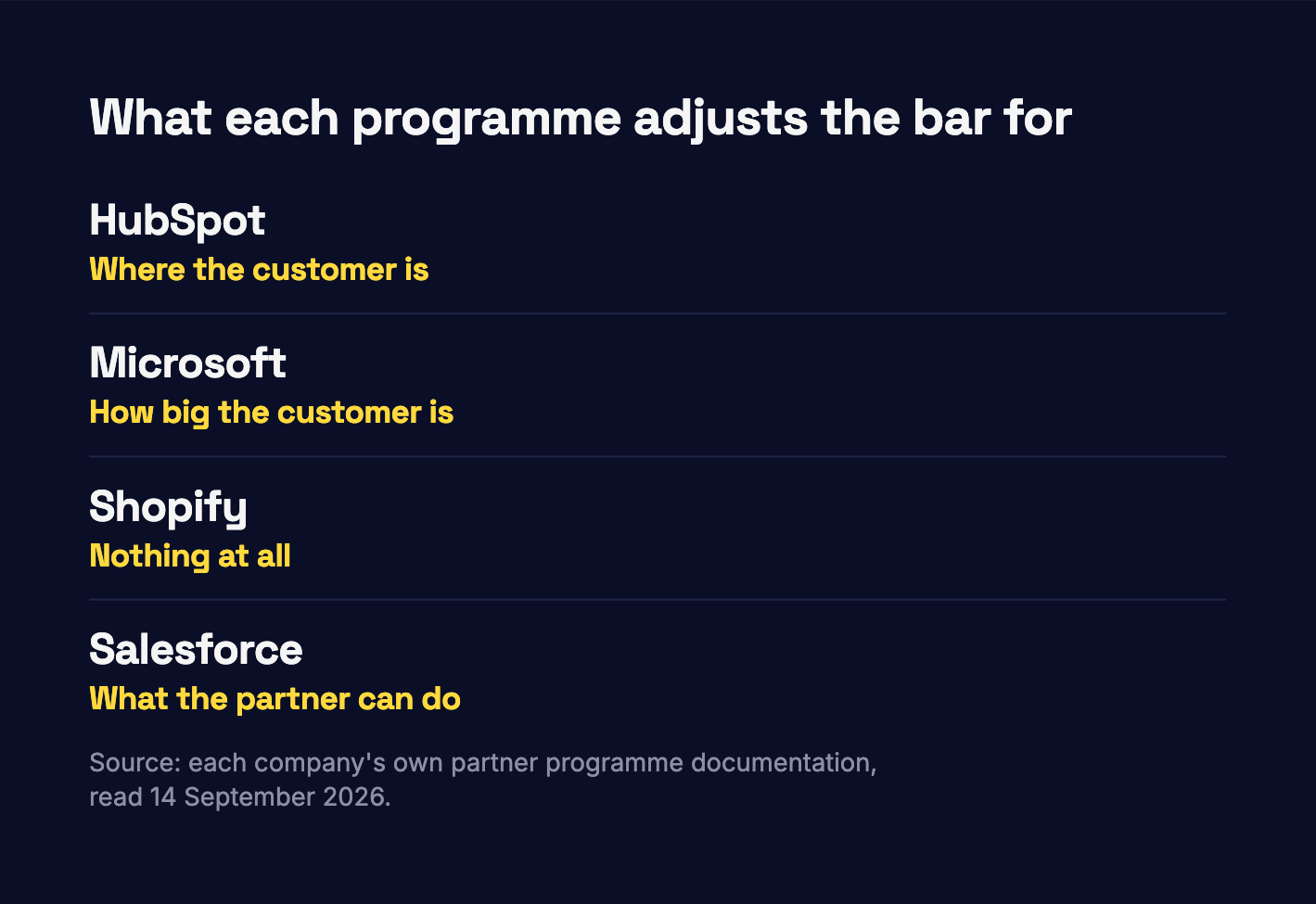
HubSpot decided it was the map
HubSpot pays double.
Tier points come from the revenue a partner brings in, 5 points per 100 US dollars of monthly recurring revenue. For a customer sitting in what HubSpot calls a growth market, it is 10.
By January 2027, Gold costs 1,150 USD in sourced monthly revenue if every one of your customers is in those markets, and 2,300 if none of them are. Same badge, half the revenue, and the only thing that changed is where your customer’s business sits. The list runs across most of Asia, all of Latin America and all of Africa, and it is published.
Here is the part I did not expect. Until 2022 the break followed the partner. Register your agency in one of those countries and your targets dropped. Then HubSpot moved it onto the customer instead, so now anybody earns the 2x for selling there. A firm in Chicago selling into Jakarta gets it. A firm in Bangalore selling into Germany does not.
That one change turned a fairness policy into a targeting instrument. It stopped paying partners for where they are and started paying them for where they sell. Perfectly legitimate. Also a completely different thing, and it looks identical from the outside.
One more line from the same page, because it tells you who holds the pen. Customer location is decided at HubSpot’s sole discretion.
Then Microsoft picked something else entirely
Microsoft looked at the same problem and landed on how big your customers are.
Its partner designations run on a score, 70 points out of 100 to qualify. Before any of that gets measured, Microsoft sorts you into one of two tracks, Enterprise or small business. You land in the small business track if 80% or more of your customers are small businesses. The thresholds in each are not the same.
On the Enterprise track a customer only counts if they spend at least 1,000 US dollars on Azure. On the small business track, 500 does it.
The certification rule is where it gets good. An Enterprise partner needs two people through each of two required exams, and those exams earn zero points. They are gates. You clear them, get nothing, and only then does anything else you have done start counting. A small business partner needs one person per exam, and each of those pays four points.
Same exams. Half the headcount. And the smaller partner gets paid for clearing the hurdle the bigger one clears for free.
Then Microsoft does something I think is quietly excellent, and I have not seen anyone point at it. It flexes what it takes to qualify and refuses to flex what counts as success. Usage growth and deployments are scored identically on both tracks. The inputs bend for who you are. The results do not bend for anybody.
If you take one rule out of this piece, take that one.
The bit that made me go back and check
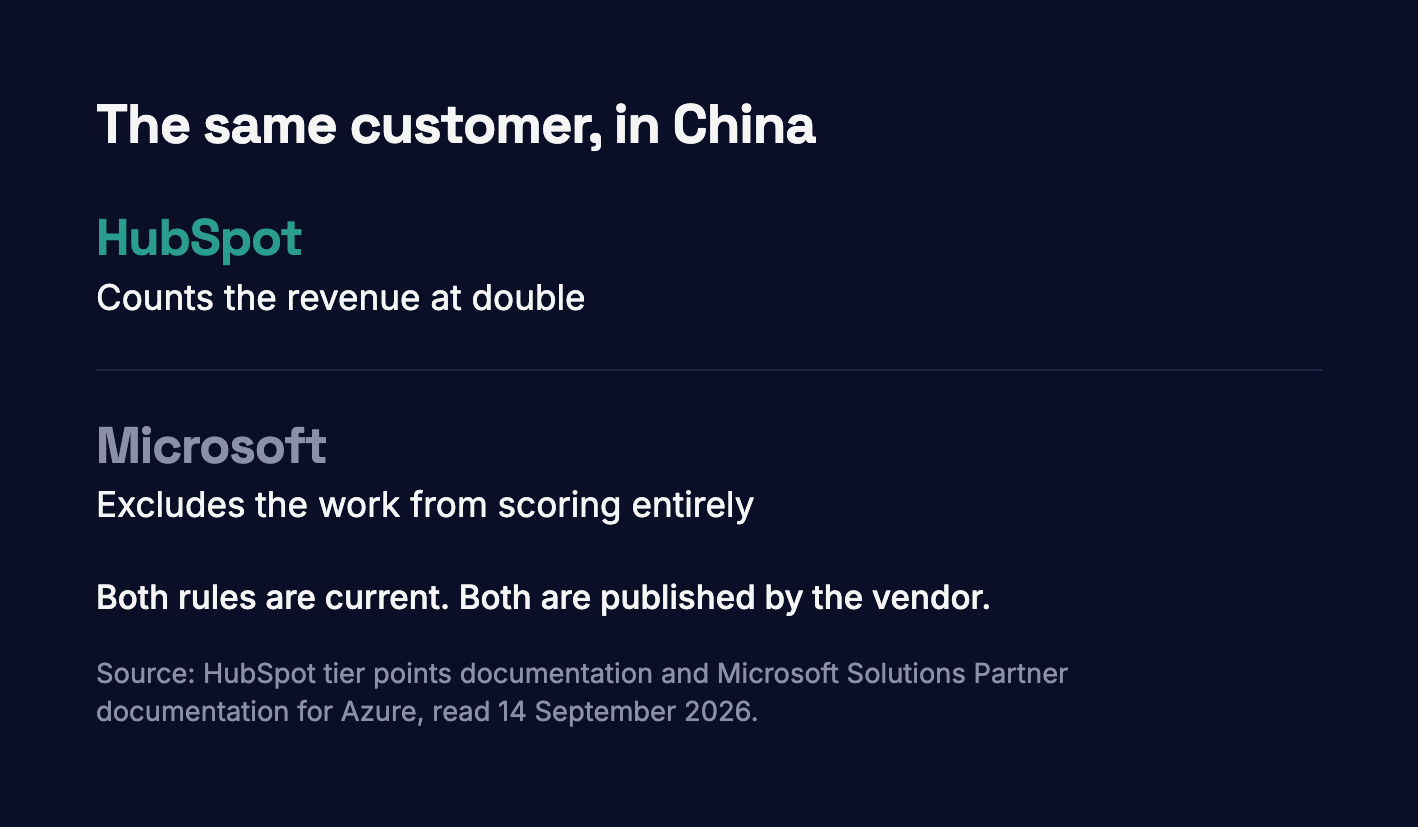
Microsoft does not ignore geography. It uses it to subtract.
Azure subscriptions in isolated and sovereign environments, Azure China among them, do not count toward eligibility or scoring at all. A partner doing that work scores nothing for it.
HubSpot pays double for a customer in China.
Both current, both published, both written by the vendor for its own partners. Two of the most sophisticated channel teams in software looked at the same country, and one decided it was worth twice as much and the other decided it was worth nothing.
Shopify thinks the whole question is noise
Shopify’s tiering guide is four pages long and it adjusts for nothing. Select starts at 100,000 US dollars of new referred revenue. Platinum wants 5 million. Those numbers are the same in Toronto and in Manila.
And for 2026 it has switched capability off entirely. Credentials are waived, the guide says. Only commercial activity is evaluated.
Which is the exact opposite of what Salesforce did in the same year.
I want to be fair to it, because a flat bar is legible. Every partner can work out where they stand in about ninety seconds, nobody argues about whether their market qualifies, and Shopify never has to defend a list of countries. The cost is the one Forrester named.
Salesforce took the revenue ladder out
Four consulting tiers became two. And 170 separate distinctions became 28 competencies, each scored on certifications, delivered projects and how happy the customer was at the end.
So Salesforce’s answer is what you can actually do. Not where you sold it, not who you sold it to.
The company calls this radical simplification, and its partner chief is quoted talking about stripping away complexity. I would push back gently here. Two tiers, times two levels of recognition, times 28 competencies is more for a partner to keep track of than four tiers was. Better measure. Not a simpler one.
One thing I went looking for and did not find. Every agency blog covering the change says Agentforce competency is what gets you to the top tier. It is in a dozen of them. It is in neither Salesforce document I read, which say certifications, projects and customer satisfaction. The product gate everybody is repeating is not in the place it would have to be.
What is actually being handed out
Strip the four answers away and the prize is identical everywhere.
HubSpot’s partner matching, the tool its own reps use to route real customers to partners, opens at Gold. Shopify marks its partner success manager and both of its funding programmes as by invitation. Salesforce ties marketplace visibility to competencies. Microsoft puts co-selling behind designations.
The benefit is not the badge. The badge is a receipt, and what it buys is a share of the vendor’s own pipeline.
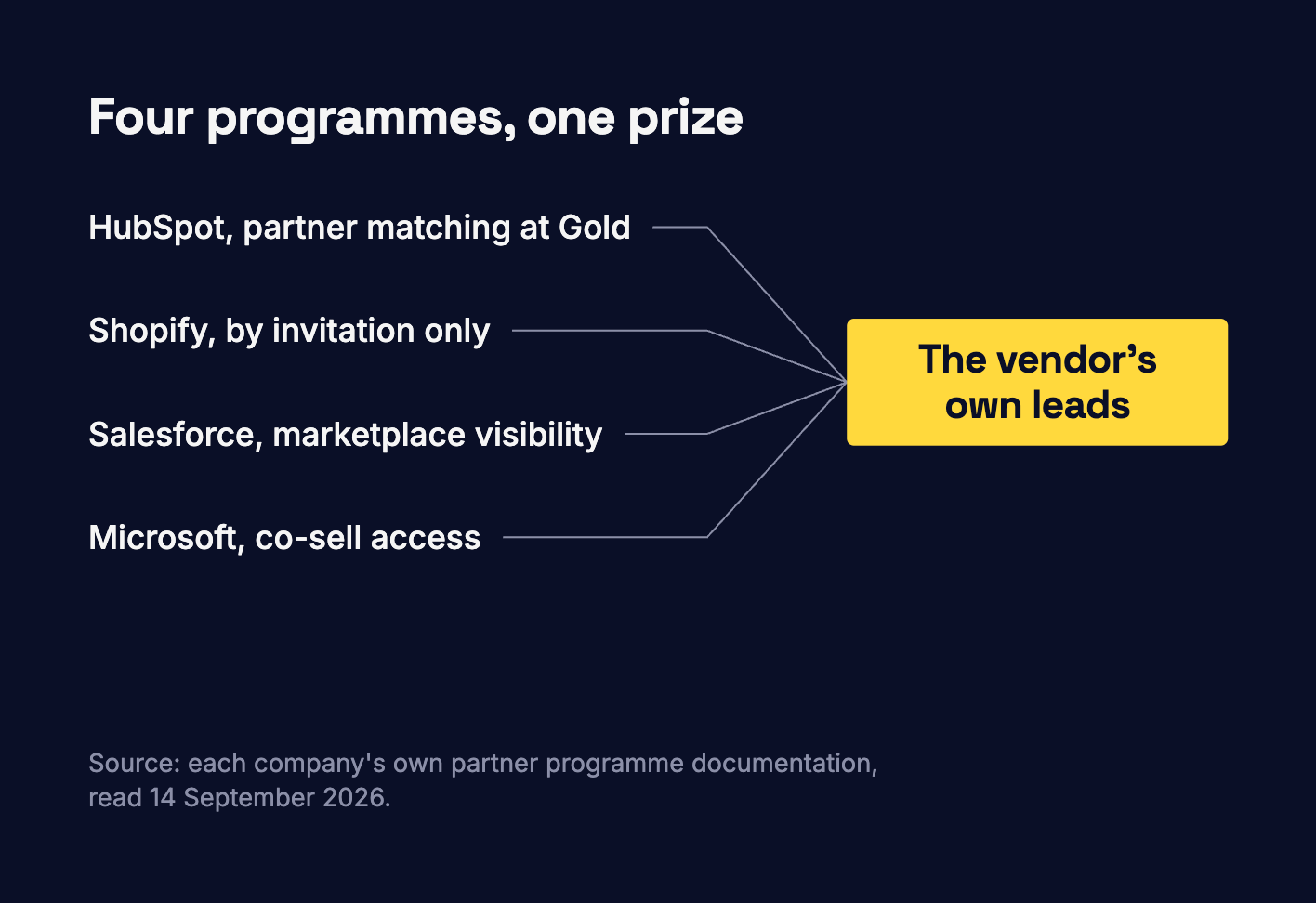
Which changes what you are doing when you set a tier. Setting a tier decides who gets your leads, and every adjustment to the bar decides which of your partners eats.
HubSpot pointed its leads at markets it cannot reach alone. Microsoft pointed them at partners serving the segment it is built for. Shopify pointed them at whoever sells the most. All three are coherent, and not one of them is neutral.
What I would actually do with this
Decide what your bar is compensating for before you pick the number. Market difficulty, customer size, capability, or nothing at all. Nothing is a real answer and Shopify has taken it. What is not a real answer is setting a revenue threshold and working out eighteen months later that you built a programme which only ever rewards partners in your two biggest markets.
Steal Microsoft’s rule while you are there. Change what it takes to qualify, never change what counts as a good result. The moment growth or retention means something different depending on which partner you are looking at, your programme has stopped measuring anything at all.
And if you do adjust, be clear whether it follows the partner or the customer, because those are not two versions of the same policy. Attach it to the partner and you have a fairness mechanism, which is defensible right up until somebody incorporates in the convenient country. Attach it to the customer, the way HubSpot now does, and you have a targeting mechanism that quietly points your entire channel at the markets you want opened. Both work. I would want everyone in the room to know which one they had picked.
If you only do one thing, go and read the programme you are already in. All four of these documents are free and none of them takes more than an afternoon. Most people planning a channel for 2027 will not open a single one. They will read a blog post about them, written by an agency that holds a tier in one.
If there is a partner line in your 2027 plan, what does your tier table adjust for, and can you name who decided that?
If this was useful, subscribe. Free, every Monday.
Every figure above comes from the companies’ own partner documentation: Salesforce’s FY27 Consulting Partner Program brochure and programme page, HubSpot’s tier points page, Microsoft’s Solutions Partner documentation for Azure, and Shopify’s Q3 2026 Partner Program Tiering Guide. All were opened and read on 14 September 2026. Shopify recalculates tiers on 1 October 2026.
Monday GTM is a weekly read on how B2B go-to-market actually works, for the people doing the work. No theory, no fluff. Just what holds up when you look closely.