

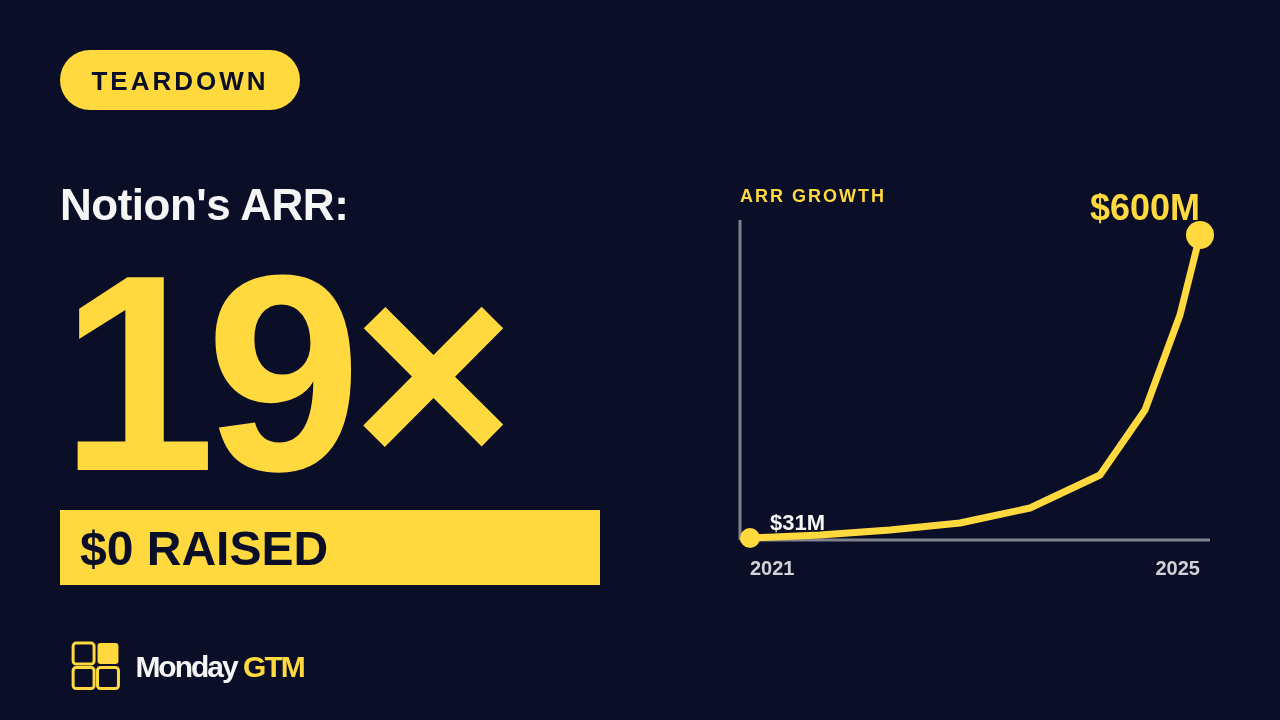
Last week I told you Notion raised at an $11 billion valuation in 2021 and then spent four years quietly growing big enough to deserve it.
Half of that sentence is wrong.
The half that’s wrong is the interesting part.
Notion’s Series C closed in October 2021 at a $10 billion valuation, not $11 billion. They raised $275 million from Coatue and Sequoia, and that was the last primary round they’ve ever done. Four and a half years later, they still haven’t raised another dollar.
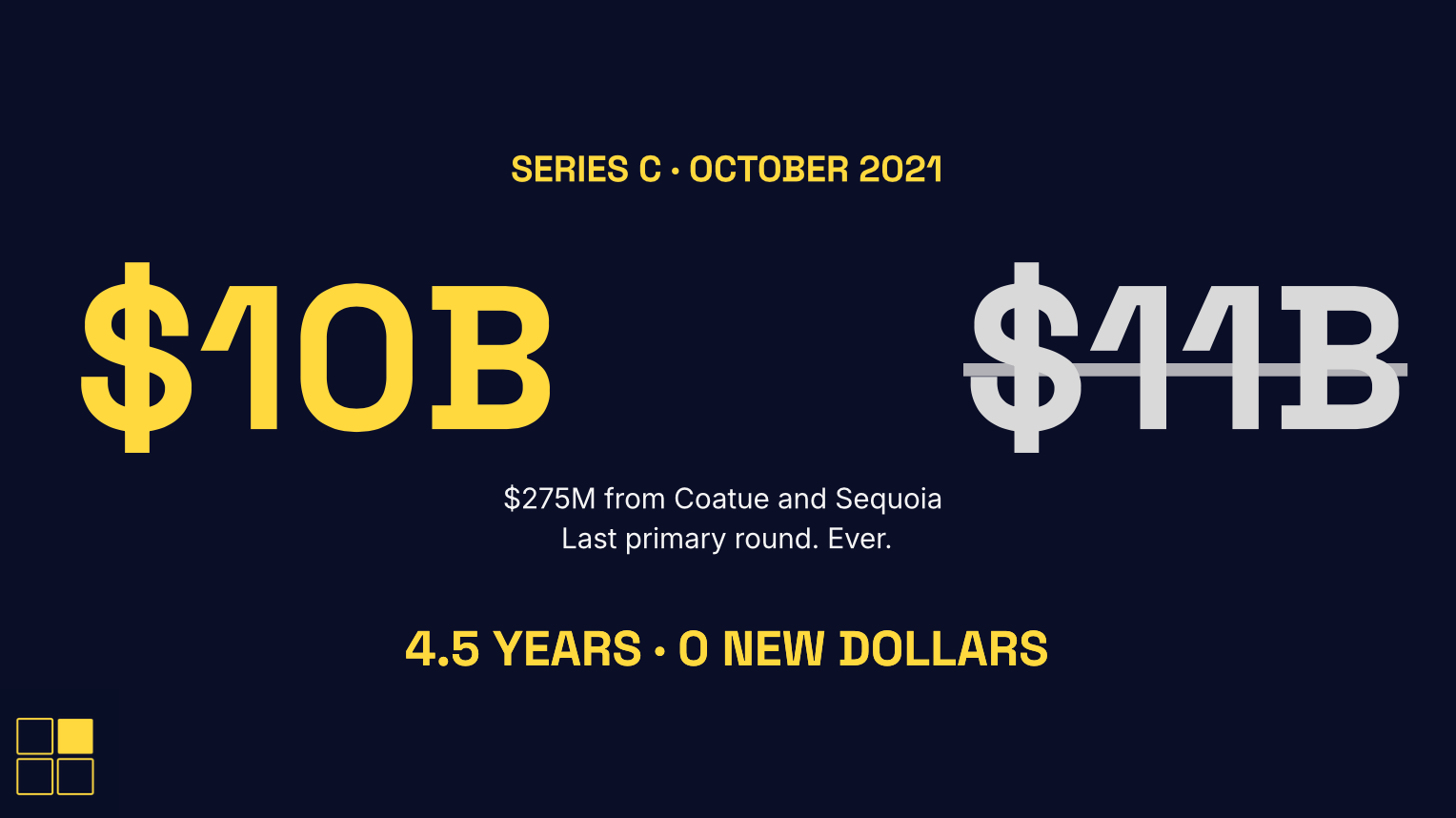
The $11 billion number is real, but it’s from an entirely different event. In December 2025, Notion ran an employee tender offer at $11 billion, employees and early investors selling shares to GIC, Sequoia, and Index. No new capital came into the company. No dilution. The valuation barely moved in four years.
Here’s what did move. In October 2021, Notion was doing roughly $31 million in ARR. By December 2025, that number was $600 million. Revenue grew 19x. The valuation moved 10%.

The multiple compressed from 322x ARR to roughly 18x. To put those numbers in plain English: at 322x revenue, investors are paying for a company that doesn’t exist yet, a bet on a future eight to ten years out, in a market where money was basically free. At 18x, you’re valuing a company for what it actually is today - profitable, compounding, proven. Notion moved from one to the other without lowering their price tag. Most companies can only make that trip by taking a down round. Notion made it by just growing.
Most people writing about Notion this year are staring at the valuation story. The valuation story is a symptom. The actual question, the one worth spending the next fifteen minutes on, is this: what kind of GTM machine compounds for four years without new capital, grows revenue 19x, converts half its customer base to an entirely new product line midway, and stays profitable the whole time?
That’s the teardown. Let’s use the Canvas.
Layer 1: WHO
The customer isn’t who you think it is.
Most B2B companies pick an ICP and go sell to it. Notion did something weird. They picked a sequence.
The first customer was never the customer. It was the acquisition channel for the customer.
Notion built the free plan around an individual - a student, a solo operator, a knowledge worker tired of switching between Google Docs and Microsoft Word and Confluence and whatever the shiny new thing was that week. That individual wasn’t the buyer. They were the Trojan horse. Every person who set up a personal Notion workspace was a potential inviter, because the interesting features only unlocked when someone else joined the doc.
So individual users pulled in their teams. Teams showed up as a unit. And once teams were roped in, Notion layered in the enterprise features - SSO, admin controls, SOC2, audit logs - so whoever was already paying for Teams could escalate to Enterprise without a sales rep ever starting the conversation from cold.
The ICP wasn’t one buyer. It was three, in sequence. The individual got you in. The team made you the system for records. The enterprise signed the annual contract and made leaving expensive.
Akshay Kothari, Notion’s COO, told CNBC last September that 90% of their business now comes from “multiplayer usage”- teams, not individuals. The individual never was the customer. They were always the channel.
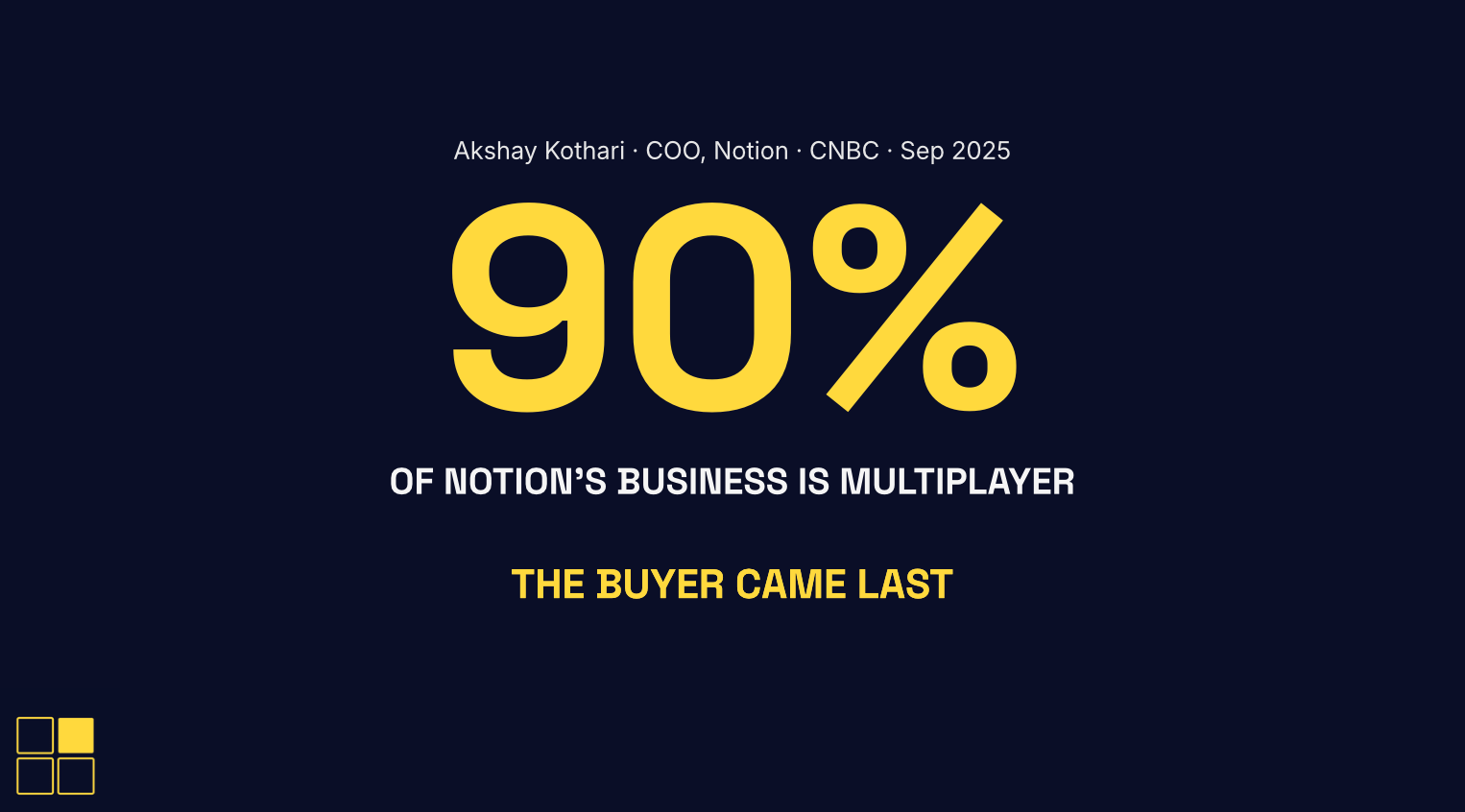
Most B2B GTM starts with the question “who’s the buyer?” Notion’s answer was a sequence, not a target. The buyer came last.
Layer 2: WHAT
The offer is a primitive, not a product.
Here’s where most Notion teardowns go wrong. They describe Notion as a “workspace tool” or an “all-in-one productivity app” and move on. That’s a feature description and it misses the point entirely.
Notion doesn’t sell a product. It sells a primitive. A block that can be a paragraph, a database row, a page, a task, a toggle, a button, a callout, an embedded calendar. Every feature they have ever shipped is built out of the same primitive. Add up enough blocks in the right order and you get a CRM, a project tracker, a meeting notes hub, or a company handbook. The product scales in capability without ever scaling in complexity.
This is the move most founders miss. A product that scales by adding features gets heavier every quarter. A product that scales by combining the blocks stays light forever. Notion figured this out early and hasn’t deviated from it once.
And here’s the clever bit - once the primitive exists, the customer becomes the product team. Users build templates out of blocks. Other users download those templates. Some of them edit and republish. The long tail of the Notion catalogue isn’t built by Notion, it is built by users who have figured out use cases Notion never imagined.
Thomas Frank’s Ultimate Brain template alone generated $760,000 in a single year. Easlo crossed half a million dollars in lifetime template sales. Others are running full-time businesses on the Notion template economy. When your users are building businesses on top of your product, you have crossed the line from tool to platform and you don’t have to fight for relevance anymore.
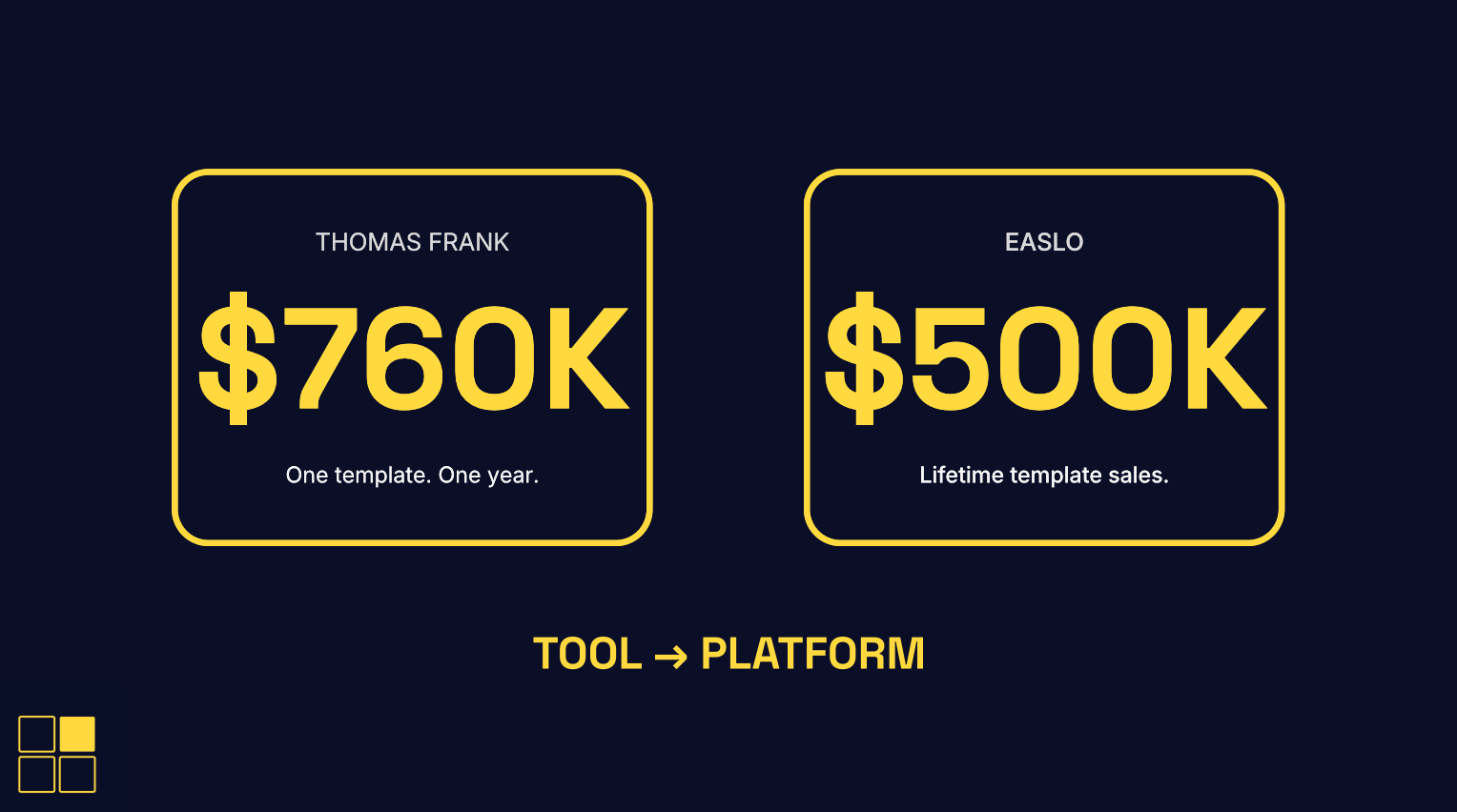
Most products are sold as use cases. Notion is sold as a primitive that generates use cases. Use cases decay. Primitives compound.
Layer 3: HOW (ACQUIRE)
Three channels stacked, each one cheap because of the one above it.
The Canvas says pick two or three channels. Notion picked three, but not in the way most companies pick three. They built three stacked layers where each one made the next one structurally cheaper. Miss any layer and the whole thing falls apart.
Community-led top of funnel. Notion didn’t build a community the way most B2B companies do - they didn’t run a few events and call a Slack group a community. They built an infrastructure for other people to build communities. The Ambassador program has over a hundred sub-communities run by volunteer moderators. There are over a hundred thousand people in r/Notion, one of the largest product-led communities on Reddit. The template gallery is stocked by users, not by Notion. None of this is paid media. All of it is the top of the acquisition funnel.
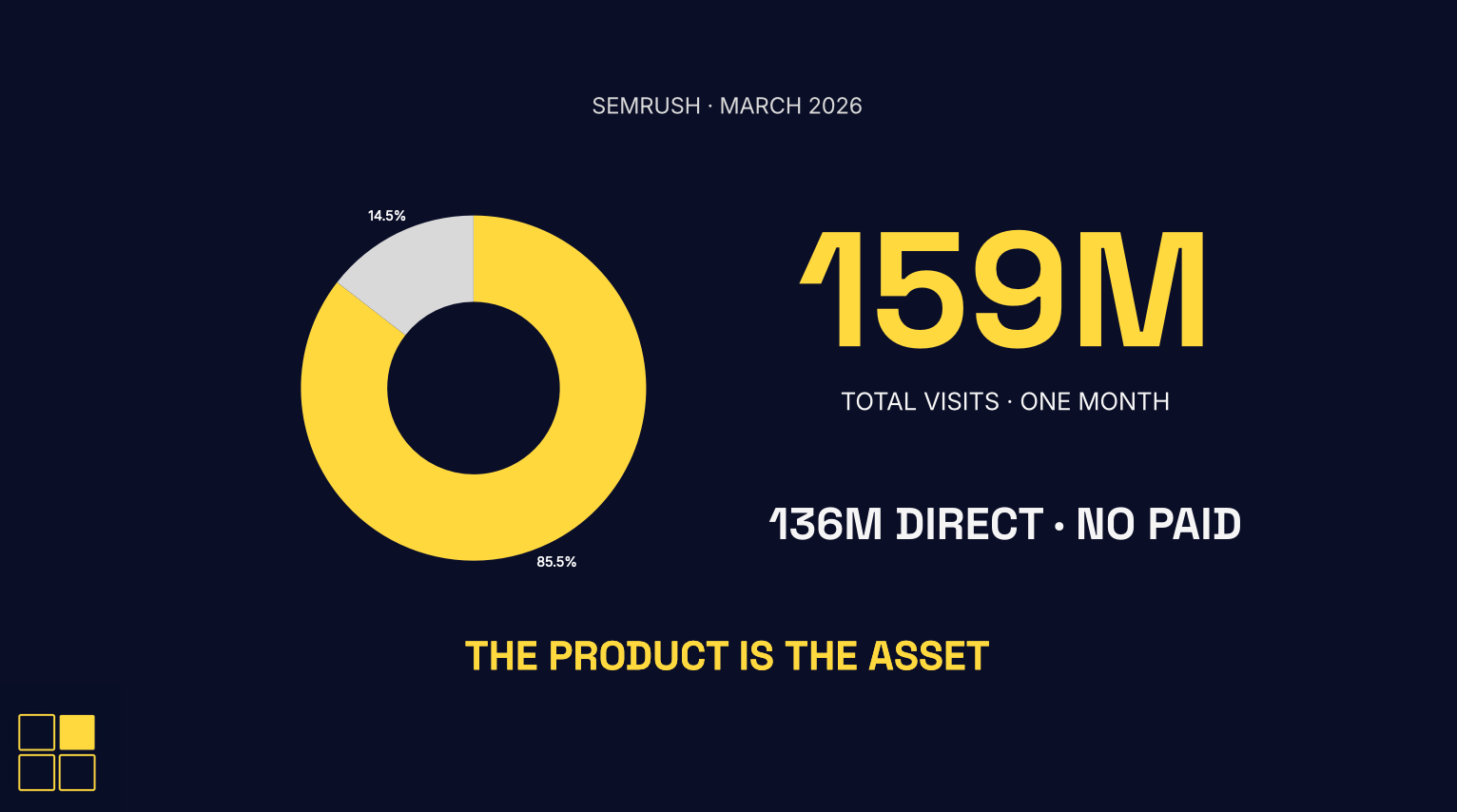
Per Semrush’s March 2026 data, notion.so got 159 million visits last month and 85.5% of that was direct. People typing the URL from memory or clicking a bookmark. Roughly 136 million direct visits per month, no paid search, no ad spend. That’s pure brand recall, not performance marketing. Most B2B companies spend seven figures a quarter trying to manufacture demand at a fraction of that volume. Notion manufactures it for free because the product IS the asset.
PLG conversion engine. The community produces the awareness. The product converts it. Free plan, team invites, paid tier - the block being shared is also the sign-up moment. Nobody has to be sold anything. The viral coefficient isn’t marketing copy, it is the product’s default state.
Enterprise sales overlay. Built on product-qualified leads, not marketing-qualified ones. Sales doesn’t hunt, it harvests teams that already self-selected into paid. Kothari again: “We’re doubling this year and likely going to double the sales team next year.”
Each layer is cheap because the previous layer did the hard work. Community is cheap because the product is the asset. PLG is cheap because the community did the acquisition. Enterprise sales is cheap because PLG did the qualification.
Most companies run one channel and call it GTM. Notion runs three that compound into each other. That is the actual moat, not the product, not the brand, not the template gallery.
Layer 4: HOW (KEEP)
The retention layer that quietly became a new revenue line.
This is the part of the Notion story that most teardowns get wrong. Or ignore entirely.
Notion launched their AI product in November 2022 two weeks before ChatGPT. For the next two and a half years, they ran it as a paid add-on at roughly $10 per user per month on top of whatever plan you were already on. Most customers didn’t buy it. In 2024, the AI attach rate sat at 10 to 20%.
Then something interesting happened.
Kothari told CNBC in September 2025 that the attach rate “shot up to 30% or 40% earlier this year and recently crossed 50%.” Within roughly eighteen months, AI went from a minority add-on to a feature more than half their paying customer base was already opting into. And the moment it crossed majority, Notion did the smart thing. They killed the add-on.
In May 2025, AI got bundled into the Business and Enterprise plans at no extra charge. If you wanted AI, you had to be on a team plan. If your team was scattered across the free tier, someone had to pay to upgrade everyone. The attach rate turned into an expansion event. The same customers, paying more, without a single upsell rep picking up the phone.
By the end of 2025, more than half of Notion’s ARR came from AI customers. That share had doubled in a single year. At Ramp alone, 9 out of 10 employees across a company of 1,200 now use Notion’s AI features monthly. That is not an account-level attach rate. That is saturation at the individual seat level, inside one paying customer.
Most SaaS companies price AI as a premium. Notion used it as a tripwire. They let the attach rate build on its own, waited for majority, and then flipped the pricing model so the feature did the expansion work for them.
Retention became expansion. Expansion became a new revenue line. None of it required a new GTM motion - just the one they already had, with a better lever pulled at the right moment.
The lesson
Back to the opening paradox. Why did Notion’s valuation barely move while ARR grew 19x?
The passive answer is “they grew into it.” That framing is lazy and it makes the whole thing sound accidental. The active answer is that every layer of the Canvas was built to reinforce every other layer, and the machine kept compounding for four years without needing new money.
The WHO sequence made the WHAT obvious. The WHAT produced the community that drove the HOW (ACQUIRE). The HOW (ACQUIRE) created the installed base that made the HOW (KEEP) layer work. None of this happened in parallel. It happened because each layer made the next one structurally cheaper.
The valuation staying flat wasn’t the story. It was the byproduct of a machine that didn’t need new capital to grow.
If you are a B2B founder who raised in 2021 or 2022 at a multiple you cannot defend on paper today, you don’t fix that with a down round or a pivot narrative. You fix it by building the version of this machine that works for your product. Sequence your WHO. Find your primitive. Stack your HOW. Make your retention layer do expansion work.
Or burn capital trying to outgrow the valuation. Notion just showed you which one works.
Monday GTM is a weekly newsletter for B2B founders and growth teams. One practical playbook or teardown, every Monday. No fluff. No advice. Just the frameworks, teardowns, and hot takes that actually move the pipeline.
Next Monday: LinkedIn Ads for B2B — the only guide you’ll need in 2026. What actually works, what everyone is still doing wrong, and the single targeting move most teams are leaving on the table.
See you then.
Key data points in this post are linked inline to their original sources.