


There’s a specific kind of envy that hits when you watch a company grow without doing the thing everyone told you growth requires.
No floor of SDRs. No sales org burning through money to hit quarterly targets. Just a tool that most people will tell you is genuinely hard to learn, surrounded by a crowd outside the company who talk about it constantly, for free, in public. If you build go-to-market for a living, that crowd is the part worth staring at. The talking is the distribution. And it wasn’t an accident.
The lazy version of this story is that Clay built a great product and a community happened. That’s not what happened, and the real version is more useful to steal from.
The overnight success that took eight years
Everyone repeats the same headline number. Clay went from around $1M to $100M in ARR in roughly two years, then raised a $100M Series C at a $3.1B valuation in August 2025. Over 14,000 customers now, OpenAI and Anthropic and Canva and Rippling among them.
Looks like a rocket. It wasn’t. Clay says that two-year sprint sat on top of six years of slower product work where they were mostly still working out what they were building. So the question that matters isn’t how they grew fast, because lots of companies grow fast and lose money doing it. The question is how they grew that fast on a fraction of the acquisition spend you’d expect at that stage.
They stopped treating customer acquisition as their job, and handed it to people who didn’t work there.
They went looking for the loudest people on purpose
This is the part almost nobody copies, because it doesn’t look like a growth tactic.
When co-founder Varun Anand went hunting for Clay’s ideal customer, he didn’t book a positioning offsite. He sat inside a sales community, read the threads, and pulled out about thirty people who clearly knew what they were talking about when it came to enrichment and outbound. He talked to them. What came back was that cold email agency owners were the most vocal of the lot, the most technical, and the most openly frustrated by the exact problem Clay existed to solve.
That became the beachhead. Not “B2B SaaS.” Not some industry vertical. A small, specific tribe who built their living on Clay’s problem and, conveniently, talked for a living too.
Then came the move that actually spins the flywheel. Clay brought in Eric Nowoslawski, a sales influencer the agency world already listened to, and let him build things in front of everyone on LinkedIn. Agency owners watched a peer make something they wanted, and signed up. New users didn’t just get a login either. They went on a waitlist, got vetted, and were told to turn up to onboarding with a real dataset or a real problem to solve live. So the first thing a new user ever did in Clay was fix something that genuinely mattered to them, with someone from Clay watching.
Sit with the difference for a second. Most tools land a customer and then spend a year nagging them to actually use it. Clay landed customers whose actual job was recommending tools to other people.
The product is hard, and that turns out to be the point
Here’s where it looks like a flaw.
Clay is not easy. Reviews keep landing in the same place: a steep curve, two to four weeks before you’re building workflows that hold up. One partner guide puts the difficulty somewhere near implementing Salesforce. Credits drain fast. You can lose a week to a table that ends up doing nothing.
Normally that’s a churn problem. Here it’s the engine.
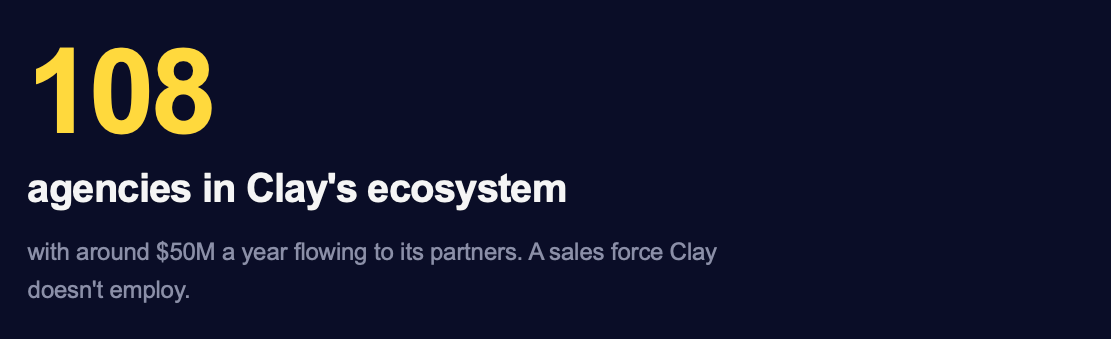
The difficulty opens a gap between what Clay can do and what a normal person can actually get it to do, and that gap has to be filled by somebody. The somebody isn’t on Clay’s payroll. It’s agencies, freelancers, people selling courses, bootcamp grads, all of them earning a living off being the person who can make Clay do the impressive thing. Clay puts its ecosystem at 108 agencies and around $50M a year flowing to its data and integration partners. Those are Clay’s own figures, a company quoting its best numbers, so take them with the usual pinch. But you don’t need to trust the exact count to see the shape of it from outside. There’s a whole little economy of people who earn more, the more Clay matters.

Each of them is a salesperson Clay never hired. Each client they sign is a Clay seat Clay didn’t have to sell. And every “here’s how I built this” post is content marketing Clay didn’t write.
This is the whole game, and it’s the bit most teardowns miss. Clay didn’t acquire customers. It created practitioners, and the practitioners went and acquired the customers.
Then they named it, and a job appeared out of thin air
Most companies would have parked it there, pleased with a tidy partner programme. Clay did something weirder. It gave the work a job title.
In 2023 it started calling this person a GTM Engineer, someone who builds revenue systems instead of working on a prospect list by hand. It sounded like marketing, and honestly, early on it was. But putting a name on something is how you drag it into being.
Look at what followed. By January 2026 there were more than 3,000 GTM Engineer roles live on LinkedIn, for a job that barely existed three years earlier, growing at 205% year on year. Someone went through a thousand of those postings and found a median salary near $127,500, sitting above what a senior RevOps hire pulls.
Not every one of those jobs runs on Clay. Plenty use a different tool, or a whole stack of them, and the role would exist in some form even if Clay had never named it. But Clay did name it. The entire market now recruits in vocabulary Clay invented, and in that same analysis of a thousand postings, Clay is the single most common tool in the list. You don’t have to own every job to win when you wrote the job description everyone else borrowed.
Now read that back as a GTM person. Clay put a name on a way of working, and the market picked the name up. That alone is worth more than it looks. The vocabulary a market hires in shapes which tools sit at the centre of the job, and Clay made sure it sat at the centre of this one. It is the most common tool in those job postings, and it turned proficiency in itself into a certifiable skill, a credential for a job it helped name.
What you can actually take from this
Most of us are never going to invent a profession, and that’s fine.
Start with who you seed. The reason Clay’s seeding worked is dull when you say it plainly: the first users talked for a living. So when you pick an early ICP, lean towards the ones with an audience and a reason to use you, not just the ones with the sharpest pain. A smaller segment that posts beats a bigger one that stays silent. Treat distribution as something you select for at the start, not something you bolt on once the product’s built.
Then there’s the difficulty thing, which runs against every instinct you have. The reflex with a hard product is to sand it down until anyone can use it. Sometimes that’s right. But the friction is also exactly what lets other people build a business on top of you, and those people turn into a salesforce you don’t pay. If your product mints experts, give them somewhere to stand and something to win. A directory. A certification. Status they can wave around. The mistake is competing with your own ecosystem instead of handing it the ammunition.
And last, name the thing. People won’t organise around a feature. They’ll organise around who it lets them be. Clay never told anyone to “use the product more.” It gave them a title for their LinkedIn headline and a room full of people doing the same work. If your product implies a new way of working, naming it costs almost nothing, and the downside is just that nothing happens. The upside is recruiters writing your positioning for you.
None of it needs a $3.1B valuation behind it. It needs you to decide that your actual job is making other people look good in public, and then getting out of the way while they do.
Next week
Next Monday I’m going after the MQL. Specifically the bit where everyone declared it dead and then rebuilt it under a new name. If you still report on lead volume, read that one first.
If you got something out of this, subscribe. Every Monday I take apart how go-to-market actually works and tell you which bits you can use.
Monday GTM takes apart how B2B companies actually go to market, every Monday. Teardowns, playbooks, and the occasional hot take. No fluff, no recycled LinkedIn wisdom, just the moves you can steal.